Imagine waiting two years for your green card, only to learn you were reading the wrong line the whole time. It happens every month to people who misread the Green Card Bulletin. One wrong chart, one wrong country column, or one wrong date can quietly cost you a year of your career, your plans, and your time with family.
You do not have to be one of them. This guide shows you how to read the November 2026 green card bulletin the right way, in plain English. You will see what the dates mean if you were born in Africa or any country without its own column, which 2026 rule changes could affect your case, and the steps that can move you forward sooner.
Read Also: November 2026 Visa Bulletin Delivers Big Wins for EB-2
What the Green Card Bulletin Is
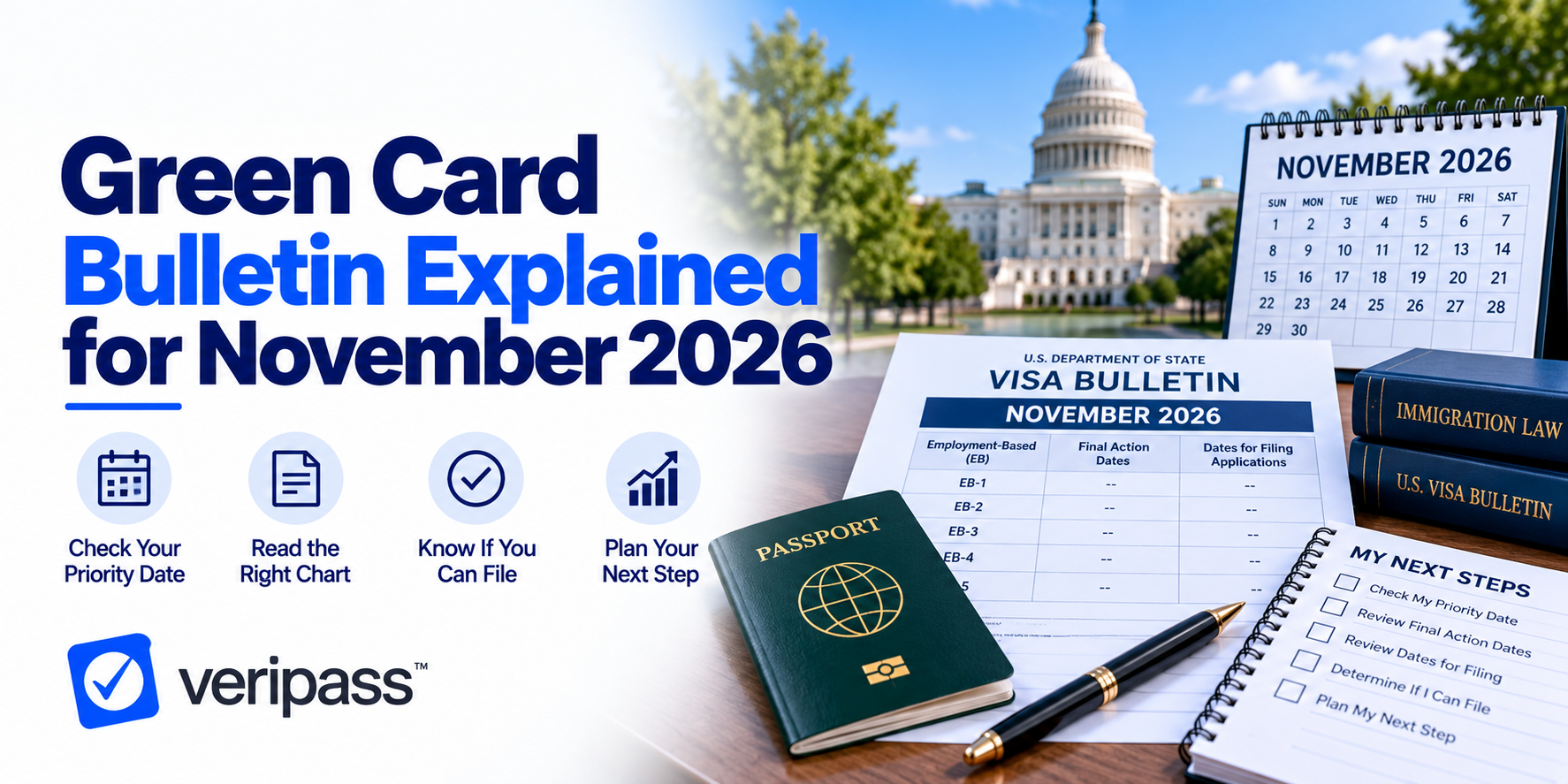
“Green card bulletin” is the everyday name for the Visa Bulletin, a monthly report from the US Department of State. Congress limits how many employment-based and family-based green cards the US can give out each year. The bulletin tells you who can move forward this month within those limits.
A few facts make it easier to read.
- The US government’s fiscal year starts on October 1, so each October bulletin opens a new yearly supply of green cards. The November 2026 bulletin is the second one of fiscal year 2027.
- The law sets at least 140,000 employment-based green cards a year and at least 226,000 family-based ones.
- No single country can take more than 7% of the total. This limit explains why some countries have their own column.
- The State Department publishes each bulletin before the month it covers, so check the official page in the last weeks of every month.
The bulletin only covers green cards. Temporary visas such as the O-1 and H-1B never appear in it.

Find Your Column First
Every chart has five columns. Four belong to China (mainland-born), India, Mexico, and the Philippines. The first column, “All Chargeability Areas Except Those Listed,” covers every other country. Most people shorten it to ROW.
If you were born in Nigeria, Ghana, Kenya, South Africa, Egypt, or any other African country, you read the ROW column.
Three rules decide your column.
- Your country of birth sets your column. Your passport and where you live today do not.
- If you were born in a backlogged country, you may be able to use your spouse’s country of birth instead. Lawyers call this cross-chargeability.
- Your spouse and unmarried children under 21 usually join your case and move in the same line as you.
Your Priority Date Is Your Place in Line
Your priority date is the date you joined the queue. Each month, you compare it with the bulletin.
Here is where it comes from.
- If your employer filed a PERM labor certification for you, your priority date is the day the Department of Labor accepted it.
- If you self-petition through EB-1A or EB-2 NIW, your priority date is the day USCIS received your Form I-140.
- In family cases, it is the day USCIS received Form I-130.
You will find it on your receipt notice (Form I-797C) and on your approval notice.
This matters most if you plan to self-petition. Your place in line starts only when you file. Every month you delay your I-140 is a month you add to your wait.
Final Action Dates vs. Dates for Filing
Every green card bulletin has two charts.
- Final Action Dates (Chart A) show when the government can approve your green card.
- Dates for Filing (Chart B) show when you can start the paperwork.
Your priority date must be earlier than the date in the chart. If it falls on the same day, you still wait. “C” means current, so everyone in that category can move forward. “U” means no green cards are available.
If you are inside the US and applying through adjustment of status, USCIS tells you which chart to use each month. For November 2026, USCIS lets you use Dates for Filing for both employment and family cases. USCIS can switch charts from month to month, so check that page every time.
If you are outside the US, the National Visa Center uses Dates for Filing to invite you to send documents. Your interview comes once your date is earlier than the Final Action Date.
November 2026 Green Card Bulletin for ROW Applicants
These are the official November 2026 dates for the ROW column, taken from the State Department bulletin.
| Category | Final Action Date | Date for Filing | Change since October (final action) |
|---|---|---|---|
| EB-1 | Current | Current | None |
| EB-2 (includes NIW) | Apr 1, 2025 | Mar 15, 2026 | 3 months forward |
| EB-3 skilled workers and professionals | Jun 15, 2024 | Aug 1, 2024 | 1 month forward |
| EB-3 other workers | Jun 1, 2022 | Jul 1, 2022 | 5 months forward |
| EB-5 unreserved | Current | Current | None |
| F1 | Jan 22, 2021 | Feb 1, 2021 | 1 year forward |
| F2A | Oct 22, 2026 | Current | 1 month forward |
| F2B | Aug 22, 2020 | Sep 1, 2020 | 1 year forward |
| F3 | Oct 22, 2015 | Nov 1, 2015 | 1 year forward |
| F4 | Oct 22, 2012 | Nov 1, 2012 | 1 year forward |
Spouses, parents, and unmarried children under 21 of US citizens do not wait on this chart at all. They count as immediate relatives.

Read It in Four Steps
Amara was born in Nigeria and works as a product manager. USCIS received her EB-2 NIW petition on February 10, 2026, so that is her priority date.
- She finds EB-2 in the employment charts.
- She reads the ROW column because she was born in Nigeria.
- The filing date is March 15, 2026. Her date is earlier, so she can file her green card application now if she is in the US, because USCIS accepts Chart B this month.
- The Final Action Date is April 1, 2025. Her date is later, so USCIS cannot approve her green card yet. She waits until Chart A passes February 10, 2026.
Nobody can tell Amara exactly when that will happen. The chart moves with demand.
Your Category Decides Your Wait
Look at the ROW column again. EB-1 is current. EB-2 approvals are reaching people who filed before April 2025. EB-3 approvals are reaching people who filed before mid-2024.
That gap is the real cost of choosing the wrong category. If your record meets the EB-1A standard, you avoid the EB-2 line for ROW applicants today.
- EB-1A is for people with extraordinary ability and sustained national or international acclaim. You do not need an employer or a job offer.
- EB-2 NIW is for people with an advanced degree or exceptional ability whose work benefits the US. You do not need a job offer.
- EB-3 usually needs a US employer to sponsor you through PERM.
- EB-5 needs a qualifying investment in a US business. ROW is current.
Where the O-1 Fits
The O-1 is a temporary work visa, so it never appears in the green card bulletin. Many founders and executives use it to live and work in the US while they build toward EB-1A or EB-2 NIW. The evidence for these routes often overlaps, so a well-built O-1 file can become the base of your green card case.
What to Do When Your Date Is Current
Your next steps depend on where you are.
If you are in the US
- File Form I-485 to adjust your status. You can file Form I-765 for a work permit and Form I-131 for travel permission at the same time.
- Attend your biometrics appointment.
- Submit your medical exam on Form I-693 as USCIS instructs.
- Track your case and compare it with USCIS processing times.
If you are outside the US
- Pay the National Visa Center fees and complete Form DS-260.
- Upload your civil documents, such as birth and marriage certificates.
- Complete your medical exam with an approved panel physician.
- Attend your interview at the US embassy or consulate.
A current date does not mean approval. USCIS or the embassy still reviews your case after you file, and that can take months. If demand rises, the State Department can also move a date backward. This is called retrogression, and it can push people who were current back into the line. When your date becomes current, file quickly and keep your documents ready.
Three 2026 Changes to Check Before You Act
- The travel proclamation. Since January 1, 2026, Proclamation 10998 has partially suspended visas for nationals of 19 countries, including Nigeria, Senegal, Côte d’Ivoire, Tanzania, Zambia, and Zimbabwe. For these countries, the suspension covers immigrant visas, with limited exceptions. It applies to people who were outside the US and did not hold a valid visa on January 1, 2026. You can still apply and attend an interview, and the embassy may still refuse to issue the visa. The government reviews the list every 180 days.
- Interview delays. In late August 2026, the State Department postponed immigrant visa interviews at its embassies and consulates so officers could train on new public charge screening. Read your embassy’s notices before you book travel or resign from a job.
- USCIS processing for travel-ban countries. In June 2026, a federal court struck down USCIS policies that froze green card and work permit decisions for people from these countries. USCIS says it is complying while the government appeals. If your case stalled, you can ask USCIS to act on it.
These rules change fast. Check the latest position before you file, pay fees, or travel.
Mistakes That Cost People Years
- Reading the wrong column. Your country of birth decides your column.
- Treating “the same date” as eligible. Your priority date must be earlier than the date shown.
- Waiting on the DV lottery. The bulletin also lists diversity visa numbers. Nigeria has been on the ineligible list in recent years, including DV-2026, so Nigerian-born applicants usually cannot enter unless they qualify through a spouse’s or parent’s country of birth.
- Letting a child age out. Children must be under 21 to come with you as dependents. The Child Status Protection Act can protect some children using a formula tied to the bulletin. Check this early if your child is close to 21.
- Delaying your petition. You cannot hold a place in line until you file.
- Confusing “current” with “approved.” Current means you can move to the next step. You still need to pass review.
If the US Line Is Too Slow for You
The green card bulletin only controls US green cards. Other countries run talent routes with no monthly bulletin and no per-country limit. If the US timing or the 2026 restrictions do not suit you, these are worth a look.
- UK Global Talent visa. For leaders or potential leaders in academia or research, arts and culture, and digital technology. You do not need a job offer. Decisions usually take 3 weeks if you apply from outside the UK, and you may settle after 3 or 5 years.
- Canada C10 significant benefit work permit. For people whose work will bring significant economic, social, or cultural benefit to Canada. Canada tightened its review of these cases in 2026, so strong evidence matters.
- Canada Global Talent Stream. An employer-led route for specialized talent and in-demand tech roles, with fast processing.
- Australia National Innovation visa (subclass 858). A permanent visa for people with an internationally recognized record of exceptional achievement. You need an invitation, so you start by submitting an expression of interest.
The same achievements that support an EB-1A or O-1 case often support these routes too.
Green Card Bulletin FAQs
What is the current wait time for a green card? There is no single wait time. It depends on your category and your country of birth. The November 2026 green card bulletin shows how far behind each line is for ROW applicants.
- EB-1 is current, so you only wait for processing.
- EB-2, including NIW, is approving people who filed before April 1, 2025, about 19 months behind.
- EB-3 skilled workers who filed before June 15, 2024 are being approved, about two and a half years behind.
- F4 siblings of US citizens who filed before October 22, 2012 are being approved, about 14 years behind.
Processing time for your forms and interview comes on top of this, and the line can speed up or slow down from month to month.
What are the Visa Bulletin predictions for 2026? The State Department does not publish long-range forecasts. It sets new dates each month based on demand. The October and November 2026 bulletins both moved forward, with EB-2 advancing three months and most family categories gaining a full year in November. Any prediction you see online is an estimate. Dates can also move backward later in fiscal year 2027 if demand rises, so plan around the latest official bulletin.
What is the latest green card update? The November 2026 Visa Bulletin moves EB-2 to April 1, 2025, EB-3 skilled workers to June 15, 2024, and EB-3 other workers to June 1, 2022. USCIS also lets applicants inside the US use the Dates for Filing chart this month. Two other updates to watch are Proclamation 10998, which still suspends most immigrant visas for nationals of 19 countries, including Nigeria, who apply from outside the US, and the postponement of embassy immigrant visa interviews since late August 2026.
Is the green card 2027 application open? If you mean the DV-2027 green card lottery, it is not open yet. Registration never opened on its normal schedule. A federal court has ordered the State Department to open it by November 1, 2026, and the government has appealed. Watch dvprogram.state.gov, the only official entry site, and ignore anyone who asks you to pay them to register. The DV-2027 eligible country list has not been published yet, and Nigeria has been ineligible in recent years. If you mean an employment-based green card, there is no application window, and you can file an EB-1A or EB-2 NIW petition at any time.
How Veripass Helps You Move Faster
The green card bulletin shows you the line. It does not tell you which line you belong in or how to build a case strong enough to get through it.
Veripass works with founders, executives, and skilled professionals on exactly that.
- We find your fastest route. We review your profile against EB-1A, EB-2 NIW, and O-1, and against UK Global Talent, Canada C10 and Global Talent Stream, and Australia’s National Innovation visa. If you qualify for a shorter line, we show you.
- We build your evidence. We shape your case from start to finish and stay with you at every step. Where it helps, we write and publish articles under your name to prove your expertise.
- We time your filing. We help you file early so you secure your priority date, and we track each month’s bulletin and USCIS chart choice with you.
- We plan around the 2026 rules. If a travel restriction or interview delay affects your country, we help you weigh your options before you spend money on the wrong path.
You have spent years building your career. Do not let one wrong guess about a category or a chart add years to your wait. Find out today which route fits you, and start moving.