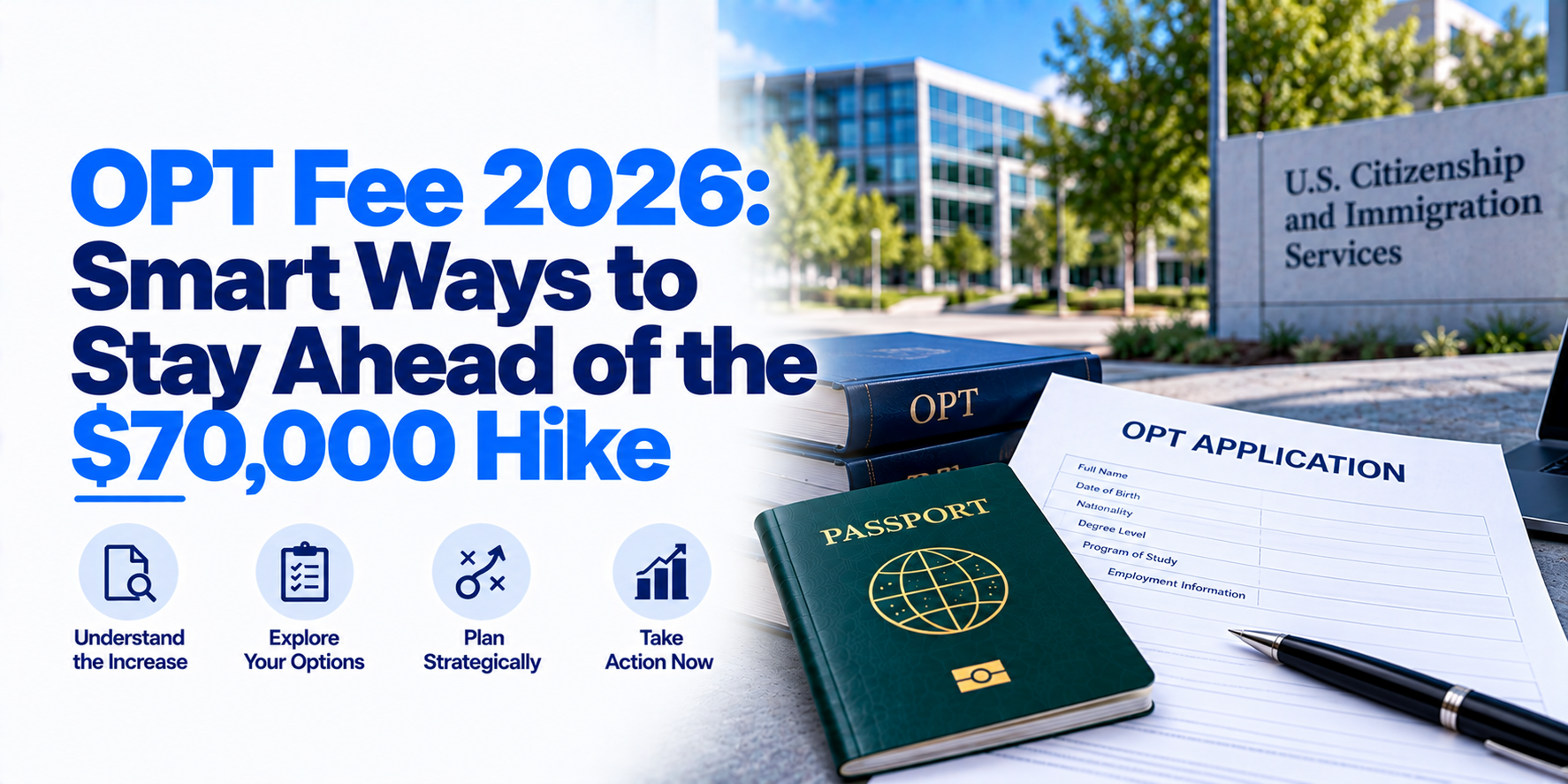
Imagine you finish your degree, land a job offer, and then hear that your school must pay $70,000 before you can start work. That could soon be the reality of the OPT fee. Today, the OPT fee is $470 if you file online. On October 8, 2026, the US government proposed adding $70,000 for your first OPT and $30,000 for every OPT after that.
For years, OPT was the bridge between a US degree and a US career. Many families saved for years, borrowed, and gave up a lot to make that plan work. Now that bridge may come with a toll few students can afford.
The good news is that the new fee is not law yet, and OPT is not the only way in. This guide shows you what you pay today, what could change, and the routes that depend on your talent instead of your school’s budget.
The full OPT fee picture, today and proposed
Most pages mix current costs with proposed ones. This table keeps them apart.
| Cost | Amount | Who pays | Status |
|---|---|---|---|
| Form I-765 filing fee (online) | $470 | Student | In effect now |
| Form I-765 filing fee (paper) | $520 | Student | In effect now |
| Premium processing (optional) | $1,780 | Student or employer | In effect since March 1, 2026 |
| New fee for your first OPT | $70,000 | School (may pass it to you or your employer) | Proposed |
| New fee for each OPT after that, including STEM OPT | $30,000 | School (may pass it to you or your employer) | Proposed |
If the proposal becomes final, a STEM graduate who uses post-completion OPT and then the STEM extension could face $100,000 in new fees, before any filing fees. A student who also uses pre-completion OPT during school would pay the $70,000 for that first OPT and then $30,000 for every OPT that follows, according to the proposed rule.
Check the current filing fee on the USCIS Form I-765 page or the USCIS fee calculator before you file. Premium processing gets you a faster answer. It does not guarantee a yes, and it does not speed up delivery of your card.

What DHS proposed, and who pays
The Department of Homeland Security (DHS) published the proposal in the Federal Register on October 8, 2026. Here is how it would work.
- Your school pays the fee before its designated school official (DSO) can recommend you for OPT in SEVIS, the government’s student database.
- USCIS would not approve your work permit if your school has not paid.
- The fee is not tied to one employer. It applies each time your school recommends you for OPT.
- Your school may pass the cost to you, to all students through tuition, or to your employer.
- Your school may ask for a refund if you never receive your work permit. The government reviews each refund request, and its decision is final.
DHS says the fees target fraud, such as fake employers and “pay-to-stay” schemes, and protect US workers. The rule also states that DHS may shut OPT down entirely if it cannot charge these fees. The money would go to the US Treasury. It would not be set aside for fraud checks or for the student program itself.
This matters for you because schools now decide who gets OPT. DHS expects schools to recommend fewer students, so a strong academic and professional record will count for more than it did before.
When the new OPT fee could start, and who it affects
Public comments close on November 9, 2026. DHS then reviews the comments and may publish a final rule. The proposal says the final rule would take effect 60 days after it is published, so the earliest realistic start is early 2027. Lawsuits could delay it further.
The fee would apply to any OPT recommendation your DSO dates on or after that start date. If you already have OPT, or your DSO recommended you before that date, the new fee would not apply to that OPT.
The gray areas matter just as much. The rule does not clearly say what happens if you got your first OPT before the start date and then ask for a STEM extension after it. DHS’s own cost estimate assumes schools pay the full $70,000 for everyone in the first year, STEM students included. DHS is also asking for comments on charging the $70,000 again each time a student moves to a higher degree, such as from a bachelor’s to a master’s.
Here is what that means in three common situations.
You are on OPT now and plan to apply for STEM OPT later. If your STEM recommendation comes after the start date, your school may owe a new fee. Ask your DSO now if your school will pay it, pass it to you, or stop recommending STEM extensions.
You finish your degree in late 2026 or 2027. A recommendation dated before the start date avoids the fee. Talk to your DSO early about your filing window and do not wait until the last week.
You live outside the US and plan to start a US degree in 2027. By the time you graduate, the fee may be in effect. Before you accept an offer, ask the school in writing if it will recommend students for OPT and who will pay the fee.
The OPT fee is one of several 2026 changes
On its own, the OPT fee is a high cost. Combined with the other 2026 changes, it reshapes the usual student-to-work route.
| Change | What it does | Status |
|---|---|---|
| Fixed period of admission rule | Ends open-ended student stays. Some students must file to extend their stay, and the grace period after your program drops from 60 days to 30. | In effect since September 15, 2026 |
| Proposed OPT fees | $70,000 for first OPT, $30,000 for each later OPT | Proposed, comments close November 9, 2026 |
| Proposed H-1B fee | Adds $103,265 to each new cap-subject H-1B petition, the usual next step after OPT | Proposed; comment period closed September 24, 2026 |
The usual plan was to study, work on OPT, win the H-1B lottery, and then apply for a green card. Under these proposals, an employer could pay over $100,000 at the H-1B step, after your school has already paid up to $100,000 at the OPT step. A separate $100,000 H-1B charge from a 2025 presidential proclamation is also tied up in court.
For founders and executives who hire international graduates, the math changes too. A new graduate who once cost you a salary and some paperwork may soon cost your company a share of the OPT fee and a six-figure H-1B fee. Many employers will look for candidates who qualify for routes without a lottery or a cap.
How post-study work compares in the UK, Canada, and Australia
If you have not chosen where to study yet, compare before you commit. None of these countries has a school-paid fee like the US proposal.
| Country | Post-study route | How long you can stay | One thing to know |
|---|---|---|---|
| United States | OPT | 12 months, plus 24 months for STEM | Proposed $70,000 and $30,000 fees |
| United Kingdom | Graduate visa | 2 years if you apply by December 31, 2026. 18 months from January 1, 2027. PhD graduates get 3 years. | No job offer or sponsor needed |
| Canada | Post-Graduation Work Permit | Up to 3 years, based on your program length | Some programs must meet field-of-study rules |
| Australia | Temporary Graduate visa (subclass 485) | Usually 2 years for a bachelor’s or coursework master’s, 3 years for research degrees | Age limit is generally 35 |
Each of these is a temporary bridge, just like OPT. The real question is what comes after it, and that is where talent-based visas come in.
Routes that do not depend on OPT
OPT depends on your school, a fee, and a time limit. Talent-based visas depend on you and your record. None of them uses a lottery, and none of them requires the proposed OPT fee.
| Visa | Country | What it gives you | What you need to show |
|---|---|---|---|
| O-1A | US | A work visa with no annual cap or lottery | Extraordinary ability in your field, plus a US employer or agent to file for you |
| EB-2 NIW | US | A green card. You can file for yourself without a job offer. | An advanced degree or exceptional ability, and work of national importance to the US |
| Global Talent visa | UK | A flexible visa with no job offer needed | Endorsement from an approved body as a leader or potential leader in your field |
| C10 significant benefit permit | Canada | A work permit without a labor market test | That your work brings a significant benefit to Canada |
| Global Talent Stream | Canada | A fast work permit route for in-demand tech and specialist roles | A Canadian employer that applies through the stream |
| National Innovation visa (subclass 858) | Australia | Permanent residence | An internationally recognized record of outstanding achievement, an invitation, and a nomination |
If you are a graduate, you do not need to wait until OPT runs out. You can ask to move from F-1 status to O-1, or file an EB-2 NIW, while still in school or early in your career, as long as your record is strong enough.
If you are a founder, executive, or senior professional, these routes were built for your profile. You can often skip the student route completely.
What you should do now
- Talk to your DSO this month. Ask when you can file, if your school plans to pay the OPT fee, and if it will charge you.
- File on time, not late. If you are in your OPT filing window, a recommendation dated before the final rule starts would avoid the fee.
- Budget for the current fees. Plan for $470 online, plus $1,780 if you need premium processing.
- Watch out for fake employers. DHS found students placed at empty offices and homes listed as worksites. A job that asks you to pay to be “employed” can put your status at risk. Walk away from it.
- Start building your record now. Awards, published work, judging roles, media coverage, and letters from experts all count toward O-1, EB-2 NIW, and the other talent visas. This record takes months to build.
- Get your case assessed early. Find out which talent visa fits your profile before OPT, or the money for it, runs out.
- Have your say before November 9. Anyone can comment on the proposal.
How to submit a comment
- Go to the comment page on Regulations.gov, docket ICEB-2026-0100.
- Write in English and name the part of the rule you are responding to.
- Explain how the fee affects you, with facts and numbers where you can.
- Submit by 11:59 p.m. Eastern Time on November 9, 2026.
Comments are public, so leave out private details such as your passport number or home address. DHS says comments sent by email or letter will not count.
Frequently asked questions
What is the OPT fee?
Today, the OPT fee is the USCIS filing fee for Form I-765: $470 online or $520 on paper. You pay it when you apply for your OPT work permit. Premium processing is optional and costs $1,780 more. DHS has also proposed new fees of $70,000 for your first OPT and $30,000 for each subsequent OPT. Your school would pay these and could pass the cost to you or your employer. These new fees are not in effect yet.
Is there a $100,000 fee for OPT?
No single $100,000 OPT fee exists. Under the proposal, though, a STEM graduate could face $100,000 in total, which is $70,000 for post-completion OPT plus $30,000 for the STEM extension. The $100,000 figure you may have seen in the news usually refers to a separate H-1B charge from a 2025 presidential proclamation.
Will F-1 OPT holders have to pay the $100,000 visa fee?
No. The $100,000 charge applies to certain new H-1B petitions, and employers pay it, not students. USCIS guidance said it did not apply to students who change from F-1 to H-1B inside the US, and a court has since blocked the guidance that put it in place. A different proposed H-1B fee of $103,265 would apply to new cap-subject H-1B petitions, including F-1 to H-1B cases. Employers would pay that one too, and it is not in effect yet.
Is OPT paid or unpaid?
It can be either. During your first 12 months of post-completion OPT, you can work unpaid, such as volunteering or an internship, as long as the work relates directly to your degree and takes at least 20 hours a week. STEM OPT is different. Your employer must pay you, and your pay must match what a similar US worker earns. Either way, keep track of your days without work, since you can only be unemployed for a limited time on OPT.
How Veripass helps you plan past OPT
The OPT fee shows how fast a plan built on one program can change. A plan built on your own record is harder to take away, and that is the work Veripass does with you.
Veripass is a global immigration advisory for founders, executives, and skilled professionals. We help you pursue the O-1, EB-1A, and EB-2 NIW in the US, the Global Talent visa in the UK, the C10 permit and the Global Talent Stream in Canada, and the National Innovation visa in Australia.
Here is what working with us looks like.
- We assess your profile. We review your degrees, work, and achievements and tell you which visa fits you best, and which ones do not.
- We find the gaps. If your record is not strong enough yet, we show you what to add and in what order.
- We help you build your evidence. This includes preparing articles under your name to show your expertise, gathering expert letters, and organizing proof of your impact.
- We stay with you to the end. We guide you from your first call through filing, so you always know the next step.
If you are on OPT now, about to graduate, or deciding if a US degree is still worth it, you do not have to guess. A short conversation can show you which route fits your goals and how long it will take to get there.
Take the free Veripass assessment and find out if your talent can take you where OPT may no longer reach