 Eniola Oloyede
You’re 32 years old. You file for an EB-3 Green Card today. Your daughter is 10. By the time your visa becomes available, she’ll be 22, too old to get her Green Card with you. She ages out. You get your American dream. She doesn’t. This is the reality of getting EB1 vs EB2 vs EB3 wrong when you’re from India or China.
Most people treat the choice between EB1 vs EB2 vs EB3 like picking a form at the DMV. Check a box, submit papers, and wait for your turn. But this isn’t a line at the post office. This is 12 years of your life versus 6 months. This is your family’s future versus bureaucratic roulette. This is the difference between building your empire in America and watching from the sidelines while your H-1B clock runs out.

The wrong choice doesn’t just delay you, it derails everything you’ve worked for. And the advice flooding the internet? Written by people who’ve never spent a decade in limbo, never missed a parent’s final years because they couldn’t leave the country, never had to explain to their teenager why they can’t get that college scholarship reserved for permanent residents.
Read Also: EB1A vs EB2-NIW: Which One Should You Choose?
What EB1 vs EB2 vs EB3 Actually Means for You
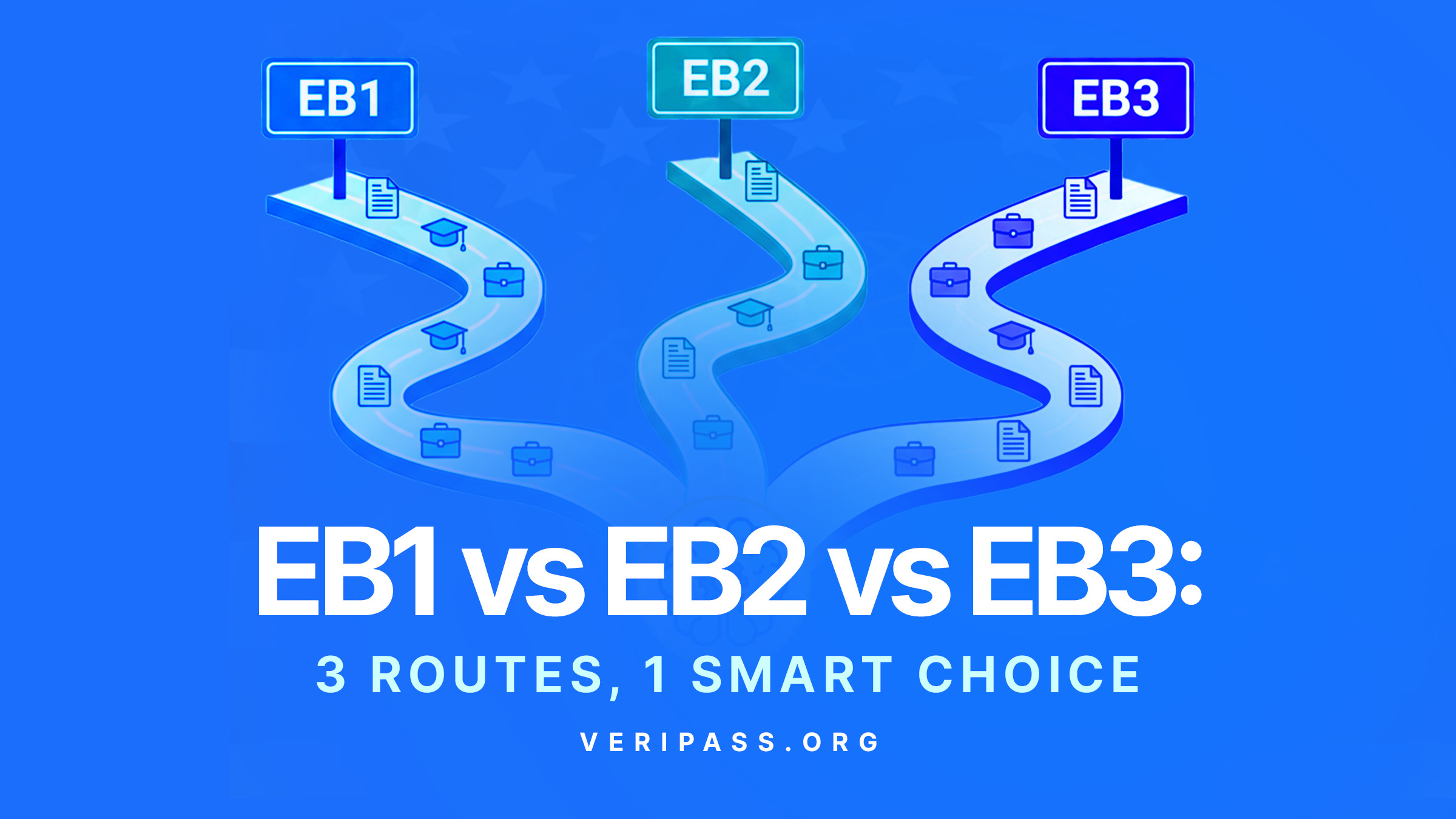
When you look at EB1 vs EB2 vs EB3, you’re looking at three different lanes on the same highway to permanent residency. But these lanes move at wildly different speeds, cost different amounts of money, and demand different levels of proof.
EB-1 is the executive lane. You’re either genuinely extraordinary in your field, or you’re a multinational executive, or you’re an outstanding professor with international recognition. No labor certification needed. No proof that Americans can’t do your job. Just you and your proof that you’re at the top of your game.
EB-2 is the professional lane. You have an advanced degree or exceptional ability. Most people need employer sponsorship and must prove through PERM labor certification that no qualified American worker is available. The exception? EB-2 National Interest Waiver (NIW), where you can self-petition if your work benefits the United States.
EB-3 is the accessible lane. You’re skilled, you’re professional, or you’re willing to do work that needs doing. Requirements are lower. Wait times? Much longer.
The real question when comparing EB1 vs EB2 vs EB3 isn’t “Which one am I qualified for?” It’s “Which strategy gets me there fastest with my specific background and passport?”
The Numbers They Don’t Want You to See
Here’s where understanding EB1 vs EB2 vs EB3 gets real. Current data from the Visa Bulletin shows wait times that vary dramatically based on where you were born:
For EB-1:
- Most countries: Current (no wait)
- India: Stuck at February 2022 (about 3+ years behind)
- China: November 2022 (about 3 years behind)
For EB-2:
- Most countries: Moving forward steadily
- India: January 2013 (over 12 years behind)
- China: December 2020 (about 5 years behind)
For EB-3:
- Most countries: About 2.5 years wait
- India: February 2013 (over 12 years behind)
- China: November 2020 (about 5 years behind)
Read that again. If you’re from India and you filed an EB-2 or EB-3 petition in 2013, you might just be getting your Green Card now in late 2025.
This is the conversation other articles avoid. When discussing EB1 vs EB2 vs EB3, they give you clean comparisons. They don’t tell you that your country of birth matters more than almost anything else in determining your actual timeline.

The Real Price Nobody Warns You About
When you compare EB1 vs EB2 vs EB3, most sources focus on paperwork and processing steps. Here’s what actually happens to your life:
EB-1 Timeline:
- No labor certification delays
- Direct petition filing
- Faster USCIS processing
- Premium processing available for expedited review
EB-2 Timeline:
- The labor certification process adds months
- Employer must prove that no qualified U.S. workers are available
- Premium processing available for the I-140 stage
- NIW option bypasses labor certification entirely
EB-3 Timeline:
- Labor certification is required for all applicants
- Longer backlogs due to higher demand
- Premium processing is available, but it doesn’t solve the visa availability
- Extended wait times multiply other delays
But here’s what really matters: what you lose while waiting. If you’re stuck 12 years in EB-3 India when you could have qualified for EB-1 and gotten approved in under a year, you’ve sacrificed:
- Job mobility, you’re tied to your sponsoring employer for over a decade
- Negotiating power, your employer knows you can’t leave without restarting everything
- Time with aging parents, you can’t sponsor them for Green Cards until you have yours
- Investment opportunities, uncertainty blocks long-term property purchases and business decisions
- Your children’s future, they risk aging out before your priority date becomes current
- Career advancement, you can’t take promotions that change your job description
Understanding EB1 vs EB2 vs EB3 means understanding these real-world implications. The categories aren’t just different application processes; they’re different futures.
Your Passport Determines Your Strategy
The most important factor in choosing between EB1 vs EB2 vs EB3 is your country of birth. Here’s the strategy for different situations:
If you’re from India, EB-2 and EB-3 are basically equivalent in wait time (both over 12 years). Your only real options are:
- Push for EB-1 qualification (even if it’s a stretch)
- File EB-2 NIW and maintain flexibility
- Consider the O-1 visa first, then convert to EB-1
- File EB-3 early to lock in a priority date, then “port” to EB-2 later if you qualify
If you’re from China, EB-2 (5-year wait) is significantly better than EB-3 (5-year wait for skilled, much longer for unskilled). EB-1 is still your best bet if qualified (3-year wait versus 5+).
If you’re from most other countries, EB-2 and EB-3 timelines are manageable (2-4 years). EB-1 still saves you significant time if you qualify. The math actually works out where spending more on a strong EB-1 or EB-2 NIW petition makes financial sense.
The Porting Strategy Most Articles Miss
Here’s something most discussions of EB1 vs EB2 vs EB3 don’t explain: you can “port” your priority date from EB-3 to EB-2 if you later qualify for EB-2.
How it works:
- You file EB-3 in 2025 and get a priority date of January 1, 2025
- Two years later, you earn a master’s degree or gain enough experience to qualify for EB-2
- Your employer files a new PERM and I-140 under EB-2
- You request to keep your original EB-3 priority date (January 1, 2025)
- You now wait in the EB-2 queue, but with an earlier priority date
This doesn’t work going from EB-2 to EB-3. It also requires careful execution. Get it wrong, and you lose your priority date entirely. But for Indians and Chinese nationals stuck in long backlogs, this can save years.
When comparing EB1, EB2, and EB3, consider whether this upgrade path makes sense for your situation.
What Happens When You Switch Jobs
Another gap in typical EB1 vs EB2 vs EB3 discussions: job mobility.
With EB-1:
- EB-1A: No employer needed, you’re completely mobile
- EB-1B: Tied to the specific university/research institution
- EB-1C: Tied to the specific company (must remain in managerial/executive role)
With EB-2:
- Regular EB-2: Completely tied to your sponsoring employer until you get your Green Card
- EB-2 NIW: Fully mobile, no employer sponsorship at all
- After 180 days of pending I-485, you can invoke “portability” and switch to a similar job
With EB-3:
- Completely tied to your sponsoring employer
- After 180 days of pending I-485, you can invoke portability
- If you switch jobs before I-485, you start the entire PERM process from scratch
Real-world impact: If you’re an entrepreneur or your industry moves fast, EB-2 NIW or EB-1A becomes exponentially more valuable. If you’re in a stable corporate role with a committed sponsor, EB-2 or EB-3 works fine.
When evaluating EB1 vs EB2 vs EB3, ask yourself: “Can I stay put for the entire wait time?” If not, mobility matters.
Success Rates: The Data Nobody Publishes
USCIS doesn’t publish approval rates by category, but immigration attorneys track them. Here’s what practitioners see:
EB-1A (Extraordinary Ability):
- Self-petitions: 40-60% approval rate
- With strong legal representation: 70-85% approval rate
- Main denial reason: Insufficient evidence of extraordinary ability
EB-1B (Outstanding Professors/Researchers):
- Approval rate: 75-85%
- Main denial reason: Not enough evidence of international recognition
EB-1C (Multinational Executives):
- Approval rate: 80-90%
- Main denial reason: Role doesn’t qualify as truly managerial/executive
EB-2 (Regular):
- Approval rate: 85-95% (after PERM approval)
- Main denial reason: PERM labor certification issues, not the I-140 itself
EB-2 NIW:
- Approval rate: 65-75%
- Main denial reason: Failure to prove national interest under the Dhanasar framework
EB-3:
- Approval rate: 90-95% (after PERM approval)
- Main denial reason: Job requirements don’t match EB-3 criteria, or PERM issues
The lesson: When considering EB1 vs EB2 vs EB3, understand that higher categories have stricter standards and more denials. But if you qualify and execute well, they’re worth the risk for the time saved.
Your Family’s Green Card Journey
Here’s what happens to your spouse and children under each category:
All categories (EB-1, EB-2, EB-3):
- Your spouse and unmarried children under 21 are eligible as derivative applicants
- They get Green Cards based on your approval
- Spouses can apply for work authorization (EAD) while waiting
- Children can “age out” if they turn 21 before a visa becomes available (Child Status Protection Act helps, but timing is critical)
The real issue: With EB-2 and EB-3 India/China backlogs extending over 10 years, your children face a real risk of aging out. If your child is 12 years old when you file, and you’re looking at a 12-year wait, they’ll be 24 when your priority date becomes current; they age out at 21.
This is why, when comparing EB1 vs EB2 vs EB3 for Indian and Chinese nationals, EB-1 becomes crucial if you have older children.
If You Get Denied: Your Real Options
Most articles about EB1 vs EB2 vs EB3 act like denial is impossible if you qualify. Here’s what actually happens:
After an I-140 denial, you can:
- File a motion to reconsider (within 30 days) if you think USCIS made an error
- File a motion to reopen (within 30 days) with new evidence
- File an appeal with the Administrative Appeals Office (within 30 days)
- File a completely new petition with stronger evidence
- Downgrade to a lower category (EB-1 to EB-2, or EB-2 to EB-3)
After a PERM denial (for EB-2 and EB-3):
- Request reconsideration from DOL (within 30 days)
- Start the entire PERM process from scratch
- File under a different job title or requirements
The hardest denials to overcome are EB-1A (extraordinary ability) denials. If USCIS says you don’t meet the standard, gathering more evidence is difficult because you’re trying to prove something that’s inherently subjective.
EB-2 NIW denials are often more workable. You can strengthen your case for national interest and refile.
When thinking about EB1 vs EB2 vs EB3, consider: “If I get denied, what’s my backup plan?”
Premium Processing: When It Helps and When It Doesn’t
Premium processing costs $2,805 and guarantees 15-day processing of your I-140 petition. But here’s the catch most sources gloss over when discussing EB1 vs EB2 vs EB3:
Premium processing helps when:
- You need certainty about approval before your work visa expires
- You’re applying from outside the U.S. and want to speed up the timeline
- Your employer needs to know if you’re approved for business planning
- You’re from a country with reasonable wait times after I-140 approval
Premium processing doesn’t help when:
- You’re from India or China and face 10+ year backlogs (paying for faster I-140 doesn’t matter if you wait a decade for visa availability)
- Your PERM is still pending (can’t file I-140 until PERM is approved)
- You’re filing EB-2 NIW and want time to gather stronger evidence
Real talk: If you’re Indian or Chinese and filing EB-2/EB-3, premium processing is often wasted money. The I-140 approval isn’t your bottleneck; visa availability is.
For EB-1 from any country or EB-2/EB-3 from countries without backlogs, premium processing can shave months off your total timeline.
How Veripass Changes the EB1 vs EB2 vs EB3 Calculation
Here’s where strategy meets execution. You can understand EB1 vs EB2 vs EB3 perfectly and still fail because of poor petition preparation.
Most people approach this process backwards:
- They pick the category they think they qualify for
- They hire an attorney
- The attorney files what’s needed
- They cross their fingers and hope
But high-net-worth individuals and truly exceptional talents don’t operate this way. They approach their Green Card like they approach their careers: strategically, with expert guidance, and with a focus on positioning.
Veripass specializes in exactly this approach. They don’t just file paperwork—they build your case from the ground up with one goal: approval.
Here’s how Veripass approaches the EB1 vs EB2 vs EB3 decision:
Step 1: Strategic Assessment. They analyze your credentials, achievements, and timeline needs. Often, people undersell themselves. You might think you’re EB-2 material when you actually qualify for EB-1. Or you might be pushing for EB-1 when a strong EB-2 NIW case is more likely to succeed.
Veripass has reviewed thousands of cases. They know what USCIS actually approves, not just what the requirements say on paper.
Step 2: Positioning Your Achievements. Here’s the difference between a denied EB-1A petition and an approved one: presentation. You could have won major awards, been featured in the media, and led significant projects. But if you present it wrong, USCIS says no.
Veripass helps frame your work in terms USCIS understands. They know which evidence matters and which is just noise. For EB-2 NIW cases, they help you articulate the national interest argument using the specific Dhanasar framework that USCIS evaluates.
Step 3: Document Preparation The average EB-1 petition is 200-400 pages. EB-2 NIW petitions are similar. This isn’t just your resume and some letters. It’s a complete case that proves you meet every requirement with multiple forms of evidence.
Veripass handles this documentation process. They know which expert letters carry weight, how to structure the evidence, and what USCIS looks for at each service center (yes, different centers have different patterns).
Step 4: Timeline Optimization. If you’re from India or China, Veripass helps you think multi-dimensionally about EB1 vs EB2 vs EB3. Maybe you file EB-2 NIW now for the priority date, work on strengthening your EB-1 credentials, and file EB-1 in 18 months. Or maybe you file both simultaneously.
The strategy depends on your specific situation. Veripass navigates this with you based on current processing times, your career trajectory, and your family’s needs.
Step 5: Contingency Planning What if you get a Request for Evidence (RFE)? What if you’re denied? Veripass doesn’t just file and disappear. They prepare for these scenarios upfront and respond quickly if issues arise.
For people serious about their U.S. future, Veripass changes the EB1 vs EB2 vs EB3 question from “Which form do I file?” to “What’s the optimal strategy for my specific situation?”
They offer a free webinar that walks through real case studies, explains what actually gets approved, and helps you understand whether you’re approaching this correctly. No generic advice, no form-filling service, actual strategy for people who’ve built something worth protecting.
The Real Choice Between EB1 vs EB2 vs EB3
Let me summarize what matters:
Choose EB-1 if:
- You genuinely have an extraordinary ability with proof (major awards, significant media, original contributions)
- You’re a multinational executive transferring to a U.S. role
- You’re an outstanding professor/researcher with international recognition
- You’re from India or China and want to avoid the decade-long backlog
- You value job mobility and can self-petition (EB-1A)
Choose EB-2 if:
- You have an advanced degree and a sponsoring employer
- You qualify for a National Interest Waiver and value independence
- You’re from most countries (not India/China) and can wait 2-4 years
- You’re building toward EB-1 but want to lock in a priority date now
Choose EB-3 if:
- You don’t meet EB-1 or EB-2 requirements
- You have a committed employer sponsor
- You’re from a country without massive backlogs
- You’re willing to wait and want the broadest eligibility criteria
But here’s what most discussions of EB1 vs EB2 vs EB3 miss: this isn’t always an either/or choice. Sometimes the right strategy is filing multiple petitions. Sometimes it’s filing one now and another later. Sometimes it’s pursuing an O-1 visa first and converting to an EB-1 after building more credentials.
The people who succeed in U.S. immigration aren’t necessarily the most qualified; they’re the ones who understand the system and execute their strategies effectively.
Take Action on Your U.S. Future
You’ve built something significant. Whether you’re running a company, conducting research that matters, creating art that moves people, or leading teams that change industries—you didn’t get here by hoping things work out.
The choice between EB1 vs EB2 vs EB3 deserves the same strategic thinking you’ve applied to building your career.
Veripass specializes in working with high-achieving professionals who understand that a Green Card isn’t just about immigration status, it’s about building a foundation for everything else you want to accomplish in the United States.
Their free webinar walks you through:
- Real case studies of successful EB-1, EB-2, and EB-3 petitions
- How to position your achievements for maximum impact
- Country-specific strategies for India, China, and other nations
- Timeline optimization based on your specific situation
- What actually gets approved versus what people think qualifies
Watch the free webinar now and see if the way you’re thinking about your U.S. immigration actually aligns with what works in practice.
Your future in the United States isn’t about luck. It’s about strategy, positioning, and execution. Start with understanding the real landscape of EB1 vs EB2 vs EB3, then take the next step with people who’ve helped hundreds of exceptional individuals get it right the first time.
The wait times are real. The backlogs are real. But your path forward doesn’t have to be uncertain.
Is EB-1 faster than EB-2?
Yes, EB-1 is significantly faster than EB-2. For most countries, EB-1 has no wait time after approval; your visa is immediately available. EB-2 typically requires 2-4 years of waiting for most countries. If you’re from India, EB-1 has about a 3-year backlog, while EB-2 faces over 12 years. For China, EB-1 waits are around 3 years compared to EB-2’s 5-year backlog. EB-1 also skips the PERM labor certification process, which alone saves 6-12 months. The only exception is EB-2 NIW, which also skips PERM but still faces the same visa availability delays.
Which is faster EB-2 or EB-3?
For most countries, EB-2 and EB-3 have similar wait times of 2-4 years. But for India and China, they’re roughly equal; both face 10+ year backlogs. The real difference is the PERM process: EB-3 positions often have simpler job requirements, which can make labor certification slightly faster to obtain. However, EB-3 has a higher overall demand, which creates longer visa queues. If you qualify for both and you’re from India or China, the wait times are nearly identical, so choose based on which category you can build the strongest case for, not speed.
Which one is better, EB-1 or EB-2?
EB-1 is better if you qualify because it’s faster and gives you more control. You can self-petition with EB-1A (no employer needed), skip labor certification entirely, and face shorter wait times. EB-2 is better if you don’t meet EB-1’s high standards but have an advanced degree or exceptional ability. EB-2 NIW is particularly strong because you can self-petition like EB-1A while meeting lower qualification requirements. The real answer depends on your credentials: EB-1 requires extraordinary ability or outstanding achievements, while EB-2 requires an advanced degree or exceptional ability in your field. If you barely qualify for EB-1, a strong EB-2 case might have better approval odds than a weak EB-1 petition.
Who is eligible for an EB-1 visa?
EB-1 has three subcategories with different eligibility requirements. EB-1A is for people with extraordinary ability in the sciences, arts, education, business, or athletics. You need sustained national or international recognition, major awards, published work, or original contributions to your field. EB-1B is for outstanding professors and researchers with at least three years of experience and international recognition, plus a permanent job offer from a U.S. university or research institution. EB-1C is for multinational executives or managers who worked abroad in a qualifying role for at least one of the past three years and are transferring to a U.S. branch, subsidiary, or affiliate of that company. The standards are high; USCIS expects proof that you’re at the top of your field, not just experienced or successful.