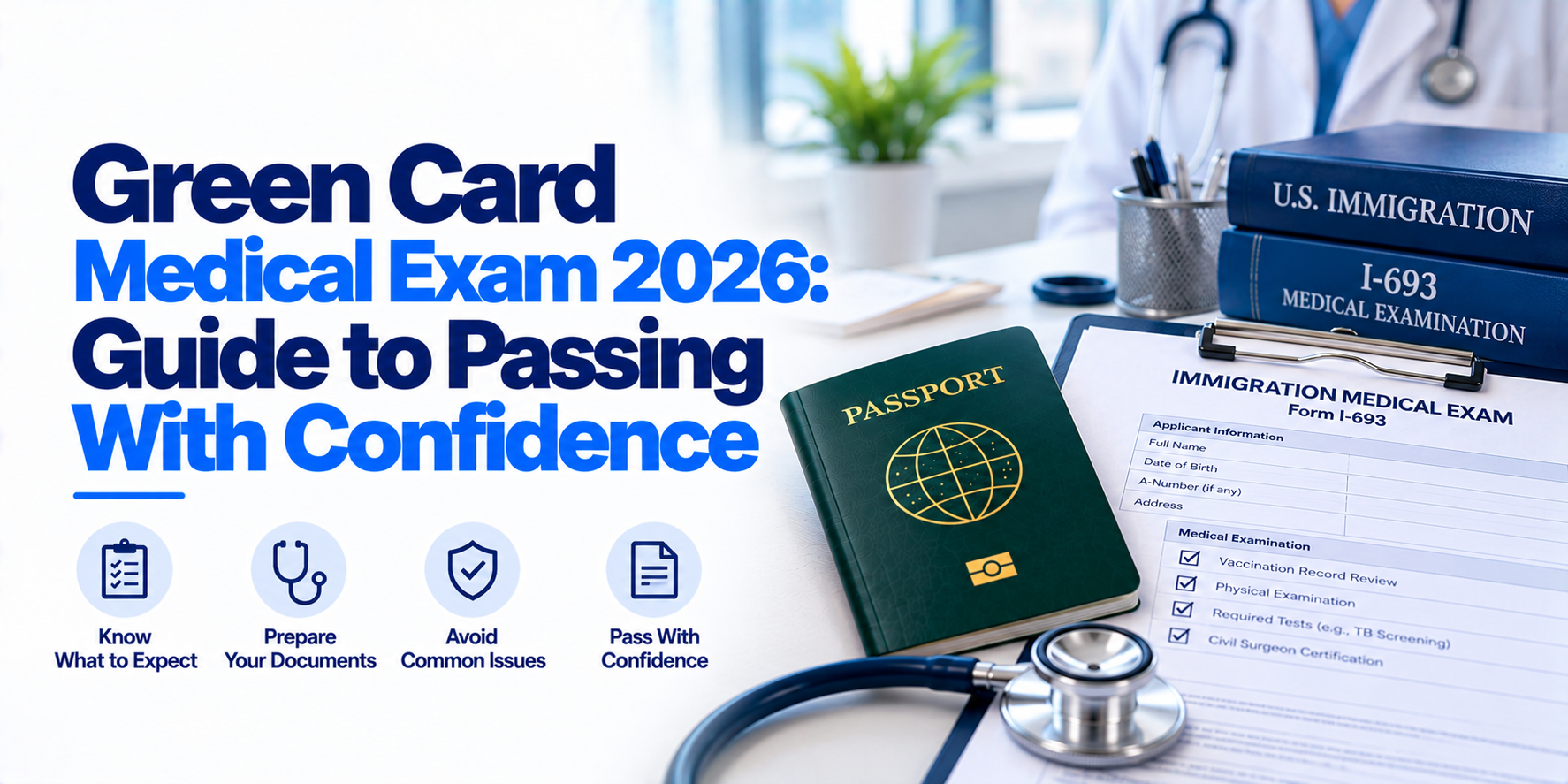
I’ve changed my earlier category suggestion. The medical exam is a compliance step in both adjustment of status and consular processing, so it fits this category better than Timelines and Priority Dates.
Picture this. You’ve spent years building a career the US wants. You’ve won the awards, earned the press, and collected letters from experts who vouch for you. Then your green card application comes back rejected, and the reason has nothing to do with your talent. Your green card medical exam form was missing, opened, or filled out wrong.
That outcome is avoidable. The green card medical exam is a short appointment, and getting it right protects everything you’ve worked for. This guide shows you who examines you, what they test, what you’ll pay, how long your results stay valid, and the mistakes that send strong applications back.
Read Also:NIW Green Card, Your Proven Path to American Freedom
Who Needs a Green Card Medical Exam
You need this exam when you apply for US permanent residence. For most founders, executives, and skilled professionals, that means an EB-1A or EB-2 National Interest Waiver application. Both routes let you apply without an employer sponsoring you, which we explain in our guide to getting a green card without sponsorship.
If you hold an O-1 visa, you don’t need this exam to get or keep your O-1. You’ll take it later if you apply for a green card from inside the US.
The UK, Canada, and Australia run their own health checks with different rules. We cover those briefly near the end.
Two Routes and Two Kinds of Doctors
Where you are when you apply decides who examines you.
| Applying inside the US | Applying from outside the US | |
|---|---|---|
| Process name | Adjustment of status | Consular processing |
| Who examines you | A USCIS-designated civil surgeon | A panel physician your US embassy approves |
| Where results go | To USCIS on Form I-693, with your Form I-485 | To the US embassy or consulate handling your case |
| How to find a doctor | The USCIS civil surgeon locator | Your embassy’s immigrant visa instructions page |
If you’re applying from inside the US
You’re likely on a status such as O-1 or H-1B and filing Form I-485. Only a civil surgeon can examine you. Your regular doctor can’t complete the form unless USCIS has designated them. Search the USCIS Find a Civil Surgeon tool or call the USCIS Contact Center at 800-375-5283.
Know one change before you file. A USCIS policy memo dated May 21, 2026 tells officers to treat adjustment of status as a discretionary benefit and consular processing as the normal route. The memo doesn’t stop eligible people from filing, and officers now weigh past status violations more heavily. Keep your status record clean and settle your filing route with an adviser before you book the exam.
If you’re applying from outside the US
You see a panel physician approved by the embassy handling your case. Results from any other doctor won’t be accepted. In Nigeria, the US Consulate in Lagos instructions list the Migration Health Assessment Centre in Lagos and Abuja, and they tell you to allow at least seven days to finish the whole medical process. In Ghana, Kenya, South Africa, or elsewhere, open your own embassy’s page on travel.state.gov to see its approved doctors. Book your medical as soon as you receive your interview date.
Check your country’s status before you pay for a medical. Since January 1, 2026, Presidential Proclamation 10998 has suspended immigrant visa issuance for nationals of countries on the US travel restriction lists, and Nigeria is on the partial list. Unless an exception applies, Nigerians applying from abroad can’t receive an immigrant visa while the proclamation stays in effect. We track these changes in our September 2026 visa bulletin guide.
What Happens During the Exam
The exam doesn’t measure how healthy you are overall. It checks for specific conditions that US immigration law cares about, following the CDC Technical Instructions for Civil Surgeons. Expect five parts.
- Medical history. The doctor asks about past illnesses, hospital stays, medications, mental health, and any drug or alcohol use. Answer honestly, because a gap found later causes bigger problems than the truth told now.
- Physical exam. The doctor checks your eyes, ears, nose, throat, heart, lungs, abdomen, lymph nodes, and skin.
- TB blood test. Everyone aged 2 and older takes an IGRA blood test for tuberculosis. A positive result leads to a chest X-ray.
- Syphilis and gonorrhea tests. Applicants aged 18 to 44 take a syphilis blood test, and applicants aged 18 to 24 are screened for gonorrhea. People outside those ages are tested only if the doctor has reason to suspect infection.
- Vaccination review. The doctor checks your records against the required list and gives you any missing shots.
The civil surgeon must order your lab tests at the exam itself. Results from tests you took elsewhere beforehand won’t count, so don’t pay for them twice.
HIV is no longer part of the required screening. The doctor may offer an HIV test, and you can decline it.
Vaccines You May Need
The CDC sets the vaccine list by age. Common ones include measles, mumps, and rubella (MMR), tetanus, diphtheria and pertussis, polio, varicella, hepatitis B, and the flu shot during flu season.
USCIS stopped requiring the COVID-19 vaccine on January 22, 2025. Some clinic pages still list it, so don’t let an old article send you for a shot you don’t need.
Three things save you time and money here.
- Bring your records. Your childhood vaccine card, a yellow card, or clinic records all help. Get any non-English record translated into English first.
- Don’t rush to get shots before the exam. The Form I-693 instructions tell you to let the civil surgeon assess you first, since some vaccines may not be right for you.
- Ask about a blood test if your records are lost. The doctor can sometimes prove your immunity with a blood test instead of giving you a new shot.
If a vaccine doesn’t suit your age, isn’t medically safe for you, or isn’t available, the doctor records that on your form and you don’t file anything extra. If you object to a vaccine for religious or moral reasons, you must apply for a waiver on Form I-601, and approval isn’t automatic.

What Your Results Mean
The doctor places any finding into one of three groups.
| Result | What it means for you | Examples |
|---|---|---|
| No class | Nothing relevant was found | Most applicants |
| Class B | A condition is noted and doesn’t block your green card | Latent TB, syphilis already treated |
| Class A | A condition blocks your green card until it’s treated or waived | Active TB, untreated syphilis |
Class A sounds alarming, and many Class A findings are treatable. The CDC syphilis instructions say a person treated for syphilis moves from Class A to Class B. Long-term conditions such as diabetes or high blood pressure don’t block you on their own.
If your TB test comes back positive
A positive IGRA doesn’t mean you have TB. Under the CDC tuberculosis instructions, the path looks like this.
- You get a chest X-ray.
- If the X-ray is clear, you’re classed as having latent TB, which is Class B. The doctor reports it to the local health department and can complete your form.
- If the X-ray suggests active TB, you’re sent to the health department for sputum tests.
- If those tests confirm active TB, you finish treatment before the doctor completes your form.
Step 4 can add months to your timeline. Book your exam early enough to absorb that delay if it happens.
If you’re pregnant
If you need a chest X-ray, you can have it with your consent and protective shielding, or you can postpone the X-ray and the exam until after your pregnancy. Plan your filing date with your adviser if you choose to wait.
If you’re bringing children
Each child needs their own exam. Children under 2 don’t take the TB blood test, and children usually skip the syphilis and gonorrhea tests unless the doctor suspects infection. They still need every vaccine that fits their age, so bring their full records.
What the Green Card Medical Exam Costs
USCIS charges nothing to file Form I-693. You pay the doctor, and USCIS doesn’t regulate those fees. Several 2026 guides from US clinics and law firms put the base exam at roughly $200 to $500, with vaccines and extra tests added on top. Many civil surgeons don’t accept insurance, and insurance often won’t cover the parts it could.
Call at least three civil surgeons and ask each one for a full quote that includes the TB blood test, the other lab tests, and any vaccines you’re likely to need. If you’re applying from abroad, you pay the panel physician directly, including X-ray and blood test fees.
For the full picture of filing fees, legal costs, and other expenses, read our breakdown of how much a green card costs.
How Long Your Results Stay Valid
The rules changed twice in the last two years, so older articles often get this wrong.
- You must file Form I-693 with your Form I-485. Since December 2, 2024, USCIS may reject your green card application if the medical form is missing. You can no longer send it later.
- Your form is tied to one application. Since June 11, 2025, a Form I-693 signed on or after November 1, 2023 stays valid only while the application you filed it with is pending. If that application is withdrawn or denied, you need a new exam for any future filing.
- Overseas results have a shorter life. Embassy instructions generally say your medical report must be less than six months old when you enter the US as an immigrant.
Book your exam once your I-485 package is nearly ready. That way, your results reflect your health at filing time, and nothing sits around going stale.

The Sealed Envelope Rule
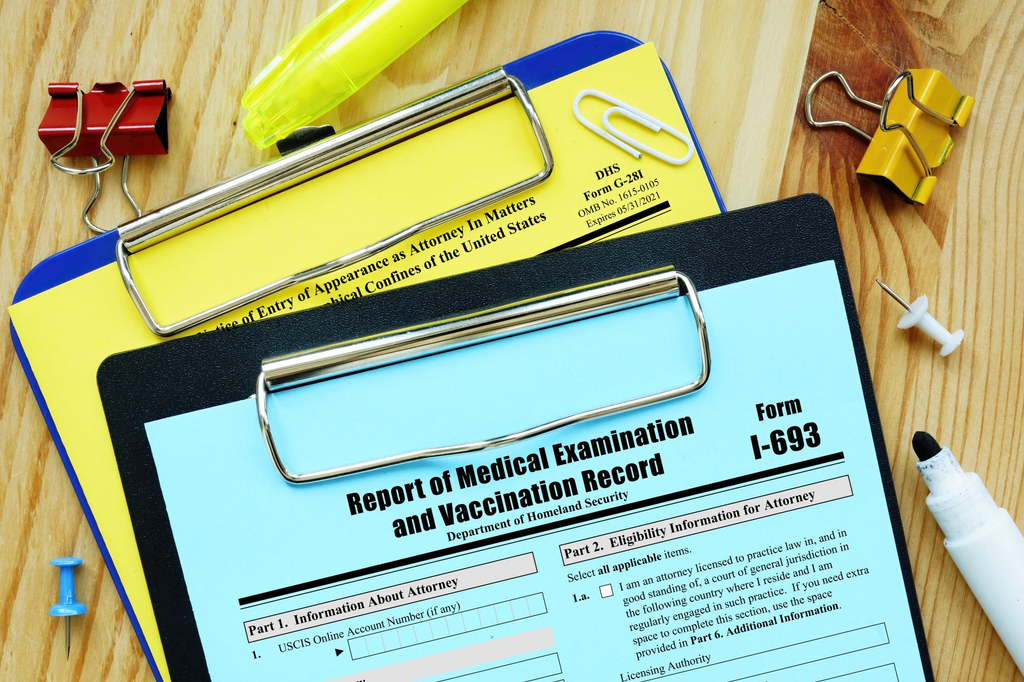
The civil surgeon gives you your completed Form I-693 in a sealed envelope. What you do with it depends on how you file, according to the USCIS Form I-693 page.
- Filing by mail. Send the envelope unopened with your I-485 package. USCIS won’t accept a form that arrives opened or altered.
- Filing online. Open the envelope, upload the completed form, and keep the original form and envelope until USCIS decides your case. An officer may ask to see them at your interview.
- If USCIS rejects your package and returns the envelope opened. You can refile with the opened original form, the civil surgeon’s documents in the original envelope, and a copy of the rejection notice.
Your Step-by-Step Plan
- Confirm your route. Decide with your adviser whether you’ll adjust status inside the US or go through an embassy abroad.
- Gather your records. Pull together vaccine records, past TB results, and any treatment certificates a few weeks ahead.
- Compare and book a doctor. Get quotes from at least three civil surgeons, or book the panel physician your embassy lists.
- Attend the exam. Bring everything on the checklist below.
- Wait for lab results. Most results return within days. A positive TB test adds more steps.
- Collect your sealed form. Check that your name and date of birth match your passport before you leave.
- File or attend your interview. Send the form with your I-485, or bring your results to your embassy interview if the doctor doesn’t send them directly.
Mistakes That Get Applications Rejected or Delayed
- Filing Form I-485 without Form I-693.
- Opening the envelope when you file by mail.
- Signing Form I-693 before the civil surgeon tells you to.
- Printing an old edition of the form. Check the edition date on the USCIS Form I-693 page before your appointment.
- Using a doctor who isn’t on the USCIS or embassy list.
- Paying for lab tests elsewhere before your exam.
- Leaving out past illnesses, treatment, or medications from your medical history.
- Reusing a medical form from a withdrawn or denied application.
What to Bring to Your Appointment
- Your passport or another government photo ID
- Your embassy appointment letter, if you’re applying from abroad
- Form I-693 with Part 1 completed and left unsigned, if you’re applying inside the US
- Vaccine records, translated into English where needed
- Past TB test results, chest X-ray films, and treatment certificates, if you have them
- A list of your current medications and any long-term conditions
- Records of any treatment for mental health or substance use
- Payment, since many clinics won’t bill insurance
Applying to the UK, Canada, or Australia Instead
The green card medical exam applies only to the US. The other routes Veripass clients use have their own health checks.
| Country and route | Health check | Official guidance |
|---|---|---|
| UK Global Talent | A TB chest X-ray if you’re coming for 6 months or more and have lived in a listed country, such as Nigeria, for 6 months or more. The certificate is valid for 6 months from your X-ray. | GOV.UK TB tests for visa applicants |
| Canada C10 and Global Talent Stream | Most work permit holders don’t need a medical exam unless the job is one where public health must be protected. A later permanent residence application usually needs one. | IRCC medical exams for workers |
| Australia National Innovation visa | You must meet Australia’s health requirement, often through exams with an approved panel physician. Results are valid for 12 months. | Home Affairs health requirement |
Frequently Asked Questions
What medical test is done for a green card?
The medical tests done for a green card cover tuberculosis, syphilis, gonorrhea, and your vaccinations, alongside a medical history review and a physical exam. Everyone aged 2 and older takes an IGRA blood test for TB, and a positive result leads to a chest X-ray. Applicants aged 18 to 44 take a syphilis blood test, and applicants aged 18 to 24 are screened for gonorrhea. The doctor also checks your vaccine records and gives you any shots you’re missing. You no longer need the COVID-19 vaccine, and HIV testing is optional.
What medical conditions disqualify you from a green card?
The medical conditions that can disqualify you from a green card are called Class A conditions. They include serious communicable diseases such as active TB or untreated syphilis, missing required vaccines, a physical or mental disorder linked to harmful behavior, and drug abuse or addiction. Most of these block you only until you deal with them. You can finish treatment, catch up on vaccines, or in some cases apply for a waiver on Form I-601. Long-term conditions such as diabetes or high blood pressure don’t disqualify you on their own.
Can my family doctor do my green card medical exam?
Your family doctor can do your green card medical exam only if USCIS has designated them as a civil surgeon. Search the USCIS locator before you book. If you’re applying from abroad, only the panel physicians your embassy lists can examine you.
Do I need a new green card medical exam if USCIS denies my application?
You need a new green card medical exam if USCIS denies your application or you withdraw it. A Form I-693 signed on or after November 1, 2023 stays valid only while the application you filed it with is pending, so your next filing needs a fresh exam.
Where Veripass Fits In
The medical exam is one of the last steps before a green card. The harder questions come first. Which route fits your profile? Is your evidence strong enough? When should you file?
Veripass is a global immigration advisory that works with founders, executives, and skilled professionals on the O-1, EB-1A, and EB-2 NIW in the US, the UK Global Talent visa, Canada’s C10 and Global Talent Stream, and Australia’s National Innovation visa. Here’s how we help you.
- We find your best route. Our free assessment looks at your background and recommends the visa that fits you, so you don’t spend money on the wrong application.
- We build your case with you. We position your profile and gather the evidence officers look for, including publishing articles under your name to show your expertise.
- We stay with you to the finish. We guide you through each stage, so steps like the medical exam happen at the right time, and nothing holds up your filing.
Your civil surgeon or panel physician still handles the medical side. We make sure everything around it moves in the right order.
Your Green Card Is Closer Than You Think
You’ve spent years building a career that deserves recognition. Don’t let one confusing step, or one wrong guess about your route, cost you another year of waiting.
Take the free Veripass assessment now and find out which visa fits you, what your case needs, and how to move forward with a team beside you.