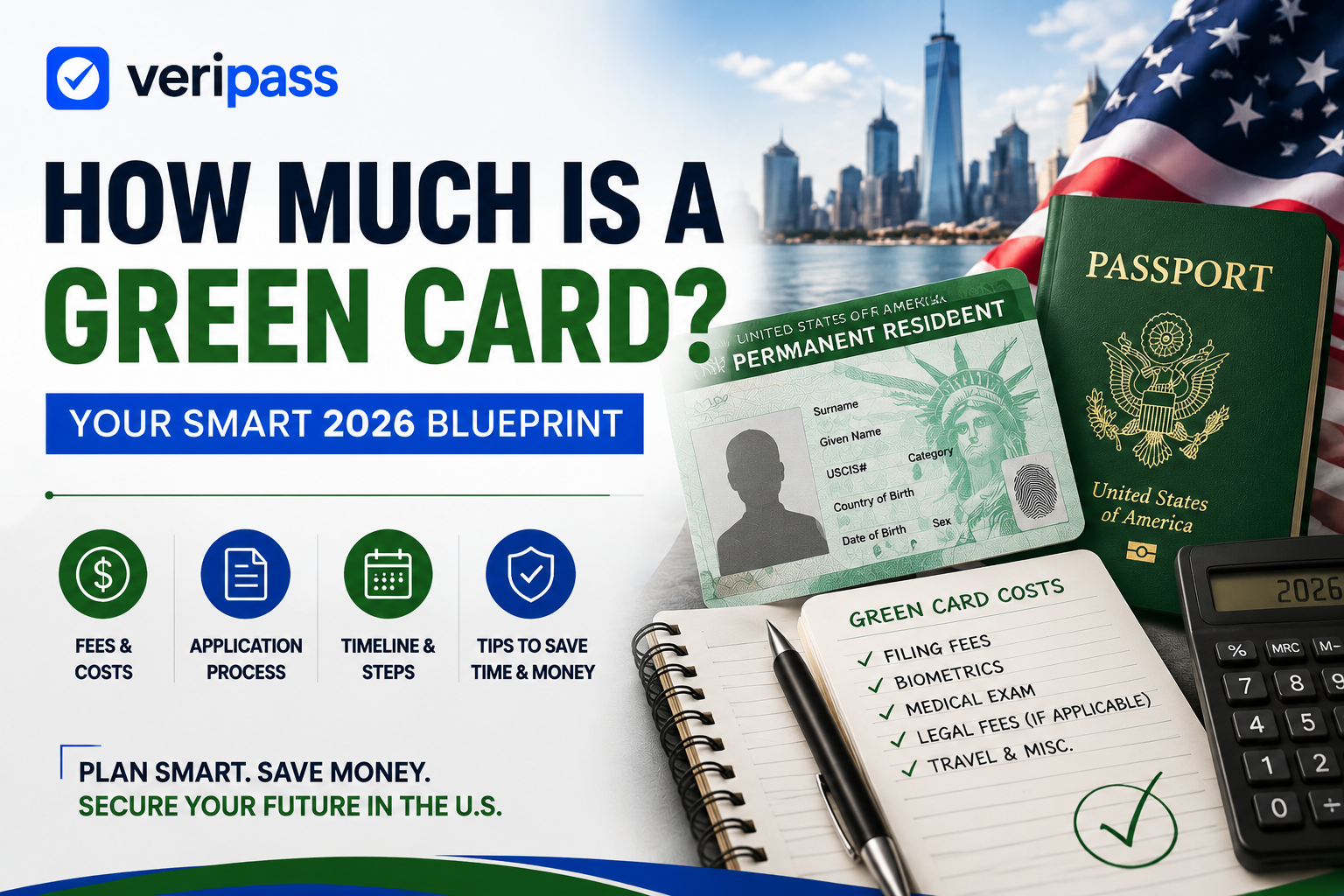
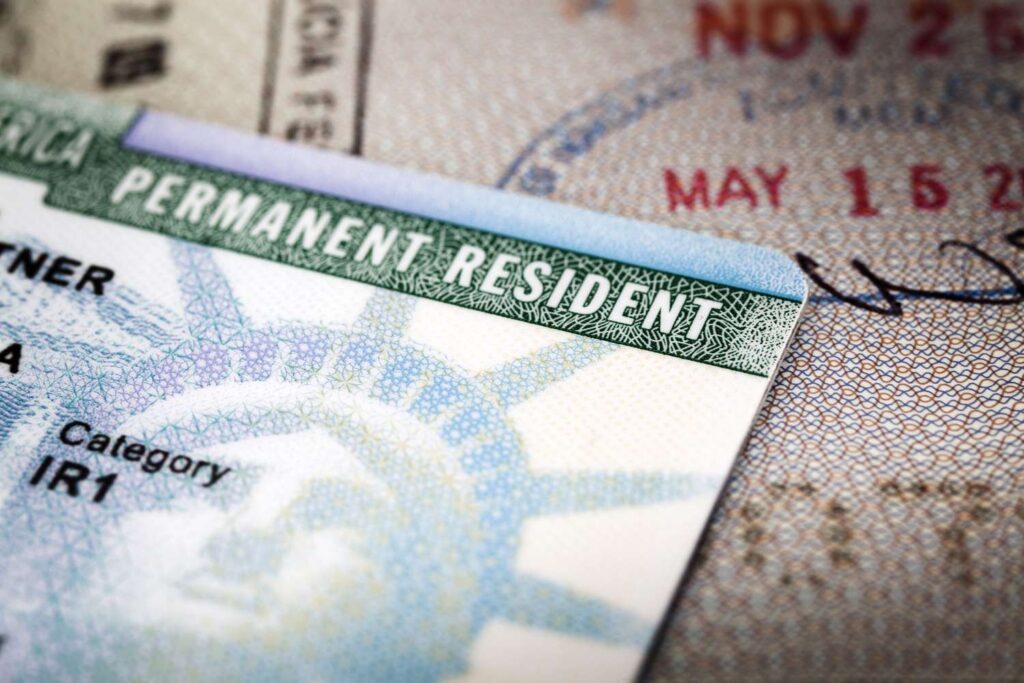
The money is gone either way. USCIS refunds nothing when a petition fails, and most people learn that only after they have answered how much is a green card with a number they read on the first page of Google: around $3,005 filed inside the United States, around $1,340 filed from abroad. Those figures come from a spouse petition and an affidavit of support. If you are a founder, an executive, or a specialist coming through O-1A, EB-2 NIW, or EB-1A, most of those line items never touch your case, and the ones that do cost you more. So when you ask how much a green card is, the internet quietly prices someone else’s life and hands you the bill.
Here is the real range. Plan for $7,000 to $20,000 from first document to approved green card, and expect most of it to sit outside the government fee schedule.
That gap is where people lose years, not only money. Someone trims the preparation budget to save $4,000, files a thin petition, collects a Request for Evidence nine months later, and pays twice for the same case. Filing fees are the small part of your total. What you spend building the case determines your outcome.
Read Also: North America Immigration Laws: 7 Powerful Facts for 2026
How Much Is a Green Card in Government Fees?
Two things move your total. The category you file under, and where you are standing when you file.
Self-petitioning through EB-2 NIW or EB-1A
You file Form I-140 for yourself. No employer, no job offer, no labor certification.
| Fee | Filing inside the US | Filing from abroad |
|---|---|---|
| Form I-140 petition | $715 | $715 |
| Asylum Program Fee (self-petitioner rate) | $300 | $300 |
| Form I-485 green card application | $1,440 | Not required |
| Immigrant visa application (DS-260) | Not required | $345 |
| USCIS Immigrant Fee | Not required | $235 |
| Mandatory government total | $2,455 | $1,595 |
| Work permit, Form I-765 (optional) | $260 | Not available |
| Travel document, Form I-131 (optional) | $630 | Not available |
| Premium processing, Form I-907 (optional) | $2,965 | $2,965 |
Those totals add up. Check the arithmetic yourself, because several of the biggest pages ranking for this question publish totals that do not reconcile with their own line items.
One detail costs people their filing date. USCIS treats an individual self-petitioner as a small employer for the Asylum Program Fee, so you pay $300 instead of $600. You claim it by answering “no” to question 5 and “yes” to question 6 in Part 1 of the I-140. Leave those blank, and USCIS assesses the full $600 by default. Underpay by a dollar and the entire package comes back to you.
Coming through O-1A first
The O-1A is a work visa rather than a green card, and many founders use it as the bridge while the immigrant petition runs. A US employer files it, or your own US company files as your petitioner.
| Fee | Amount |
|---|---|
| Form I-129 petition, standard petitioner | $1,055 |
| Form I-129 petition, 25 or fewer full-time employees, or nonprofit | $530 |
| Asylum Program Fee, standard petitioner | $600 |
| Asylum Program Fee, 25 or fewer full-time employees | $300 |
| Asylum Program Fee, nonprofit | $0 |
| Premium processing, Form I-907 (optional) | $2,965 |
| Consular visa application, petition-based category | $205 |
A founder petitioning through their own small US company pays $830 in USCIS fees plus $205 at the consulate. The same case through a larger employer costs $1,860. Premium processing adds $2,965 on either route, and it went up from $2,805 on March 1, 2026, so any fee table published before then is wrong.
Confirm every figure on the USCIS Fee Schedule and the Department of State fee page before you pay. USCIS stopped accepting paper checks in October 2025, and fees are now adjusted more often than most blogs update.
Your family multiplies the number
Every page that answers this question prices one person. You are probably not moving alone.
Employment-based green cards carry no family rate. Your spouse and each child file their own I-485 at $1,440, or their own DS-260 at $345 plus a $235 USCIS Immigrant Fee each if you process abroad. A couple with two children adjusting inside the United States pays $5,760 in I-485 fees alone, before the petition, before premium processing, before a single medical exam.
On the O-1A side, dependents hold O-3 status. If they are already in the country, changing or extending that status costs $420 online or $470 by paper for the lead applicant, with family members added on the same form. If they apply at a consulate, each pays the $205 petition-based visa fee.
Medical exams are per person too, and so are translations of every foreign birth and marriage certificate in the family.
Who pays which line
For an EB-2 NIW or EB-1A self-petition, the answer is simple. You pay everything.
For O-1A, your petitioning employer pays the I-129 fee and the Asylum Program Fee, and either party can pay premium processing. For an employer-sponsored EB-2 that runs through labor certification, the employer must cover the PERM recruitment and filing costs by regulation, which typically run several thousand dollars in advertising alone. That rule exists for a reason, and it is worth knowing before you volunteer to absorb a cost that is not legally yours.
The costs that never make it into the fee table
Government fees rarely reach a third of what you spend. Here is the rest.
Case preparation. Attorneys quote $5,000 to $12,000 for a full EB-2 NIW petition and $5,000 to $15,000 for an O-1A. You are paying for argument and evidence selection, not form-filling. An NIW turns on the three-part Dhanasar framework, and the difference between approval and a Request for Evidence usually comes down to how the endeavor gets framed rather than raw credentials.
Expert and recommendation letters. Independent expert opinion letters run $500 to $2,000 each, and a strong petition carries several. Letters from people who already know you cost nothing in money and a great deal in coordination time.
Credential evaluation. If your degree is from outside the United States, expect $150 to $400 for an equivalency evaluation from an accredited agency.
Translations. Certified translation of degrees, publications, press coverage, and civil documents runs $20 to $50 per page. For a founder with Nigerian, Indian, or Brazilian source documents, this adds up faster than you expect.
Medical examination. Every green card applicant completes one, either with a USCIS civil surgeon inside the country or a panel physician abroad. Costs are set by the doctor, usually a few hundred dollars, and vaccinations are extra.
Travel and time. Consular interviews, document collection, and courier fees are real money, and nobody reimburses you.
Two changes in 2026 that move your number
Filing inside the US is no longer a safe assumption
On May 21, 2026, USCIS issued Policy Memorandum PM-602-0199, which reframes adjustment of status as discretionary relief granted as a matter of administrative grace. The accompanying announcement said the agency will approve it only in extraordinary circumstances.
USCIS softened that framing a week later, and the statutory right to file an I-485 has not changed. Even so, the memo directs officers to weigh negative factors more heavily, and holding valid H-1B or O-1 status does not by itself earn a favorable exercise of discretion. Attorneys expect litigation.
For your budget, this matters. If your case moves to consular processing, your work permit and travel document fees disappear, and a flight, an interview at a post abroad, and a gap in your income appear instead. The cheaper column on paper is not the cheaper option in practice.
The visa integrity fee
Public Law 119-21 created a visa integrity fee of at least $250, charged at nonimmigrant visa issuance and indexed to inflation. Green card applicants are exempt, so it hits your O-1A rather than your immigrant visa. Collection has been uneven through 2026, and the Department of State fee schedule has not published a payment procedure. Some applicants report paying it at their post. Budget for it, confirm with your consulate, and pay nobody who is not the US government.
Timing is a cost, and right now it favors you
Your priority date sets your place in the queue. For EB-2 and EB-1, the All Chargeability column in the monthly Visa Bulletin covers everyone except a handful of oversubscribed countries, and it has been current through mid-2026.
Compare that with EB-2 India, which hit its annual limit and went unavailable for the rest of fiscal year 2026, and EB-2 China, sitting at a cutoff from September 2021. Those applicants pay the same government fees you do and then wait years, absorbing legal costs for status extensions the whole time.
The Department of State warns openly that categories can retrogress or go unavailable as annual limits fill. A category that is current today is not a permanent condition. Every month you delay filing is a month of exposure to a queue that can close.
The cost of getting it wrong
USCIS does not refund filing fees. Not on denial, not on rejection, not on withdrawal.
A rejected package, from a wrong fee amount or a blank question, comes back to you and loses its place in the queue. A Request for Evidence costs $1,200 to $2,000 to answer if your attorney agreement excludes it, and it stops the premium processing clock. A denial means refiling from the start, paying $715 and $300 again, and doing it with a denial on your record.
Building the petition properly the first time is the cheapest version of this process. Every shortcut you take at the front gets billed back to you later with interest.
What to do before you spend anything
- Confirm your category before you budget. EB-1A, EB-2 NIW, and O-1A carry different evidence standards and different costs. Guessing wrong is the most expensive mistake available to you.
- Check your country in the current Visa Bulletin. Your birth country sets your queue, not your citizenship or where you live now.
- Audit your evidence honestly. List your awards, press, funding, patents, citations, and leadership roles against the criteria. Gaps you find now cost months. Gaps USCIS finds cost years.
- Price the whole case, not the filing fee. Ask any advisor what happens if you receive a Request for Evidence and get the answer in writing before you sign.
- Sort your documents early. Degrees, transcripts, letters, and civil documents all need translation and evaluation, and they move slowly.
- Decide on premium processing deliberately. It buys a decision window, not an approval. It is worth the money when a funding round, a hire, or a priority date depends on the date.
- Verify every fee on the day you file. Use the USCIS fee schedule, not a blog post.
Where Veripass fits
Veripass is a legal technology platform built for exactly this profile. Founders, executives, and specialists who qualify on merit rather than on an employer’s willingness to sponsor. Legal services come from licensed affiliate attorneys, and the platform handles the part that decides your outcome, which is how your record gets assembled and presented.
The work runs in four stages. A free eligibility assessment maps your background against every route available to you. A strategy call gives you the realistic version, including timelines and risks. Case building positions your evidence, and this is where the money you spend actually earns its return, because framing is what separates an approval from a Request for Evidence. Then submission and tracking, with responses to government requests handled as they arrive.
Two things matter for your budget. First, Veripass covers O-1A, EB-1A, and EB-2 NIW alongside the UK Global Talent visa and Australia’s National Innovation visa, so if your US category is backlogged you can see your alternatives priced side by side rather than finding out two years in. Second, the assessment costs nothing, which means you can find out where your case really stands before committing a dollar to it.
Get the numbers for your own case
A published range only takes you so far. Your category, your country of birth, your filing location, and the state of your evidence decide what you actually pay.
Veripass runs a free Saturday masterclass covering the O-1A, EB-1A, and EB-2 NIW routes, what USCIS is approving in 2026, and how to build a case that survives first review. If you are weighing $10,000 and eighteen months of your life, an hour is a reasonable place to start.
Register for the Veripass masterclass and bring your questions.
Can I get a green card for free?
Rarely. Entering the Diversity Visa lottery costs nothing, and winning still leaves you paying the immigrant visa fee, the USCIS Immigrant Fee, and your own medical exam. USCIS grants fee waivers through Form I-912 for a narrow set of humanitarian cases, including VAWA self-petitioners, T and U visa holders, and Special Immigrant Juveniles. Employment-based and standard family-based applicants do not qualify. Treat any site promising a free green card as a scam, and never pay an agent to submit a lottery entry the government accepts at no cost.
How much will it cost to get a green card in 2026?
For a self-petitioned EB-2 NIW or EB-1A, government fees start at $1,595 for filing from abroad and $2,455 for filing inside the United States. Premium processing adds $2,965. The medical exam adds a few hundred dollars. Case preparation is the bigger number, usually $5,000 to $12,000, and it is the part that decides your outcome. All in, plan for $7,000 to $20,000 for one person. Each family member adds their own $1,440 or $345, depending on where they file.
How can a Nigerian get a green card?
Not through the lottery. Nigeria has been excluded from the Diversity Visa program for years, including the DV-2026 and DV-2027 cycles, because more than 50,000 Nigerians immigrated to the United States in the previous five years. You can claim your spouse’s country of birth if they were born somewhere eligible. For most Nigerian founders, executives, and specialists, the working routes are EB-1A, EB-2 NIW, or an O-1A that leads into one of them. None of those needs an employer to sponsor you.
Is a green card for 2 years?
Most green cards last 10 years and renew. You receive a 2-year conditional card in two situations: when you gain residence through a marriage under two years old, and when you come through the EB-5 investor route. Conditional residents file Form I-751 to remove the conditions, at $750 by paper or $700 online. Green cards through EB-1A, EB-2 NIW, and PERM come with the 10-year card. Your permanent residence does not expire; only the card does.
Fee figures verified against the USCIS Fee Schedule (Form G-1055) and Department of State schedules as of August 2026. Government fees change. Confirm current amounts on the official sources linked above before you file. This article is general information and not legal advice.