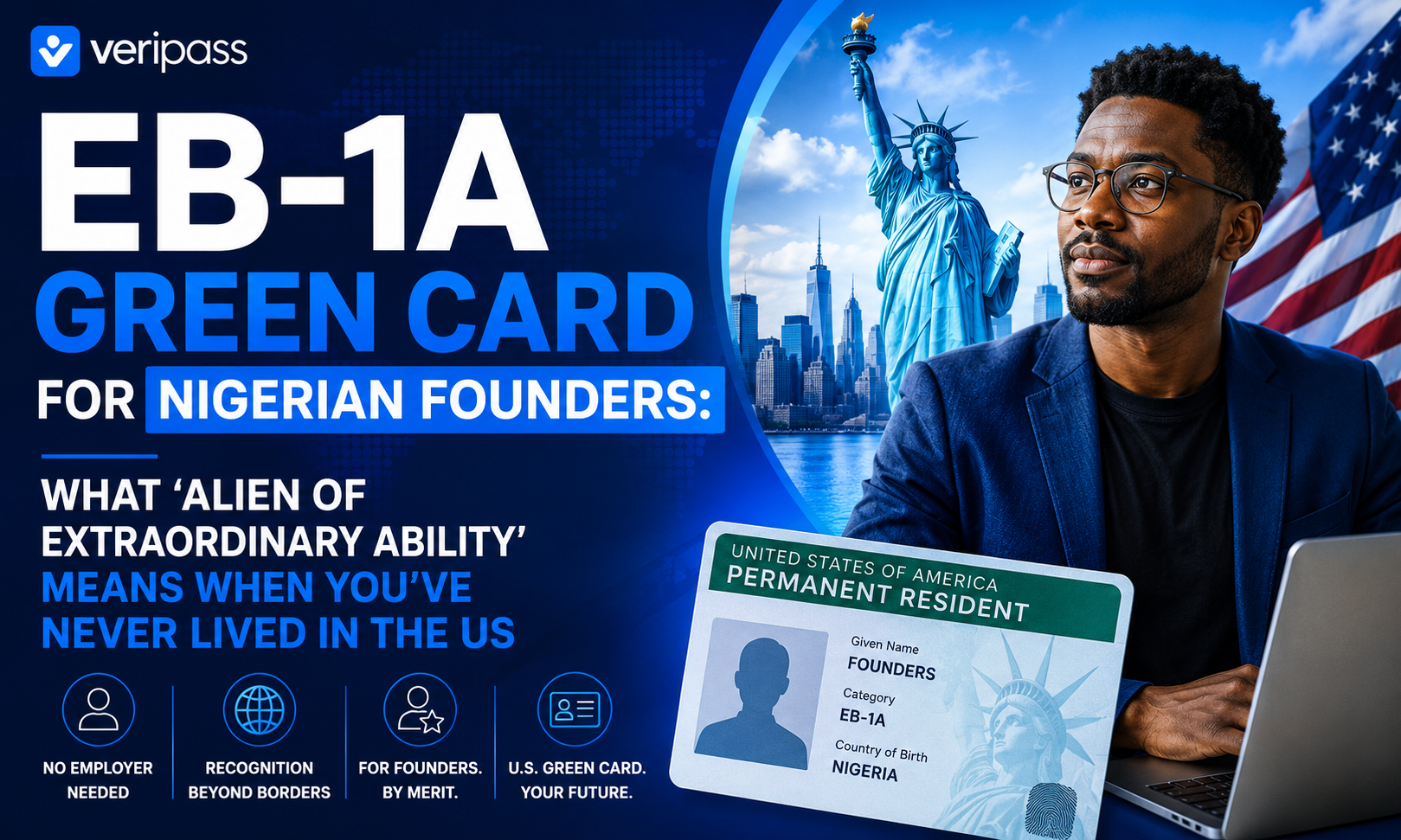
EB-1A green card for Nigerian founders is one of the most misunderstood U.S. residency paths because many founders assume their achievements only count if they happened in America.
That assumption is wrong.
You do not need to have lived in the U.S., need a U.S. employer to file for you, or be a professor, entertainer, athlete, or Nobel Prize winner to have your work reviewed.
What you need is harder, but clearer.
You need proof that your work is recognized in your field and has gained recognition in your field and that the company, product, leadership, or contribution has achieved public – not just private – recognition. Many Nigerian founders struggle with this, not because their work lacks impact, but because they do not know how to present business achievements as immigration evidence.
A founder in Lagos may have raised funding, hired staff, served thousands of users, won industry recognition, joined a selective accelerator, spoken at business events, or built a product that solved a real problem. But when the phrase “alien of extraordinary ability” appears, it can make that same founder feel unqualified.
This article explains what EB-1A means for founders whose careers were built in Nigeria or across Africa, not Silicon Valley. It also explains how EB-1A compares with EB-2 NIW and O-1A, what USCIS looks for, what evidence may count, and what you should start doing before you file.
See Also: EB-1A Approval Trends 2026
Why EB-1A Is the Most Overlooked Green Card Path for African Founders
Most African founders hear about the H-1B, O-1, EB-2 NIW, or investor visas before they hear a serious explanation of EB-1A.
That is not surprising. Most EB-1A content is written as if the ideal applicant is a researcher with citations, a famous actor, an athlete with medals, or a professor with published work. Founders read those articles and quietly disqualify themselves.
But EB-1A is not limited to academics or entertainers. USCIS states that the EB-1 first-preference category includes individuals with extraordinary ability in the sciences, business, the arts, education, or athletics. For the extraordinary ability category, a person may self-petition by filing Form I-140, which indicates that you are applying for yourself without a U.S. employer sponsor.
That self-petition point matters for founders.
A founder may not want to depend on a single employer; they may want to expand a company into the U.S., meet investors, hire talent, open a U.S. office, or build partnerships without tying their entire U.S. future to a single job offer.
For this kind of person, EB-1A can be attractive because it is an employment-based green card route that can fit independent high achievers. But it only works when the proof is strong.
No Priority Date Backlog for Nigeria and Why That Matters
For Nigerian founders, timing can also matter.
The U.S. Department of State publishes a monthly Visa Bulletin that shows the availability of immigrant visas by category and country. People born in some countries face long delays in obtaining employment-based green cards. Nigeria is usually grouped under “All Chargeability Areas Except Those Listed” unless named separately in the bulletin, so Nigerian applicants should always check the current bulletin before planning next steps.
This does not mean EB-1A approval is easy. It does not mean you can ignore evidence. It simply means that visa availability may be the preferred option for many Nigerian applicants over applicants from countries with long employment-based queues.
If your evidence is strong, that timing advantage can matter.
If your evidence is weak, timing will not save the case.
EB-1A vs EB-2 NIW for Nigerian Founders
A Nigerian founder comparing U.S. visa paths should not treat EB-1A and EB-2 NIW as the same thing because they answer different questions.
EB-1A asks, in simple terms: ”Has this person reached a high level of recognition in their field?”
EB-2 NIW asks a different question: “Does this person’s proposed work have strong value to the United States, and is the person well placed to carry it out?”
USCIS guidance for EB-2 NIW is based on the Matter of Dhanasar framework. The proposed work must have substantial merit and national importance; the applicant must be well-positioned to advance it; and USCIS must also be persuaded that waiving the usual job offer and labor certification requirements benefits the United States.
For a founder, EB-1A may make more sense when the strongest part of the profile is personal recognition. Maybe you have press, awards, a strong leadership record, judging roles, industry influence, and proof that your work is respected beyond your company.
EB-2 NIW may make more sense when the strongest part of the case is the future value of your work in the U.S. Maybe your startup can support healthcare access, education, energy, artificial intelligence, public safety, financial inclusion, job creation, or another area with national importance.
O-1A can also fit some founders. The O-1A visa is for people with extraordinary ability or achievement, but it is a temporary work visa, not a green card. For founders who have strong proof but not enough long-term acclaim for EB-1A, O-1A may act as a bridge while they build stronger evidence. USCIS describes the O-1 visa as a non-immigrant visa for people with extraordinary ability in fields such as business, science, education, the arts, or athletics.
The decision should start with your evidence, not with the visa name.
What “Alien of Extraordinary Ability” Means for a Nigerian Startup Founder
The phrase sounds cold. It also sounds bigger than it is in real life.
But in practical terms, USCIS wants to see that your achievements have been recognized and that your work places you among the small group at the top of your field. USCIS policy explains that EB-1A requires extraordinary ability shown by sustained national or international acclaim. The person must also intend to keep working in the area of expertise.
For a startup founder, this is not about saying, “I built a company.”
It is about showing why that company, and your role in it, matters.
If you built a fintech product, what problem did it solve? How many merchants, users, or clients did it support? Did respected media write about it? Did investors back it? Did industry leaders recognize it? Did you get invited to speak, judge, advise, or teach because of that work?
If you built a healthtech company, did it improve access to care, reduce delays, help hospitals work better, serve patients at scale, or attract support from health institutions?
If you built an edtech platform, did schools use it? Did it improve student records, results, learning, parent communication, or school operations? Did it gain attention beyond your immediate network?
The founder title is not enough. The proof behind the founder title is what matters.
How EB-1A Evidence Looks When Your Track Record Was Built in Nigeria
Nigerian evidence can count, but you must frame it well. USCIS officers may not necessarily understand the African tech ecosystem. They may not know which publications matter, which awards are respected, which accelerators are selective, or why building traction in Nigeria can be difficult.
So your petition has to explain the context without sounding defensive.
If your company was featured in a respected African tech or business publication, do not just attach the article and expect the officer to understand its weight. Explain the publication’s audience, authority, and relevance to your field. If the article focuses on your product, traction, funding, or market impact, make that clear.
If you won a startup award, do not just include a certificate; include the award itself. Explain who gave the award, how applicants were selected, how many people competed, who judged the award, and why the recognition matters.
If you joined an accelerator, explain the selection process. An accelerator that selected 20 startups from 2,000 applicants carries more weight than a program anyone can join after paying a fee.
If your company has revenue, users, partnerships, or funding, do not leave the numbers floating alone. Connect them to market impact. Revenue may show commercial strength. Users may show adoption. Partnerships may show trust. Funding may show outside belief in your work. Together, they can support a bigger story.
The mistake is treating each document like a separate item.
A stronger case makes the documents speak to one point that your work has been recognized, tested, trusted, and valued beyond your own claim.
The 10 EB-1A Criteria, Applied to What Nigerian Founders Actually Build
USCIS allows EB-1A applicants to show a one-time major achievement or provide evidence that meets at least three of the listed criteria. These criteria include awards, memberships, published material about the applicant, judging, original contributions, scholarly articles, leading or critical roles, high salary, and commercial success in the performing arts.
For founders, some criteria will matter more than others.
Awards can help, but they must carry weight. A local certificate with unclear selection rules may not say much. A respected founder award, innovation prize, business recognition, or sector-specific award can be stronger if the petition explains why the award matters.
Memberships can help only when they are selective. A paid business association may not add much. But a founder network, an accelerator alumni group, or an invitation-only business council that accepts members based on achievement may support your case.
Media coverage can be strong when it is independent and meaningful. A paid post that only repeats your bio is weak. A serious article that explains your work, quotes industry sources, discusses your market impact, or covers your company’s growth is stronger.
Judging can be one of the most useful founder signals. If you have judged pitch competitions, startup grants, hackathons, fellowships, business awards, or accelerator applicants, that shows other people trust your expertise enough to let you assess their work.
Original contributions can be powerful, but only if you explain the contribution clearly. A founder often says, “We built an innovative platform.” That is not enough. What changed because your platform exists? Who uses it? What problem did it solve? What proof shows the market cared?
Evidence from a leading or critical role can also work well for founders. You may have led a company, but the company itself must have some proof of distinction. A founder role in a company with press, revenue, funding, partnerships, enterprise clients, awards, or market adoption is stronger than one without such proof.
High salaries or compensation can be tricky for founders, as many pay themselves less as they grow the business. Still, compensation evidence may include salary, dividends, founder earnings, equity value, consulting income, board-approved compensation, or other clean financial proof. The point is not just the amount. The point is how it compares to others in your field.
Some criteria may not fit. For example, commercial success in the performing arts will not apply to most tech founders. That is fine. You do not need every criterion. You need the right evidence, tied together in a clear story.
Why Three Criteria Are Not Enough on Their Own
Many founders make one serious mistake.
They hear that EB-1A requires at least three criteria and think the case becomes strong once they can tick three boxes.
That is not how it works.
USCIS applies a deeper review after checking the criteria. The officer reviews the evidence as a whole and decides whether it meets the level of acclaim required for EB-1A. This review is often discussed in terms of the Kazarian framework and the final merits analysis. USCIS policy explains that after the evidentiary criteria are reviewed, officers must evaluate the entire record to determine whether the person has sustained national or international acclaim and belongs among the small percentage at the top of the field.
That means a founder with three weak categories can still fail.
For example, a founder may show a small award, a paid media mention, and a paid association membership. On paper, that looks like three categories. In reality, it may not prove high-level recognition.
Another founder may show serious press, strong judging work, a selective accelerator, revenue growth, expert letters, and a product used across several markets. That story is stronger because the evidence supports one clear point.
Quality beats quantity.
A good EB-1A case does not shout, “Look at how many documents I have.”
It says, “Look at what these documents prove.

What a Strong Petition Package Should Prove
A strong EB-1A petition for a Nigerian founder should not feel like a random folder of documents.
It should feel like a case.
Your company documents may show that the business exists. Your CAC registration may confirm ownership. Your tax records may show clean operations. Your financial statements may show traction. Your pitch deck may explain the problem and solution. Your investor documents may show outside trust. Your media features may show public recognition. Your awards may show peer respect. Your speaking invitations may show authority. Your judging roles may show that others value your opinion. Your expert letters may explain your impact in plain English.
None of these documents should stand alone.
They should work together.
The officer should be able to understand who you are, what you built, why it matters, how others recognized it, and why your work belongs in the category you claim.
That is also why expert letters matter.
A weak expert letter reads like a friend trying to help: “He is hardworking, visionary, and committed.”
A stronger letter explains facts: “Her platform helped 35,000 small businesses accept payments, reduced settlement delays, and gained adoption in three major Nigerian cities. In my view, this contribution changed how small retailers in her market handle digital payments.”
The second letter gives the officer something to evaluate.
How to Frame African Founder Evidence for a U.S. Officer
Your evidence may be strong in Nigeria, but it still needs context.
Do not assume a U.S. officer knows the meaning of your market.
If your startup grew despite poor infrastructure, low trust, fragmented payment systems, limited access to funding, or complex local regulation, explain the challenge in clear terms. Do not exaggerate. Just help the officer understand what your results mean.
If your company has 50,000 users, explain the market. If you raised funding, explain who invested and why that matters. If you’ve got press, explain why the publication is respected. If you won an award, explain who judged it and how selective it was.
This is especially important for founders whose achievements were built outside the U.S. The evidence may be real, but if the framing is weak, the officer may miss its value.
What Nigerian Founders Should Start Doing Before Filing
If you are thinking about EB-1A, start treating your business records as immigration records.
This does not mean you should manufacture proof. It means you should stop losing proof.
When your company gets media coverage, save the link, screenshots, publication details, and author information. When you speak at an event, save the invitation, speaker page, agenda, recording, and audience details. When you judge a startup competition, keep the invitation and proof of your role. When your product reaches a growth milestone, store the dashboard, report, and supporting documents.
You should also be more intentional about public credibility. If you have real expertise, publish serious commentary in your field. Apply for respected awards that match your work. Accept credible judging or advisory roles. Build relationships with industry leaders who can later write detailed letters about your impact.
Do not wait until you want to file before you start gathering proof.
A founder who starts early can build a clean evidence record over time. A founder who starts late may know the story but struggles to prove it.
EB-1A Green Card for Nigerian Founders: When Your Case Is Not Ready Yet
If your only evidence is that you registered a company, launched a product, and got a few clients, you may need more time. If your press is mostly paid PR, your awards are unclear, your company has no strong traction, and no one outside your close circle can explain your impact, filing may be risky.
That does not mean your U.S. plan is over.
It may mean you need a staged plan.
Some founders may start with O-1 if they have a U.S. sponsor, a strong body of work, and a need to work in the U.S. while building more proof. Veripass explains that the O-1 can serve as a possible bridge for high achievers who have strong evidence but still need time to build a stronger EB-1A or EB-2 NIW case.
Some founders may be better suited for EB-2 NIW if their work has a strong U.S. national interest angle, but their personal acclaim is not yet strong enough for EB-1A.
Some should spend six to twelve months building public proof before filing anything.
The right answer depends on your evidence.
What Happens After EB-1A Approval
EB-1A approval is a major step, but it is not the same as having the green card in hand.
The first step is usually the Form I-140 petition. USCIS explains that an immigrant petition must be filed, and after that, a person may pursue adjustment of status in the United States if eligible, or immigrant visa processing abroad if outside the United States.
If you are in Nigeria, your next stage may involve consular processing after petition approval and visa availability. If you are already in the U.S. with a valid status and meet the requirements, adjustment of status may be possible.
Premium processing may also be available for some petitions, but premium processing only speeds up USCIS action on the petition. It does not mean approval, and it does not finish the green card process.
This is why planning matters. Your filing strategy, location, status, timing, family plans, and visa availability should all be reviewed before you move.
The EB-1A green card for Nigerian founders is not for every founder.
It is not for someone with only an idea. It is not for someone with only a CAC certificate. It is not for someone whose entire case depends on self-praise.
But it may be worth serious review if your work has gained recognition, created measurable impact, attracted credible attention, and placed you in a strong position within your field.
Your achievements do not stop counting because they happened in Nigeria.
They only need to be proven, explained, and framed in a way USCIS can understand.
Your track record may already meet the EB-1A threshold; you just need the right lens to see it. Book a discovery call with Veripass, and let’s map your case before you assume you don’t qualify.
⚠️ This article is for informational purposes only and does not constitute legal advice. Consult a licensed immigration professional regarding your specific situation.
Can I file EB-1A from Nigeria without having lived in the U.S.?
Yes. EB-1A allows self-petition through Form I-140, and the law does not require you to have lived in the U.S. before filing. If the petition is approved and a visa is available, you may later move through consular processing outside the U.S. or adjustment of status if you are already in the U.S. and eligible.
Does being featured in Forbes Africa count as major press for EB-1A?
It can help, but the value depends on the article. A serious independent feature about your work, impact, company growth, or industry recognition is stronger than a short mention or paid profile. The petition should also explain the publication’s authority and why the coverage matters in your field.
How long does EB-1A take from petition to green card?
Timing depends on USCIS processing, the availability of premium processing, visa availability, and the next step after I-140 approval. If you are outside the U.S., consular processing can add time to the process. If you are in the U.S. and eligible for adjustment of status, the process may look different. Always check USCIS processing updates and the latest Visa Bulletin before making plans.
Can a Nigerian founder with one startup qualify?
Yes, one startup may be enough if the evidence is strong. The number of ventures is not the main issue. USCIS cares about the strength of your recognition, impact, leadership, and proof. One serious company with strong traction and public recognition can be stronger than several small ventures with weak documentation.
What are the common reasons EB-1A founder cases struggle?
Founder cases often struggle when the petition relies on weak press, unclear awards, generic expert letters, poor market context, thin proof of impact, or a simple “I own a company” argument. Another common problem is filing too early, before the founder has sufficient public proof to sustain acclaim.