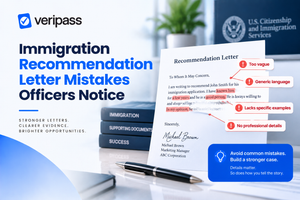

EB-2 NIW recommendation letter tips matter because a strong profile can still look weak on paper if your letters sound vague, copied, or empty. USCIS first looks at the EB-2 base rules, then at the three Dhanasar points: your work must have substantial merit and national importance, you must be well-positioned to move that work forward, and, on balance, it must help the United States to waive the job offer and labor certification step.
USCIS also says it reviews the totality of the evidence, and that no single factor or one piece of evidence controls the case.

That is why the best EB-2 NIW recommendation letter tips are not about praise. They are about proof, position, and clear writing. If you are a high net worth individual, a founder, a doctor, an engineer, an investor, a researcher, a senior executive, or a person with a strong public record, your letters must explain not just that you are good at your work, but why your work matters to the U.S. in a real and broad way.
This article gives you the parts most pages miss. You will see how to choose the right people, what each paragraph should do, what weak letters sound like, how to show national importance even if your work looks local, and how Veripass can help you build letters that fit the full case instead of sitting alone like loose paper.
See Also: Visa Social Media Check: 5 Key Steps for Success
What USCIS actually wants from your letters
The first thing to understand is simple. Recommendation letters do not win a case by themselves. USCIS looks at all the evidence together. Still, good letters can help explain your record in plain English, tie your record to the Dhanasar test, and make your case easier to follow. That matters because officers are not experts in every field, and they still have to decide if your work fits the legal test. USCIS said in its 2025 guidance that officers may look at letters of support and business plans when deciding if a person is well-positioned to advance the proposed endeavor.
So the job of a letter is not to repeat your résumé. The job is to interpret your record.
A strong letter should answer five direct questions:
- Who is the writer, and why should USCIS care about that person’s opinion?
- How does the writer know your work or know your field?
- What have you done that can be checked and understood?
- Why does that work matter beyond one employer, one city, or one client?
- Why are you a good bet to keep doing it in the U.S.?
If your letters do not answer those questions, they are weak, even if the writer has a big title.
EB-2 NIW recommendation letter tips that actually move a case
A lot of pages stop at “ask respected people” and “be specific.” That is not enough. These EB-2 NIW recommendation letter tips go much deeper.
1. Pick writers for their angle, not just their status
Do not chase titles alone. A famous person with no real angle can write a flat letter. A less famous person with direct knowledge and strong field credibility can write a far better one.
Build a mix like this:
- One former supervisor who can speak about results
- One independent expert with no close ties to you
- One client, partner, or collaborator who saw your impact
- One field leader who can explain why your work matters in the U.S.
- One writer who can speak about your future plan, not only your past
This approach makes your packet stronger because each letter has a job. One covers performance. One covers independence. One covers the market or public need. One covers future value.
2. Map every letter to the Dhanasar test
This is one of the most missed EB-2 NIW recommendation letter tips.
Do not let every writer say the same thing. Assign each letter a main purpose.
For example:
- Letter A: substantial merit and national importance
- Letter B: You are well-positioned
- Letter C: Why the waiver helps the U.S.
- Letter D: outside validation from an independent voice
- Letter E: future impact and momentum
This stops repetition. It also helps the officer see your evidence in a clean pattern.
3. Give writers a packet, not a blank page
Busy people write weak letters when you leave them with no structure. Send a short packet that includes:
- Your CV or résumé
- A one-page summary of your proposed endeavor
- Three to five major achievements with numbers
- Press, awards, patents, talks, or publications if you have them
- A short note on the Dhanasar test
- The angle you want that writer to cover
- A simple deadline
- A draft outline or talking points
This saves time and gives you better letters. It also helps the writer avoid general praise.

4. Show national importance even if your work looks local
This is where many applicants fail. Their work is real, but they describe it too narrowly.
Dhanasar says USCIS looks at the prospective impact of the endeavor and does not judge national importance only by geography. Work focused on one area can still have national importance if the broader implications are strong.
So if your work looks local, connect it to a bigger U.S. need:
- A doctor improving one clinic can support public health, access, or care quality
- A cybersecurity leader helping one firm can support U.S. data security and business resilience
- A founder building a product for one sector can support jobs, efficiency, or access at scale
- A finance expert can support risk control, compliance, lending access, or market trust
- An engineer can support energy, transport, safety, manufacturing, or infrastructure goals
This is one of the strongest EB-2 NIW recommendation letter tips because many great cases get framed too small.
5. Ask writers for examples, numbers, and outcomes
Praise is weak. The proof is stronger.
Bad line:
She is highly respected and very talented.
Better line:
Her fraud control system cut review time by 32 percent and improved risk detection across a banking operation that served thousands of users.
Bad line:
His research is important.
Better line:
His work supports a field that the U.S. uses for clean energy storage, and his published findings gave later teams a tested model to build on.
Your letters should sound like evidence with context, not applause.
6. Do not let letters read like copies of one another
This is another one of the most ignored EB-2 NIW recommendation letter tips.
When five letters use the same phrases, the same structure, and the same claims, they look managed in a bad way. USCIS reviews the whole filing, and copied letters can make the packet feel less credible.
Change the voice, the examples, and the angle in each letter. One writer can focus on leadership. Another can focus on the field value. Another can focus on the impact on end users or systems.
7. Keep the language plain
Your field may be complex. Your letter should not be.
Dhanasar itself shows that officers are looking for broader implications, future impact, and evidence that a person is well-positioned. If your letter hides behind jargon, it fails its job.
Use short lines. Explain terms. Show why the work matters in plain English.
That does not make the letter less serious. It makes the letter usable.
EB-2 NIW recommendation letter tips for the actual letter structure
Most people need a clear frame. Use this six-paragraph model.
Paragraph 1: Who the writer is
The writer should state the title, background, and why their opinion carries weight in the field.
Paragraph 2: how the writer knows you or knows your work
This can be direct work together, review of your record, industry knowledge, or both.
Paragraph 3: one or two concrete achievements
This should include facts, numbers, named projects, public records, or direct results.
Paragraph 4: Why the work matters beyond one company
This is where the writer links your work to a broader U.S. need. That link must be direct and simple.
Paragraph 5: Why you are well-positioned
The writer should explain why your past record, current plan, network, skill, or traction shows that you can keep moving the work forward.
Paragraph 6: Why the waiver helps the U.S.
This is the closing point. The writer should explain why your contribution matters enough that the U.S. benefits from letting you move ahead without the standard job offer and labor certification path.
That structure gives the officer a clear path. It also keeps the writer from drifting into empty praise.
Weak versus strong lines
Here are quick examples you can use when shaping drafts.
Weak:
He is one of the best professionals I have seen.
Strong:
In my field, I rarely see a person who can pair technical depth with policy execution the way he has, and I saw that directly in his work on cross-border compliance systems used by regulated firms.
Weak:
Her work has national importance.
Strong:
Her work addresses a U.S. need that goes beyond one employer. It improves patient access in an area where health systems are under pressure to cut delays and raise care quality.
Weak:
He is well-positioned to continue his work.
Strong:
He is well-positioned because he already has a tested model, paid clients, industry support, and a record of carrying similar work from idea to result.
EB-2 NIW recommendation letter tips for red flags that can hurt you
Watch for these problems:
- The letter sounds like a résumé in paragraph form
- The writer does not explain why they are qualified to judge your work
- The claims are big, but the proof is thin
- The letter says your work is important, but never says why
- The letter focuses on your character, not your record
- The letter talks only about one company’s needs
- The letter is too technical to follow
- The letter makes legal claims instead of factual ones
- All your letters sound alike
- The writer signs a draft that clearly does not sound like them
Any one of these can weaken a strong case.
EB-2 NIW recommendation letter tips if you also have an O-1 in mind
Some readers here are not choosing only between ordinary options. You may be weighing O-1 and EB-2 NIW at the same time.
That matters because recommendation material plays a different role in O-1. USCIS says O petitions generally require a written advisory opinion from a peer group or a person with expertise in the field, and an O petition must be filed by a U.S. employer, a U.S. agent, or a foreign employer through a U.S. agent. An NIW, by contrast, sits under EB-2, and USCIS allows self-petitioning if you first qualify for EB-2 as an advanced degree professional or a person of exceptional ability.
So if you are a founder, investor, executive, researcher, artist, or public figure, the smart move is not to ask, “Can I get good letters?” The smarter question is, “Which path fits my record, timing, and long-term plan best?” That is where strategy matters.
Where Veripass comes in
This is the point where many strong people lose time. They have real success, but their case story is scattered. Their letters do not match the full filing. Their writers are busy. Their proof sits in ten folders with no shape.
Veripass helps fix that.
Veripass does not just tell you to get letters. Veripass helps you build the logic behind the letters. That includes:
- choosing the right visa path if you may fit O-1, EB-2 NIW, or both
- shaping your proposed endeavor so it reads clearly
- mapping your record to the Dhanasar test
- picking the right mix of recommenders
- building each recommender packet
- drafting clean outlines and strong talking points
- checking letters for weak claims, copied language, gaps, and internal conflict
- tying your letters to the rest of the filing so the case reads as one story
This matters a lot for HNIs and top talent. Your record may span business, media, investment, philanthropy, research, leadership, and public impact. A weak adviser may treat that range like a problem. Veripass can treat it like your edge and turn it into a clear case story.
That can save you from the most common error in recommendation letters: sounding impressive, but not sounding relevant.
Final thoughts
EB-2 NIW recommendation letter tips are not about flattery. They are about structure, proof, and fit. A strong letter shows who is speaking, what you did, why it matters in the U.S., and why you are a strong person to keep doing it.
If your letters do that, they help your case.
If your letters do not do that, they can quietly pull your case down.
So before you file, slow down and ask:
- Does each letter have a job?
- Does each letter support a part of the Dhanasar test?
- Does each letter explain impact in simple English?
- Does each letter sound real and distinct?
- Does the full packet tell one clear story?
If you cannot answer yes to those questions, fix the letters before you file.
And if you want help shaping the case the right way from the start, Veripass should be your first call. For people with strong records and serious plans for the United States, a clear case story is not optional. It is what helps your record make sense on paper. Watch this free webinar and connect with Veripass.
How many recommendation letters do I need for an EB-2 NIW?
There is no fixed number in the law or USCIS policy. What matters most is quality, not volume. A strong case usually uses a small set of letters that each do a different job, such as proving national importance, showing you are well-positioned, and explaining why waiving the job offer and labor certification helps the United States. USCIS reviews the full record under the Dhanasar framework rather than counting letters.
Who should write an EB-2 NIW recommendation letter?
The best writers are people who can speak with authority about your work and explain why it matters. That can include former supervisors, independent experts, clients, collaborators, senior industry leaders, or academic mentors. It helps to have at least some letters from people outside your close circle because they can add independent weight to your case.
Do recommendation letters need to mention national importance?
Yes. A good letter should not stop at saying you are skilled or respected. It should explain how your work has substantial merit and national importance, how you are well-positioned to keep advancing it, and why your work benefits the U.S. enough to support a waiver of the normal job offer and labor certification process. Those are the three main Dhanasar points USCIS uses in NIW cases.
Can I use the same recommendation letters for both O-1 and EB-2 NIW?
Sometimes, but they should usually be tailored. An EB-2 NIW letter should focus on the Dhanasar standard and the national interest of your proposed endeavor. An O-1 case has a different standard and generally requires a written advisory opinion from a peer group, labor organization, or a person with expertise in the field, depending on the case. So the same base facts may help both cases, but the letters should not be copied verbatim.