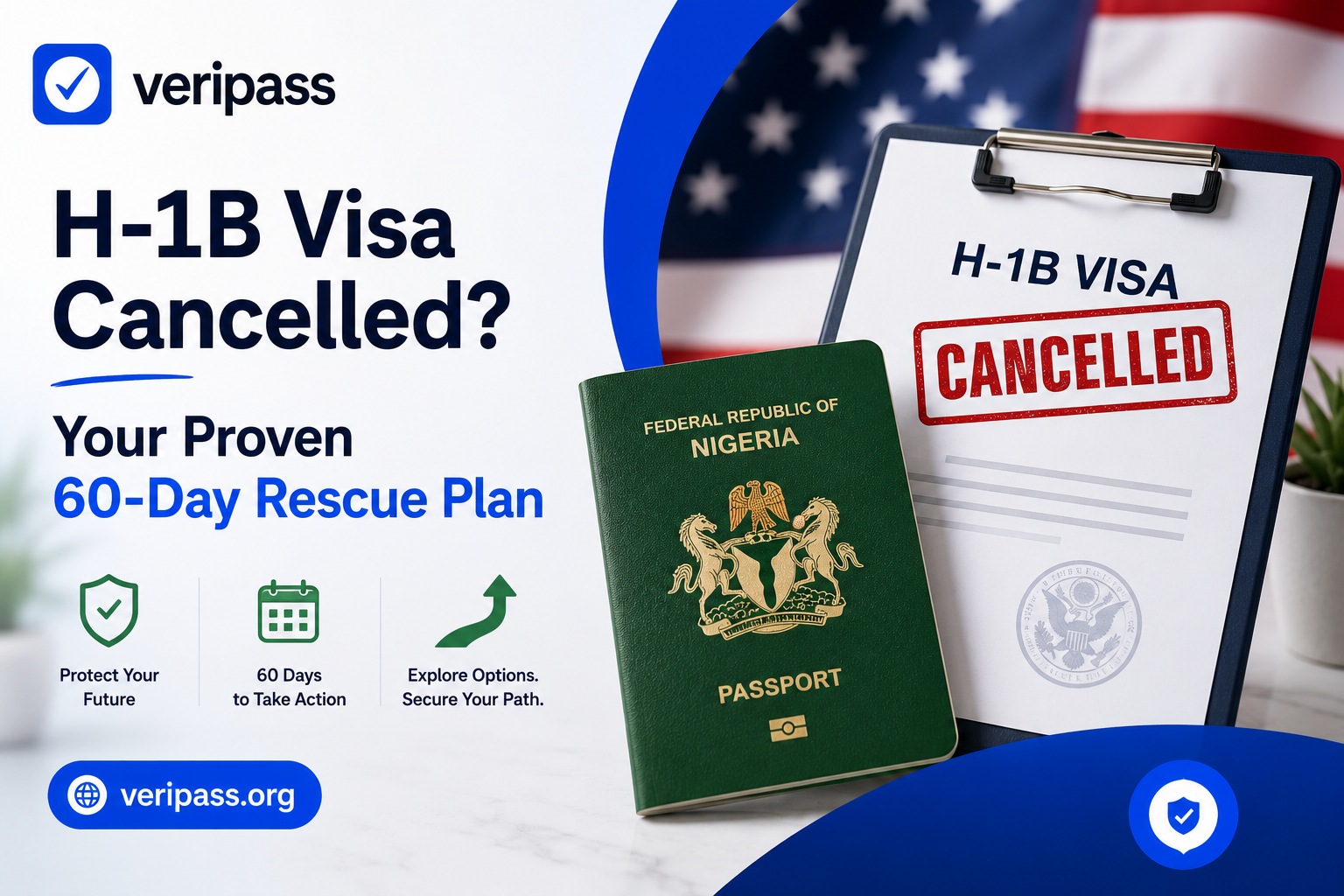
You read the words “H-1B visa cancelled” just before seven on a Tuesday morning, in an email nobody warned you about, and by the second paragraph, your work laptop has already locked you out. No phone call. No explanation. Your salary stops that day, your spouse’s work permit dies with yours, your children are three weeks into a school year in a country that has quietly started counting down the days until your family has to go. An H-1B visa cancelled this way never announces itself. It starts a clock you cannot see.
Here is the part that will make you angry. Your employer had to tell the government your job ended. Nothing in federal law required them to tell you. So the countdown had already been running for days before that email landed in your inbox.
Now the good news, and it is real. You are not out of options, and you are not out of time yet. People walk out of this exact week with their status intact, their family settled, and a green card case still moving. The ones who do share one thing. They act within the first 72 hours rather than waiting for someone to call them back.
This guide gives you that plan. What to check today, what your employer still owes you and hopes you never ask for, what happens to your spouse and children, what happens to the green card you have been waiting years for, and the one move that takes your status out of an employer’s hands for good.
See Also: Chen Immigration Free Evaluation: Your Smartest First Move
H-1B visa cancelled means four different things
Four situations share the same phrase, and they carry very different consequences. Work out which one is yours before you do anything else.
- Your petition was revoked or withdrawn. USCIS approved your employer’s Form I-129 because a specific job existed. When the job ends, the legal basis for your stay ends with it. Most people searching this phrase are in this situation.
- Your visa stamp was revoked. That is the sticker in your passport, issued by the State Department. It controls entry into the country, nothing more. A consular officer or the Secretary of State can revoke it at any time as a matter of discretion under 22 CFR 41.122.
- Your visa was cancelled without prejudice. You will see “CWOP” written across the stamp. This is usually routine paperwork, such as when a new visa is issued, or you move from one category to another. It is not a penalty.
- Your interview appointment was cancelled or rescheduled. This is a scheduling delay at a consular post, not a decision on your case.
Number one starts a countdown. Number two blocks you from re-entering, though it does not by itself end your status while you are inside the United States. Number three is often nothing at all. Number four costs you time and no more than that.
The scale here is worth sitting with. On August 10, 2026, the State Department announced it had revoked more than 175,000 visas, citing continuous vetting operations. In 2025 alone, the figure passed 100,000, including roughly 2,500 specialized worker visas. Continuous vetting means your record does not stop being reviewed after your visa is issued.
Find out what actually happened before you make a single move
Guessing costs you days you cannot spare. Spend the first hours confirming facts.
- Pull your I-94 at i94.cbp.dhs.gov. Your “Admit Until Date” caps everything that follows. If it falls in 25 days, you have 25 days, not 60.
- Check your petition at egov.uscis.gov using the receipt number on your I-797 approval notice. A withdrawal or revocation shows up here.
- Check your visa stamp through the CEAC visa status tool.
- Write to HR. Ask for your termination letter stating your exact last day of active employment, and ask them to confirm the date they notified USCIS. Put it in writing and keep the reply. That single date decides several things later.
- Save everything now. Pay stubs, approval notices, the Labor Condition Application, your offer letter, and any correspondence. Once your company laptop and email are switched off, this becomes very hard to rebuild.
The 60-day grace period is not a promise
Almost every article you will read treats the 60 days as a guarantee. It is not.
The rule sits at 8 CFR 214.1(l)(2). It allows workers in H-1B, L-1, O-1, E-1, E-2, E-3, H-1B1, and TN status, along with their dependents, to be treated as having maintained status for up to 60 consecutive days after employment ends, or until their authorized stay expires, whichever comes first. It is available once during each authorized validity period.
Read the wording again. The regulation says the period is discretionary, and that DHS may shorten or eliminate it.
Five things people get wrong about it.
- The clock starts on your last day of active work, not when severance or unused leave finishes paying out.
- It never runs past the date on your I-94.
- It ends immediately if you leave the country, and you cannot re-enter on the old petition.
- It gives you authorized stay, not permission to work. Any work during this window, including unpaid or freelance work, breaks status.
- It is not automatic. USCIS decides, usually when adjudicating whatever you file next.
There is also a live risk that most coverage has not caught up with. Following a USCIS policy memo issued in February 2025 that removed blanket exemptions from enforcement referrals, immigration attorneys began reporting from mid-2025 that some H-1B workers were receiving Notices to Appear while still inside their grace period, in some cases while a new petition was already pending. A Notice to Appear starts removal proceedings.
And on August 6, 2026, DHS sent a proposed rule titled “Eliminating the Discretionary 60-day Grace Period” (RIN 1615-AD22) to the White House Office of Information and Regulatory Affairs for review. The full text has not been published, and nothing has changed yet. The current rule still stands. If it is finalized in the form the title suggests, a layoff would mean losing status on the day the job ends.
Plan around 30 days. Treat anything past that as luck.
What your employer owes you, and what it costs them to skip it
Your employer cannot simply stop paying you and walk away. Department of Labor rules and case law recognize a three-part test for a bona fide termination.
- They must expressly end the employment relationship.
- They must notify USCIS so the agency can revoke the approved petition under 8 CFR 214.2(h)(11).
- If they let you go before your petition expires, they must offer the reasonable cost of return transportation to your last place of foreign residence, under INA 214(c)(5)(A) and 8 CFR 214.2(h)(4)(iii)(E). In practice, that means a one-way economy ticket.
Where this matters to you is step two. If a company terminates you and delays notifying USCIS, the termination is not bona fide, and the wage obligation under the Labor Condition Application can continue to run until the date they actually notify. Workers rarely know this, so they rarely ask.
Two limits worth knowing. If you resign, no return transportation is owed. Even when it is owed, it covers you and not your family or your household goods.
Your spouse and children lose status on the same day you do
H-4 status is derivative. It exists because your H-1B exists. When yours ends, theirs ends with it, and an H-4 employment authorization document stops being valid at the same moment.
That means a second income can disappear in the same week as the first. It also touches driver’s license renewals, which many states tie to immigration status, and it lands mid-school-year for children who did not see any of this coming.
If your spouse is working on an H-4 EAD, they need to stop on the same date you do. Continuing to work after that point creates a separate problem that is harder to fix than the original one.
What happens to the green card case you have been building
This is the part people panic about most, and the news is better than they expect.
Your priority date usually survives. If your I-140 was approved and has been approved for at least 180 days, the priority date generally stays with you even after your employer withdraws the petition. Years of waiting are not erased by a layoff.
A pending I-485 may be portable. If your adjustment application has been pending for 180 days or more and your priority date is current, you may be able to move it to a same or similar occupation under AC21.
There is a fallback work permit almost nobody uses. The compelling circumstances EAD, category (c)(35), gives up to one year of work authorization. To qualify, you must be the principal beneficiary of an approved I-140 in EB-1, EB-2 or EB-3, be in valid E-3, H-1B, H-1B1, O-1, or L-1 status or an authorized grace period when you file Form I-765, have no I-485 filed, have a priority date that is not yet current, have no disqualifying criminal record, and satisfy USCIS that compelling circumstances exist. Note the trade-off. It places you in authorized stay, and you are no longer in H-1B status once you start working on it.
Your options, ranked by how fast they move
- A new H-1B petition using portability. You can begin work as soon as a new employer properly files a non-frivolous petition. You do not wait for approval. Remember that the Labor Condition Application alone takes about seven working days, so build the schedule backward from your deadline.
- Premium processing on that petition, to compress the adjudication.
- A cap-exempt employer such as a university, a nonprofit affiliated with one, or a research organization. No lottery, and filings run year-round.
- A change of status on Form I-539. Filing to B-2 while you look for work has become significantly harder in 2026, with officers examining intent closely. Job hunting should not be the stated purpose of a visitor filing.
- The compelling circumstances EAD, if you meet the conditions above.
- Departure and re-entry once a new petition is approved.
Each of these needs documents, signatures, and money moving quickly. None of them pauses the clock while you organize yourself.
The pattern underneath all of this
Look again at that list. Every option depends on another party deciding to act for you.
That is the real problem, and the layoff is only where it becomes visible. Your H-1B does not belong to you. It belongs to your employer. The company that hires you also holds the switch on your family’s right to live in the country, and they can flip it with a single notification you never see.
For founders, this is stranger still. You can build a company, hire Americans, pay taxes for years, and hold your own status through an entity you control while a single filing decision unwinds it.
Two categories move that control back toward you.
The O-1A is for people with a record of extraordinary ability in the sciences, business, education or athletics. It still needs a petitioner, though an agent can file for you and cover several engagements rather than one job description. It rests on what you have done, not on one employer’s headcount plan. It sits on the same 60-day list, so the same caution applies.
The EB-2 National Interest Waiver goes further. It is a green card petition you file for yourself. USCIS can waive the job offer and labor certification requirements when your work serves the national interest, meaning you file Form I-140 on your own behalf, with no employer involved at any point. You qualify through an advanced degree or exceptional ability, then satisfy the three-part Dhanasar test on the merit and national importance of your work.
No employer to notify USCIS. No withdrawal to be blindsided by. The petition is yours.
Where Veripass fits
Most people reach these categories in the worst possible week, three days into a countdown, reading regulations for the first time while trying to hold a family together. That is the wrong time to start.
Veripass exists to move that work earlier. We assess your profile honestly against the O-1A, EB-1A, and EB-2 NIW standards and tell you plainly where you fall short, rather than selling you a filing you are not ready for. Where the profile is close, we map the gap and the evidence that closes it, which for most founders and executives means recommendation letters from the right people, documented results, media and industry recognition, and a clear articulation of what your work contributes. Then we build the petition around that record and guide the filing.
If your status is already unstable, we work the immediate options alongside the longer-term petition, so you are not choosing between surviving this month and fixing the underlying problem.
Do the next thing today
If your petition has been revoked, start with your I-94 and your termination letter. If your status is stable and you simply do not want to be in this position later, start with your profile.
We are running a live session on Saturday, August 29 covering the self-petition pathways that take your status out of an employer’s hands. Register here.
Bring your questions. Come with your CV.
Has the H-1B visa been cancelled?
No. The H-1B program is still running. Congress sets the annual cap at 65,000 visas plus 20,000 reserved for holders of U.S. master’s degrees, and that has not changed. What people are reacting to is a run of policy activity around the program, along with individual petitions being revoked or withdrawn one at a time. Those two things get reported in similar language, which is where the confusion starts. Your own petition can end while the program itself carries on without you.
Is the H-1B visa getting revoked?
Individual petitions are, and always have been. USCIS can revoke an approved petition when the job ends, when the employer closes or downsizes, when the facts on the filing no longer match reality, or when the employer withdraws it. The most common trigger by a wide margin is a layoff, because federal rules require your employer to notify USCIS when your employment ends. Separately, the State Department can revoke the visa stamp in your passport at any time as a matter of discretion under 22 CFR 41.122, which stops you from re-entering the country, though it does not by itself end your status inside it. What has changed is the volume. On August 10, 2026, the State Department reported revoking more than 175,000 visas across all categories, up from more than 100,000 during 2025, and it attributed the increase to continuous vetting.
What is the latest news on H-1B visas?
Five developments matter as of August 2026.
1. The $100,000 fee on certain new petitions is currently blocked. A Massachusetts federal court vacated it on June 8, 2026, as an unlawful tax, and on July 24, 2026, the First Circuit refused to pause that ruling while the government appeals. USCIS cannot assess the fee right now, though the appeal continues and the outcome may change.
2. The random lottery is gone. A DHS final rule effective February 27, 2026, replaced it with wage-weighted selection, giving a registration up to four entries depending on its Department of Labor wage level. It applied to the FY 2027 season and continues going forward.
3. DHS sent a proposed rule to the White House on August 6, 2026, titled “Eliminating the Discretionary 60-day Grace Period.” The text has not been published, and nothing has changed yet.
4. Enforcement referrals have widened. Following a February 2025 USCIS policy memo, attorneys have reported H-1B workers receiving Notices to Appear while still inside their grace period.
5. Consular vetting now extends to applicants’ online presence, and posts have cancelled and rescheduled interview appointments to match the slower pace that review creates.
Is ICE arresting H-1B visa holders?
Holding valid H-1B status does not put you on a target list, and the great majority of H-1B workers go about their lives without any contact with ICE. That said, enforcement in 2026 has reached people who previously felt out of range. Reporting through July and August 2026 describes arrests at more than a dozen U.S. airports, including people waiting on visa extensions and people with pending green card cases, following a data-sharing agreement between TSA and ICE. The National Immigration Law Center issued a community alert on July 29, 2026, warning that airport travel carries risk even for people with active or pending status.
The pattern in these reports is a gap between what the record shows and what the traveler believes. An expired visa stamp with valid underlying status, a pending extension, a lapse after a layoff, or an old law enforcement contact can each prompt questions. Two practical steps follow from that. Carry your passport, I-797 approval notice, most recent I-94, and a recent pay stub when you travel domestically, and speak to an immigration attorney before booking if your status is in any way unsettled.
This article is general information and not legal advice. Immigration outcomes turn on individual facts and on rules that are changing quickly. Confirm anything time-sensitive against the official USCIS and State Department sources linked above before you act.