Picture years of late nights, product launches, and hard-won results shrinking into a paragraph an officer skims past. That is what a weak immigration letter of support does to a strong career. It takes your best work and makes it sound ordinary.
Officers who review O-1 and EB-2 NIW petitions, UK Global Talent endorsements, Canada C10 work permits, and Australia’s National Innovation visa read hundreds of letters. They recognize a copied template quickly and give it little weight. A well-built immigration letter of support does the opposite. It puts a credible outside voice behind your achievements and makes your case hard to ignore.
This guide shows you what each route asks for, who should write your letters, how to get them when your writers live abroad, and what a strong letter says. You will also get a complete sample you can model.
Read Also: EB2 NIW Recommendation Letter Sample pdf: 7 Strong Examples
What an immigration letter of support is (and what it is not)
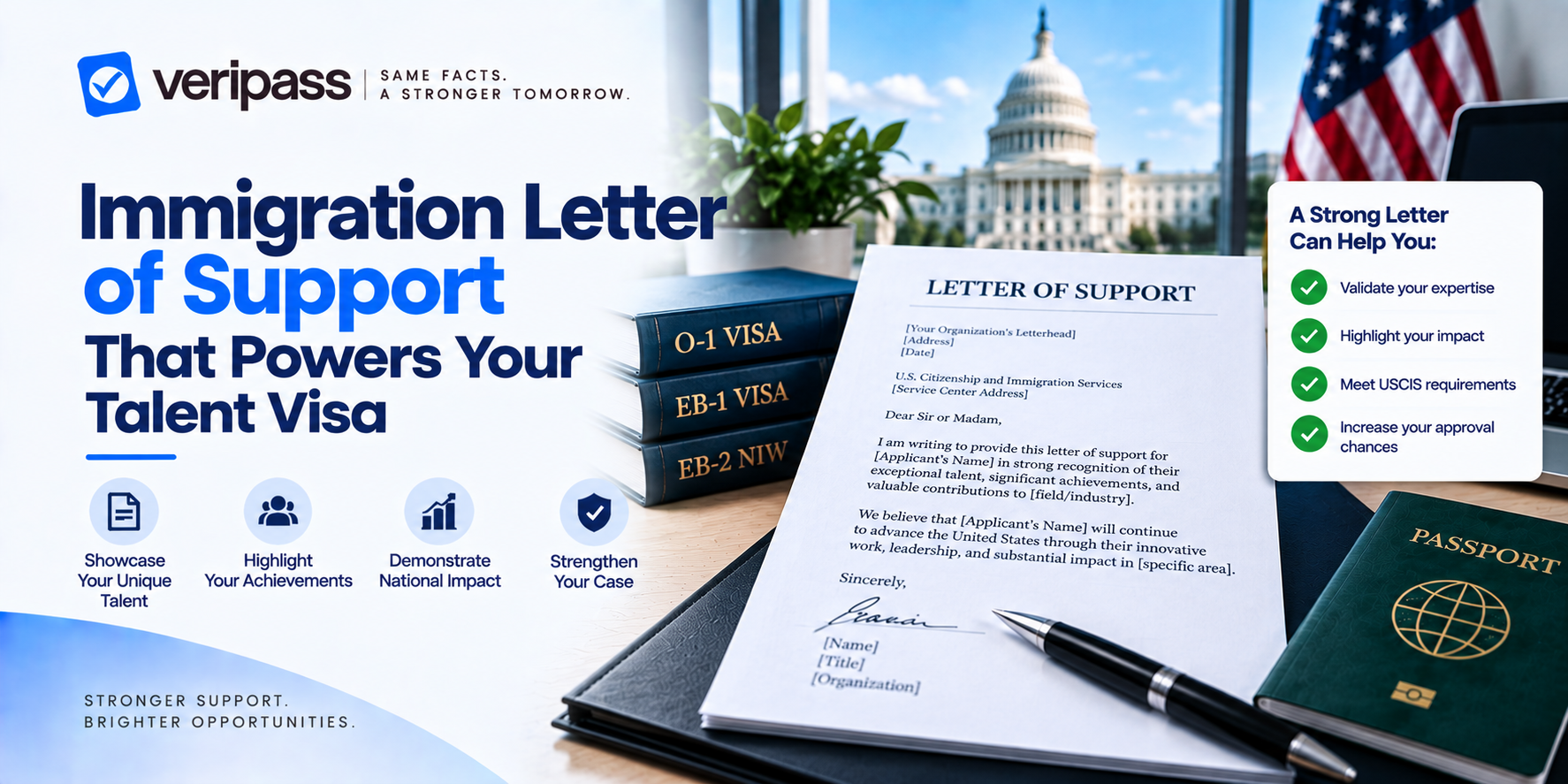
An immigration letter of support is a signed letter from someone who knows your work, addressed to the officer or body deciding your case. It confirms facts about you, explains your impact in plain terms, and gives the decision-maker a credible outside voice.
People often confuse it with documents that sound similar. Asking the wrong person for the wrong document can cost you weeks, so check this table first.
| Document | What it does | Who signs it | Where it applies |
|---|---|---|---|
| Letter of support or recommendation letter | Explains your achievements and impact | Experts, clients, investors, collaborators | O-1, EB-2 NIW, UK Global Talent, Canada C10 |
| O-1 advisory opinion (consultation letter) | Gives a formal opinion on your qualifications for the O-1 | A US peer group, labor organization or expert in your field | O-1 only |
| Employment or experience letter | Confirms your role, dates, and duties | Current or former employer | All routes, especially EB-2 and Canada GTS |
| Form 1000 nomination | Formally nominates you and attests to your record | An Australian citizen, permanent resident, eligible New Zealand citizen or Australian organization with a national reputation in your field | Australia NIV only |
| Affidavit of support (Form I-864) | Promises financial support for a family-based immigrant | A US sponsor | Family green cards, not talent routes |
| Invitation letter | Invites you to an event or meeting | Your host | Visitor visas |
This article covers the bigger decisions around your letters. For a closer look at letter content, read our immigration recommendation letter guide.

What each visa route asks for
Each route treats letters differently. Some make them mandatory, and others treat them as supporting evidence. Here is what the official guidance says.
| Route | What you need | Official source |
|---|---|---|
| US O-1 | A written advisory opinion from a peer group, labor organization, or expert in your field, plus letters that support your evidence | USCIS O-1 |
| US EB-2 NIW | Expert letters that support the three national interest waiver tests, plus employer letters to prove your experience | USCIS Policy Manual, EB-2 |
| UK Global Talent (digital technology) | Three letters of recommendation written for this application, each with different examples, with the author’s contact details and CV | GOV.UK endorsement documents |
| Canada C10 (significant benefit work permit) | Detailed evidence of how your work benefits Canada, such as an employment letter that explains the benefit | IRCC C10 guidelines |
| Canada Global Talent Stream | Your employer leads the application, and Category A needs a referral from a designated partner. Your experience letters prove you meet the job requirements | ESDC GTS requirements |
| Australia National Innovation visa (subclass 858) | A completed Form 1000 from a nominator with a national reputation in your field | Home Affairs NIV page and Form 1000 |
Three points matter most.
- The O-1 advisory opinion is a separate document from your recommendation letters. USCIS keeps an address index of organizations that have agreed to provide one.
- For EB-2 NIW, letters support your evidence and do not replace it. USCIS notes that records created at the time of your achievements may carry more weight than letters written for the petition.
- For Canada C10, IRCC states that copying its own wording is not enough. Your employer letter must explain the specific benefit your work brings.
Who should write your letters?
The best writer is someone the officer will believe and who knows your work first-hand. A senior title with a vague letter helps you less than a respected expert with specific facts.
Aim for a mix of these three groups.
- Independent experts. These people know your work through its reputation. They adopted your product, cited your research, or judged a competition you entered. Their letters are hard to dismiss because they have no stake in your success.
- Direct collaborators. Co-founders, managers, investors, and clients saw your contribution up close and can give numbers and dates.
- Institutions. Accelerators, industry associations, universities, and government agencies that selected, funded, or partnered with you add weight from outside your circle.
Family and friends rarely help on talent routes, because their letters read as loyalty, not evidence. If you are a founder, include at least one or two writers from outside your company and its investors so the officer sees your impact from more than one angle.
How to ask for letters and get them back on time
Most delays come from the request, not the writing. Busy people agree to help and then forget, so make it easy for them.
- Start early. Give each writer four to six weeks. Senior people travel, and their teams approve documents slowly.
- Send a short brief. Explain how the writer knows you, the two or three achievements you want them to cover, and the numbers behind each one. Give each writer different achievements so your letters do not repeat each other.
- Ask for their CV or bio. UK digital technology applicants must include one, and it helps every other route show the writer is credible.
- Agree on the format. Ask for company letterhead, a date, a signature, a work email and a phone number.
- Review the draft together. Check every date and figure against your evidence. The writer must agree with every sentence, because an officer can contact them.
- Set a deadline and follow up. A polite reminder a week before the deadline saves you a month later.
If your writers live in another country
Many founders and executives have writers spread across Africa, Europe and North America. Distance is manageable when you plan for it.
- Ask the writer to sign on letterhead and send a clear scanned PDF. Keep track of the original, since the UK Home Office guidance allows endorsing bodies to request originals by post.
- Make the writer easy to verify with an official work email, a company website, and a professional profile link.
- If a letter is not in English, include a full certified English translation. USCIS sets this rule in 8 CFR 103.2(b)(3).
- Ask writers to date their letters close to your filing date so nothing looks stale.

What a strong letter says
A strong immigration letter of support answers four questions. Who is the writer, and why should the officer trust them? How do they know your work? What exactly did you do? Why does that work matter to the country you want to move to?
Compare two lines about the same founder.
| Weak | Strong |
|---|---|
| Amaka is a visionary leader who has transformed fintech in Africa. | Amaka’s fraud-detection system went live on our platform in March 2023. Within six months, our quarterly fraud losses fell by 38%. |
The strong version gives a date, a product, and a result the officer can check against your other evidence.
Sample letter for an EB-2 NIW petition
This sample comes from an independent expert. All names, companies, and figures are fictional. Use it as a structural model, and let your writers use their own words.
[Company letterhead]
September 14, 2026
U.S. Citizenship and Immigration Services
Letter of support for Amaka Obi, EB-2 National Interest Waiver petition
- My name is Daniel Mensah. I am Head of Payments Infrastructure at Solvi Pay, a mobile payments company with 3 million users in Ghana and Kenya. I have worked in payments security for 14 years. My CV is attached.
- I have never worked with or for Ms. Obi. I know her work because my team tested five fraud-detection tools in 2023 and chose the one built by her company, Fenra Labs.
- Fenra’s system flags suspicious transactions as they happen. Within six months of adopting it, our quarterly fraud losses fell by 38%, from about $410,000 to about $254,000. I reviewed these figures myself.
- Ms. Obi presented the model behind this system at a regional payments conference in 2024. Two other payment providers I know of have since adopted it.
- Ms. Obi now plans to build fraud-prevention tools for US community banks. Many of these banks cannot afford large fraud systems, and her tools cost a fraction of that price. Her results at Solvi Pay show she can deliver this work.
- I am happy to answer any questions about this letter.
[Signature]
Daniel Mensah, Head of Payments Infrastructure, Solvi Pay
daniel.mensah@solvipay.example | +233 00 000 0000
Notice what the writer does. He explains why he is qualified, says how he knows the applicant, gives checkable numbers, and connects the work to a US need. Numbered paragraphs also make it easy for an officer to point to a specific claim.
Mistakes that get letters ignored
- Praise without proof. Words like “brilliant” and “visionary” tell the officer nothing. Dates, numbers, and named results do.
- Identical letters. When three writers use the same sentences, the officer assumes you wrote them all. UK digital technology guidance requires each letter to give different examples.
- Recycled letters. A reference written for a job or an earlier visa rarely fits. UK guidance says your letters must be about your Global Talent application.
- Writers nobody can reach. A missing phone number or an inactive email makes a letter hard to trust.
- Claims the writer cannot explain. If an officer calls and the writer cannot explain a figure in their own letter, your whole file suffers.
- Letters with no backup. Every claim in a letter needs a matching document, such as a contract, a citation, a media article, or usage data.
- The wrong document. Sending a recommendation letter where the O-1 needs an advisory opinion, or a reference letter where Australia needs Form 1000, can stall your case.
How this plays out for a founder
Picture Amaka, a fintech founder in Lagos preparing an EB-2 NIW petition. She has strong results and 12 people willing to write for her. Ten of them work at her company or at firms that invested in it. Her first drafts all call her “a visionary leader,” and none of them mention the fraud numbers that make her case.
With a clear plan, she cuts the list to five writers. Two are independent experts who adopted her product, one is an investor, one is a former manager who confirms her experience, and one is a university researcher who tested her model. Each writer gets a brief with different achievements to cover, and every figure in every letter matches a document in her file.
That plan is what Veripass builds with you.

How Veripass helps you get letters that carry weight
Veripass works with founders, executives, and skilled professionals preparing talent-based visa cases for the US, UK, Canada, and Australia. The team supports you from the first call through filing, so you always know what comes next.
Here is how Veripass helps with your letters.
- Route fit. Veripass matches your evidence to the criteria of your chosen route, so every letter has a clear job.
- Writer selection. You get help choosing the right mix of writers and spotting gaps before an officer does.
- Writer briefs. Each writer receives a brief with different achievements and verified figures, so your letters never repeat each other.
- Draft review. Veripass checks every draft for vague praise, repeated content, and missing contact details.
- Evidence building. Veripass builds the rest of your case with you, including publishing articles under your name to show your expertise.
Get the right letters before you ask anyone
Your letters should prove what your evidence already shows. If you are unsure who should write them or what they should cover, talk to Veripass before you send a single request.
Book your free 30-minute discovery call and leave with a clear plan for your immigration letter of support and the rest of your case.
How do I write a support letter for immigration?
First, confirm what the letter must prove and who will read it. Then follow this structure.
1. Introduce yourself with your full name, role, organization, and contact details.
2. Explain how you know the applicant and for how long.
3. Give two or three specific examples with dates, places, and results.
4. Explain why the applicant’s work matters for the case.
5. Sign and date the letter, and attach your CV if the route asks for it.
Keep it to one or two pages and include only what you can confirm yourself.
What is an example of a good character letter for immigration?
A good character letter shows the person through real actions instead of labels. A weak letter says, “John is honest and hardworking.” A strong letter says, “I have supervised John at our Houston warehouse since June 2021. When a supplier overpaid us by $3,000 in 2023, he reported it the same day.” The strong version names the writer’s role, gives dates, and describes something the officer can picture. On talent routes, officers focus on professional impact, so keep character letters for cases that ask for them.
How do I write an immigration letter of support for a family member?
State your full name, your immigration status, and your relationship to the applicant. Describe the role they play in your family with specific examples, such as caring for children or supporting parents. Stay factual and avoid exaggeration. Officers expect family members to be supportive, so pair your letter with letters from employers or community members who confirm the same qualities. For O-1, EB-2 NIW, UK Global Talent, Canada C10, and Australia NIV cases, a family letter adds little because these routes assess professional achievement.
How do I write a letter to immigration about a friend?
Explain who you are, how you met your friend, and how long and how often you have been in contact. Describe specific things you have seen them do at work, in the community, or as a volunteer. Write only what you know first-hand, and include your phone number and email so the officer can reach you. Sign and date the letter. Like a family letter, a friend’s letter carries limited weight on talent routes, so use it only where your case calls for personal references.
This article is for general information only and is not legal advice. Check official sources and speak with a licensed adviser before you file.