
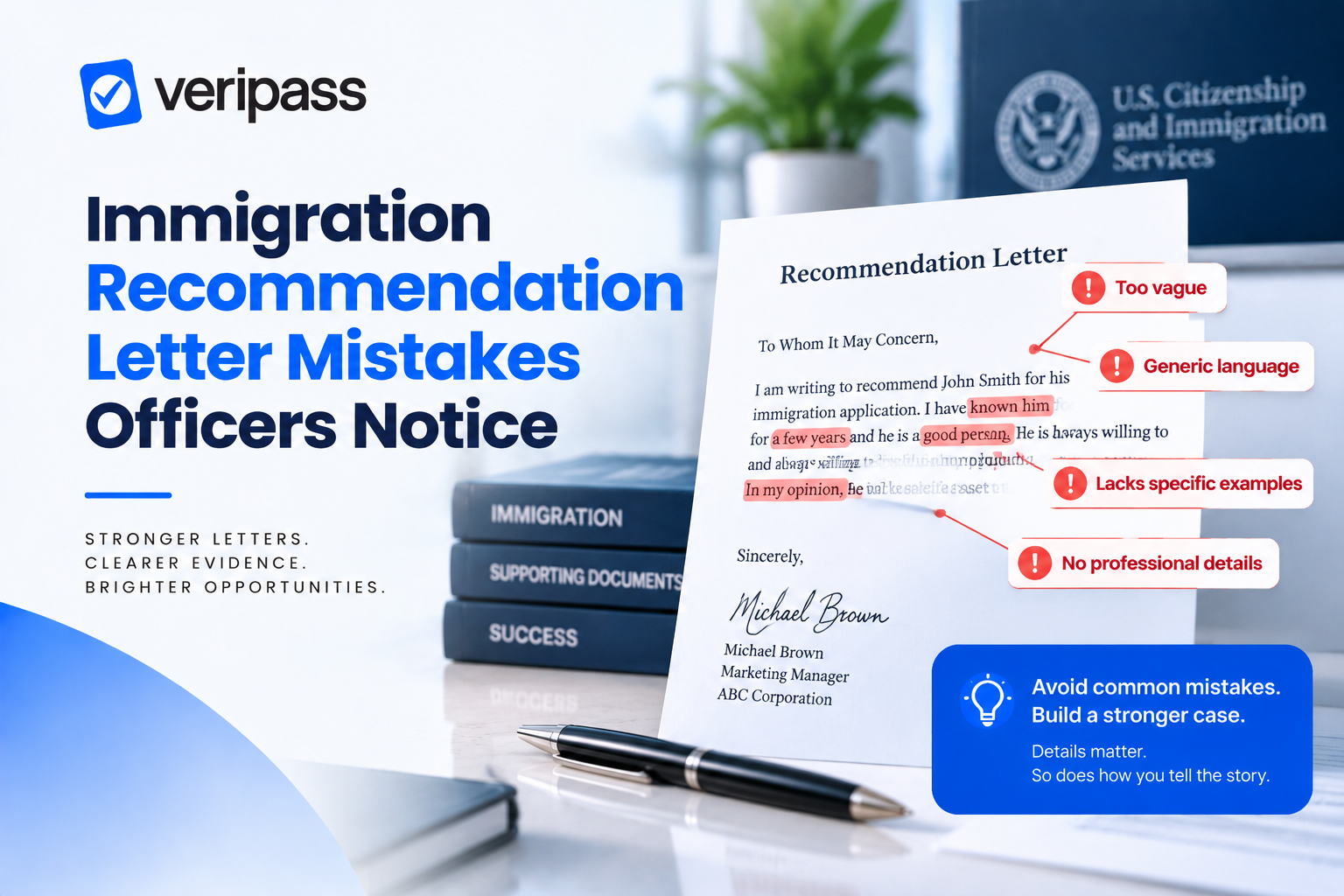
Your immigration recommendation letter can be the most flattering thing anyone has ever written about you and still count for nothing. Picture the moment. A senior figure in your field spent an hour praising your work, signed it, and sent it over. Months later the decision comes back against you, and nowhere in the reasoning does that immigration recommendation letter appear at all. It was read. It just did not count.
Here is why. You and the officer are doing two different jobs. You are collecting proof that serious people respect you. The officer is checking a legal box, and praise does not fit inside it.
Get this right and the same writers, the same career, and the same achievements produce a file an officer can act on. Here is what officers in five systems actually do with the letters you send, and how to give them something they can use.
See Also: Immigration Reference Letter: Proof Officers Love to See
What an officer does with your immigration recommendation letter
USCIS wrote this down for its own staff. In the Policy Manual chapter on extraordinary ability, the agency tells officers that letters of support carry some weight. However, they should not be the cornerstone of a claim, and witnesses’ statements should be backed by documents already in the record.
The same chapter goes further. Letters that simply repeat the agency’s own definitions, or make broad, expansive statements about you and your accomplishments, are generally not persuasive.
Read that twice, because it kills most letters people file. The sentence “Dr. Okafor has risen to the very top of her field and enjoys sustained international acclaim” is the regulation talking, not your recommender. An officer has read that line a thousand times.
There is one more rule worth knowing. The officer weighs the relationship between you and the writer, on the reasoning that someone with real acclaim would be recognized well beyond their own circle of personal and professional acquaintances. Five letters from your own leadership team tell an officer about your workplace, not about your field.
USCIS also runs a two-step review. First, it checks which pieces of evidence objectively meet the regulatory criteria. Then it looks at everything together to decide if you sit in that small group at the top of your field. Your letters work in both steps, and they work differently in each.
You can read the source yourself at the USCIS Policy Manual, Volume 6, Part F, Chapter 2.

Your pathway decides what the letter has to prove
This is where nearly every guide online goes wrong. It treats “recommendation letter” as one thing. It is five different instruments.
| Pathway | What your letters do | Who should write them |
|---|---|---|
| US O-1A | Support specific regulatory criteria. Separate from the required advisory opinion | Mix of people who worked with you and independent experts in your field |
| US EB-2 NIW | Explain your proposed work, its national importance, and why you are positioned to deliver it | Experts who can speak to the field, plus people who funded or adopted your work |
| UK Global Talent | Mandatory. Exactly three, each doing part of the endorsement argument | Senior figures at different established organizations, each writing fresh |
| Canada C10 | Back an employer’s case that your work brings measurable benefit to Canada | Industry bodies, clients, and partners who can quantify the benefit |
| Australia NIV | Support a formal nomination, which is the real gate | An Australian citizen, resident, or organization with national standing in your field |
A few details that change how you prepare.
For the O-1, the peer group advisory opinion under 8 CFR 214.2(o)(5) is not a recommendation letter. It comes from a peer group, labor organization, or expert body, and it answers a different question. Confusing the two costs applicants weeks.
For the UK Global Talent visa, the letters are compulsory rather than optional. In the arts and culture route, two must come from established organizations with expertise in your field, at least one based in the UK, and the third can come from another organization or an expert individual. Each letter must be three sides of A4 or shorter, and must be written for your Global Talent application rather than reused for another purpose. The recommender’s phone number and email address are mandatory. Check the current requirements and the endorsing body for your field on GOV.UK before you ask anyone, since the bodies and criteria have moved in recent years. govImmigram
For Canada, the ground shifted underneath applicants this year. On 24 February 2026, IRCC reorganized its officer instructions for the C10 significant benefit category to spell out more specifically when your work creates social, cultural, or economic benefit for Canadians. Officers now want numbers. The current instructions sit on canada.ca. The Global Talent Stream is a different animal again. It sits inside the Temporary Foreign Worker Program and still runs on an expedited LMIA, so the paperwork is built by your employer, not by your referees. canadaBridgePoint Law
For Australia, letters are not the gate at all. The National Innovation Visa is invitation-only, and the Department must invite you before you can apply. You start with an expression of interest that shows your achievements. You also need a nominator, an Australian individual or organization with a national reputation in your field, submitted on Form 1000. Details are on the Department of Home Affairs site. If you spend three months gathering ten glowing letters and no nominator, you have nothing. Australian Department of Home Affairs Align Law Pty Ltd
The one-sentence test
Take any sentence from a draft letter and ask if it could appear, unchanged, in a letter about someone else in your field. If yes, cut it.
Weak. “Adaora is a visionary product leader whose work has transformed digital payments across Africa and whose reputation in the industry is second to none.”
Strong. “Adaora built the reconciliation engine that my own company licensed in 2023. Before we adopted it, our failed-settlement rate ran at 4.1 percent. Six months after, it was 0.7 percent. I have no financial relationship with her or her employer, and I am telling you this as someone who paid for the product and watched the numbers move.”
The first sentence tells the officer what the applicant’s friends think. The second hands over a fact the officer can check, from someone with no reason to shade it. That second version also does something the first cannot. It matches a specific criterion.
Every claim needs an exhibit sitting behind it
This is the rule that separates approved files from refused ones.
If a letter says your method was adopted across the industry, the file needs the adoption. If a letter says your work drew national attention, the file needs the coverage. If a letter says you led a critical function, the file needs the org chart, the contract, or the board minute.
Work backward. List your exhibits first. Then ask each writer to explain the exhibits they have personal knowledge of. A letter written to match your evidence beats a letter written from memory every time.
Writing an immigration recommendation letter when your referees live abroad
This is the part almost nobody writes about, and it is the part that matters most if your career was built in Lagos, Nairobi, Mumbai, or São Paulo.
- Foreign writers are fine. No system requires your recommenders to be citizens or residents of the destination country. The UK arts route is the exception, since it asks for one UK-based organization.
- Give a reachable phone number with the country code and an email the writer actually checks. An officer who cannot verify a letter has less reason to credit it, and a dead line looks worse than no line.
- Use institutional letterhead and an institutional email address. A senior title on a Gmail address invites doubt about a writer an officer has never heard of.
- Explain the institution in one line inside the letter. An officer in Phoenix does not know which Nigerian bank is tier one, which accelerator is competitive, or which award is real. Your writer should say so plainly.
- Get a certified English translation for anything not in English. USCIS requires a certified translation for any foreign-language document submitted in support of a request. USCIS
- Build in time zones and travel. Six weeks from first ask to signed PDF is realistic. Two weeks is not.
How far you can go in briefing your writer
Here is the honest answer nobody publishes. Almost every expert letter in a serious petition starts from material the applicant supplied, and that is fine. The line sits somewhere specific.
You can send facts, dates, figures, your CV, the relevant exhibits, and a short note on which question the letter should answer. You can tell the writer the format rules and the page limit.
You should not send a finished letter for signature, and you should not send all three or five writers the same outline. That produces a set of letters with the same shape, the same order, and the same phrases.
Assessors catch this. Identical or near-identical structure across letters suggests the applicant wrote them and the referees signed, and it is one of the most common rejection patterns. Tech Nation goes further. Letters it considers duplicates or templates, or that closely match evidence submitted by other applicants, may be treated as unacceptable or fraudulent. getendorsedMedium
The same risk now runs through AI drafting. A model asked the same question by four different writers produces four letters with one voice. Send each writer a different set of facts, ask each to cover a different angle, and let them write in their own words. Uneven letters look human because they are.

If you get a request for more evidence
A letter written after an RFE does a narrower job than the ones you filed. The officer has told you exactly what is missing. Your new letter should answer that one gap, reference the exhibit that supports it, and say nothing else. Deadlines here are short and rarely extended, so identify your writer on the day the notice arrives.
What to do this week
- Write down the specific legal question your letters must answer for your pathway. One sentence.
- List the exhibits you already hold. Match each writer to the exhibits they personally know about.
- Build a mixed set. People who worked with you supply detail. Independent experts supply credibility.
- Send each writer a different brief, and never a finished draft.
- Check every factual claim against your CV, your petition, and your employment records before anyone signs.
- Collect institutional letterhead, direct contact details, signature, and date on each one.
- Cut any letter that repeats another. Four strong letters beat twelve identical ones.
- Verify the current rules on the official government page for your route before you file.
Where Veripass fits
Most people reading this have the achievements already. What they lack is the translation between a career built outside the destination country and the question an officer is trained to answer.
That gap is what Veripass works on. We help founders, executives, and skilled professionals map their record against the specific criteria of the route they are using, spot which claims have no exhibit behind them, identify and approach recommenders who carry weight with the adjudicator, and brief each writer separately so the letters read as independent because they are. We also handle the parts that quietly sink applications from outside the US, including translations, institutional context, and reachable contact details.
We are not a template service. We build the evidence file the letters are supposed to support, then make sure the letters point at it.
If you are preparing an O-1, an EB-2 NIW, a UK Global Talent endorsement, a Canadian work permit, or an Australian nomination, bring us your record before you ask anyone for a letter. The order matters.
Book a free discovery call, and we will tell you what your file is missing while you still have time to fix it.
How do you write a good letter of recommendation for immigration?
Start by saying who you are, what you do, and how you know the applicant. Give the length of time and the setting. Then state clearly that you support the application.
The middle of the letter carries the weight. Write only what you have seen yourself, with dates, numbers, and named events. Skip general praise. USCIS instructs its own officers that letters repeating the agency’s definitions, or making broad statements about how accomplished someone is, are generally not persuasive, and that what a writer says should be backed by documents already in the file.
Close with your full contact details and a line offering to answer questions. Keep it to one or two pages, sign it, and date it. If the letter is not in English, a certified translation must go with it.
One rule applies across every route. If a sentence could sit in a letter about somebody else in the same field, it is doing no work. Cut it and write a fact instead.
What does a good character letter for immigration look like?
Here is the difference in two lines.
Weak. “I have known Chidi for ten years, and he is a kind, hardworking man who would be an asset to any community.”
Strong. “I have known Chidi since 2016, when he joined our parish. He has run the Saturday food program for four of those years, and I have worked beside him at roughly forty of those sessions. When my mother was in hospital in March 2023, he organized meals for my family for two weeks without being asked. I am a US citizen and can be reached at the number below.”
The first tells an officer what a friend thinks. The second gives dates, a role, a count, and a named incident an officer could verify. That is what a character letter is for.
How do you write an immigration letter of recommendation for a friend?
Ask your friend two questions first. What is the application, and what does the letter need to show? A letter written without that answer usually misses.
Then write about what you have personally seen rather than what you have heard about them. Name specific occasions. Include your own immigration status if it is relevant to the case type.
Three things to avoid. Do not draw legal conclusions, such as saying they clearly qualify. Do not claim more than you can back up. Do not let your friend hand you a finished draft to sign. Assessors catch that. Tech Nation, the UK endorsing body for digital technology, has stated that letters it considers duplicates or templates may be treated as unacceptable or fraudulent.
A short letter in your own voice beats a polished one in someone else’s.
Why does immigration ask for a letter of recommendation?
Because the forms only carry facts. Dates, addresses, job titles, filings. They cannot tell an officer how much your work mattered, if a relationship is real, or how you have behaved over years.
A letter fills that gap with testimony from someone who was there. In some routes it is optional support. In others it is compulsory. The UK Global Talent visa requires three letters as part of the endorsement itself, each with the writer’s phone number and email address.
Worth knowing, though. A letter corroborates your case rather than proving it. USCIS tells officers that letters of support carry weight yet should not form the cornerstone of a claim. Treat them as the layer that explains your evidence, not a replacement for it.
This article is general information and is not legal advice. Immigration rules change. Verify current requirements on the official government site for your route, and work with a licensed practitioner for advice on your case.