
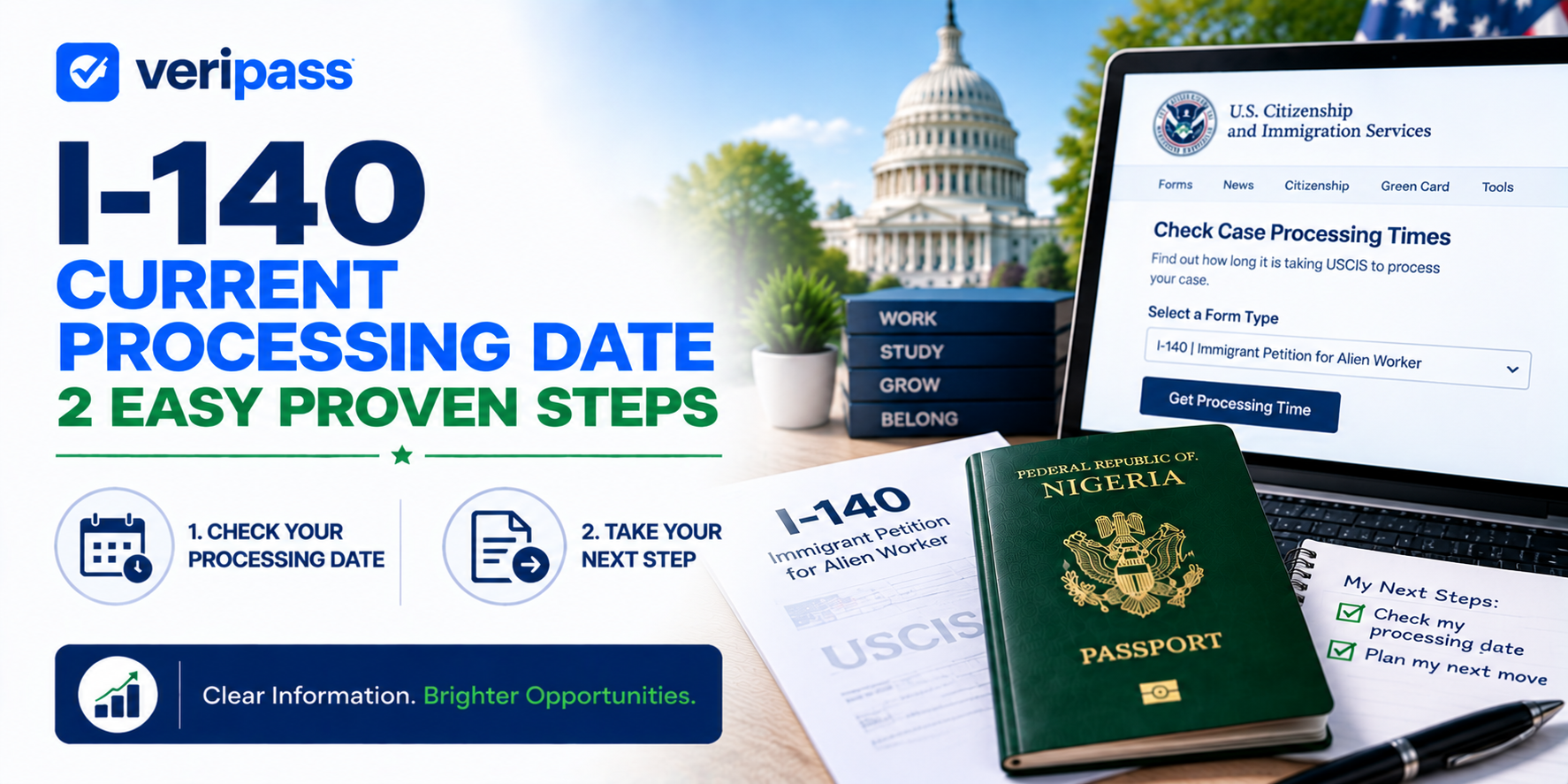
Right now, there is a date sitting on the USCIS website with your name on it, and almost nobody goes looking for it. Your I-140 current processing date is not the wait time everyone quotes back at you. It is the exact day USCIS accepts that your petition has waited too long, and the day a set of free tools opens up to you. Finding your I-140 current processing date takes about two minutes. Most people find it a year late.
Here is how that year disappears. You check the processing times page, see a range like 13 to 16 months, and settle in. Months pass. The status still reads “Case Was Received.” You refresh it on a Tuesday night for no reason. Nothing moves. And the date that would have let you act sat one scroll further down the whole time, in a small gray box almost everyone skips.
Here is where it is, how to read it against your receipt notice, and what to do the day you cross it.
See Also: I766 EAD Card Made Simple for 2026
Two dates, and only one of them helps you
The USCIS processing times tool shows you two numbers, and people confuse them constantly.
The first is the processing time. That range covers how long USCIS took to finish 80% of recent cases like yours. It describes other people’s cases and is a planning tool, nothing more.
The second is the case inquiry date, which some sites call the service request date. That one is yours. It marks the receipt date past which USCIS will accept a formal question about your file. If your receipt date falls before it, you have the agency’s own admission that your case is late, and a set of tools opens up to you.
When people search for their I-140 current processing date, this second number is what they actually want. Nobody needs an average. You need to know if your case is late and what to do about it.
Find your own date in four steps
- Pull out your Form I-797C receipt notice. Find the 13-character receipt number and the receipt date on it. The receipt date is the day USCIS took your petition in, not the day you mailed it, and the gap can run weeks.
- Read the first three letters of the receipt number. LIN means Nebraska, SRC means Texas, IOE means you filed online. That is the office to select.
- Open the USCIS case processing times tool, choose Form I-140, then your exact category. EB-1A sits under E11, EB-1B under E12, EB-1C under E13, EB-2 under E21, and the national interest waiver has its own line.
- Scroll past the blue box showing the range. Under the heading that asks when you can ask about your case, enter your receipt date and press the button. USCIS returns your inquiry date, or a link to file a question right away.
That last step is the one people miss. The blue range at the top is not your answer.
What the numbers look like right now
Two sets of figures matter, and they were published at different times.
The most recent category-level data USCIS published is dated 17 August 2026. These are national figures covering every office at once.
| Category | Published range |
|---|---|
| EB-2 advanced degree or exceptional ability (E21) | 2.5 – 7.5 months |
| EB-3 skilled worker or professional (E31, E32) | 4 – 8.5 months |
| EB-3 other workers (EW3) | 7.5 – 12.5 months |
| EB-1B outstanding professor or researcher (E12) | 15.5 – 19 months |
| Schedule A nurses | 24.5 – 26 months |
| EB-1C multinational executive or manager (E13) | 27 – 29 months |
| EB-2 national interest waiver | 29 – 32 months |
| EB-1A extraordinary ability (E11) | 31 – 34.5 months |
The office-level figures below, which carry the case inquiry dates you actually need, were last published 22 July 2026. Run your own check before acting on either set.
Nebraska Service Center
| Category | Processing time | Case inquiry date |
|---|---|---|
| EB-2 NIW | 13.5 – 15.5 months | 23 Oct 2023 |
| EB-1A (E11) | 13 – 16.5 months | 22 Sep 2023 |
| EB-1B (E12) | 13 – 15.5 months | 25 Oct 2023 |
| EB-1C (E13) | 13 – 14.5 months | 1 Dec 2023 |
| EB-2 PERM (E21) | 7.5 – 8.5 months | 20 May 2024 |
Texas Service Center
| Category | Processing time | Case inquiry date |
|---|---|---|
| EB-2 NIW | 10.5 – 14 months | 5 Dec 2023 |
| EB-1A (E11) | 14.5 – 16 months | 9 Oct 2023 |
| EB-1B (E12) | 11.5 – 14.5 months | 28 Nov 2023 |
| EB-1C (E13) | 9.5 – 12.5 months | 27 Jan 2024 |
| EB-2 PERM (E21) | 8.5 – 10.5 months | 25 Mar 2024 |
Service Center Operations
| Category | Processing time | Case inquiry date |
|---|---|---|
| EB-2 NIW | 24 – 26.5 months | 15 Feb 2024 |
| EB-1A (E11) | 23.5 – 26.5 months | 8 Feb 2024 |
| EB-1B (E12) | 19 – 20.5 months | 3 Aug 2024 |
| EB-1C (E13) | 24 – 25.5 months | 5 Mar 2024 |
| EB-2 PERM (E21) | 3.5 – 7 months | 29 Sep 2025 |
That third block stops most readers cold, because the same categories run nearly twice as long. It has a plain explanation. USCIS is moving away from naming individual service centers on its processing times pages and consolidating them under Service Center Operations, since the agency now shifts casework across several locations depending on staffing and volume. Your receipt notice may still name a specific center even when the tool has moved your category to the consolidated line. If your category appears only under that heading, that line is your line.
Why the published numbers disagree with each other
Search this topic, and you will find EB-1A quoted at 13 months on one site, 26 months on another, and 34.5 months on a third. All three can be accurate at once, which is why the label matters more than the number.
The July figures are office-level, and the August figures are national, so they count different pools of cases, and the ranges moved between publications. A third number circulating this year is neither of these. USCIS decided half of all regular I-140 petitions in about 3.7 months in fiscal year 2026, the fastest median since 2021. That figure is real, and it is a median across every category at once, pulled down hard by PERM-based EB-2 filings that clear in weeks. If you self-petitioned under EB-1A or a national interest waiver, it does not describe your case.
Use your own category, at your own office, on the day you check.
The published number is not your place in line
That range looks backward. USCIS builds it from cases it recently finished, so it describes the queue as it was. It leaves out cases sitting in RFE status, which pulls the figure down. And it covers 80% of cases, so one petition in five falls outside it by design.
What to do, based on where you land
Your receipt date falls after the inquiry date. Your case is inside the normal range. USCIS will not take a question, and pushing will not help. Confirm your address is current in your USCIS account and watch for mail.
You are within a month or two of it. Pull together your receipt notice, a record of any contact with USCIS, and a short account of what has happened. Doing this early turns a two-week scramble into a ten-minute task.
Your receipt date falls before the inquiry date. Your case is late by the agency’s own reckoning, and you have real options.
The escalation ladder
Work these in order. Each step builds a record the next one leans on.
- File an e-Request. Go to the USCIS e-Request page and choose the option for a case outside normal processing time. It is free and takes minutes. The reply is often a form letter saying your case is still under review, and that is fine. What you want is the service request number, because every later step asks what you already tried.
- Call the Contact Center. The number is 800-375-5283. The first-tier agent reads from the same screen you already checked, so ask to be escalated to a Tier 2 officer, who can see notes on your file that you cannot.
- File an expedite request. Almost nobody writing about I-140 delays mentions this, and it costs nothing. USCIS will move a case ahead of others under criteria set out in Volume 1, Part A, Chapter 5 of the Policy Manual. The ones that matter to founders and executives are severe financial loss to a company or person, an urgent humanitarian situation, a US government interest, and clear USCIS error. Severe financial loss is the workable one for most business cases, and it needs documents. A signed contract that collapses without you, a funding round with a closing date, a commercial agreement lost in writing. Needing to work is not enough on its own, and USCIS says so directly. The decision is discretionary and grant rates are low, so treat this as a free attempt rather than a plan.
- Ask your congressional office. If you are in the United States, the representative or senator for your district runs a casework desk that submits inquiries to USCIS on your behalf. You sign a privacy release and they take it from there. Most offices will not touch a case still inside normal processing times, which is why step one comes first.
- File with the CIS Ombudsman. This office sits inside the Department of Homeland Security and operates independently of USCIS. Submit DHS Form 7001 online with your receipt notices, the dates you contacted USCIS, and your service request numbers. The office requires that you try USCIS first, so again, step one matters.
- Talk to a lawyer about mandamus. A mandamus action asks a federal court to order USCIS to decide your case, not to approve it. It costs money and belongs at the end of this list.
Premium processing, and the math nobody runs for you
Premium processing is the one lever with a guarantee behind it. You file Form I-907 with $2,965, a fee set by DHS final rule effective 1 March 2026, on top of the $715 I-140 filing fee. USCIS then commits to acting within 15 business days for EB-1A, EB-1B, EB-2 without a waiver and EB-3, or 45 business days for EB-1C and EB-2 NIW. You can add it to a petition already pending, and the clock starts when USCIS receives the I-907, not when you filed the original petition.
Read the word “acting” carefully. USCIS promises an approval, a denial, a request for evidence, or a notice of intent to deny. If an evidence request comes, the clock stops and restarts only when your response arrives.
Now the part that matters if you were born in Nigeria, Ghana, Kenya, South Africa, or most countries outside India and China.
Nearly every article on this topic is written for the Indian and Chinese backlog, where an approved I-140 waits years for a visa number, which makes paying to go faster pointless. That reasoning does not apply to you. In the September 2026 Visa Bulletin, EB-1 and EB-2 are both Current for All Other Areas, the group that covers Nigeria and most countries.
Current means no queue. The I-140 decision is the only thing standing between you and the final stage. A 16-month wait is not a formality you sit through while a priority date crawls forward. It is 16 months of your life, and $2,965 collapses it into three weeks. That is a different calculation entirely, and almost nobody writes it down.
One caution. The State Department has warned that demand may force EB-2 to retrogress or go unavailable before the fiscal year closes. Current today does not mean current next quarter, which argues for moving sooner rather than later.
The rule that changed everything on 5 August 2026
Everything above deals with a case already filed. This part decides if you ever need any of it.
On 5 August 2026, USCIS issued Policy Alert PA-2026-05 and restored officers’ discretion to deny a petition outright, with no request for evidence and no notice of intent to deny, when the filing leaves out required initial evidence or fails to establish eligibility on its face. The USCIS Policy Manual carries the revised guidance. It took effect immediately and reaches cases already pending on that date, not only new filings.
For years, the request for evidence worked as a safety net. You filed, an officer flagged a gap, and you had up to 12 weeks to fix it. That net is now optional. USCIS has also confirmed that 12 weeks is a ceiling and not a default, so officers may set shorter deadlines.
For a self-petitioned EB-1A or NIW case, this is the largest risk in the process. These petitions turn on argument and evidence rather than a checklist. An officer who concludes your file does not establish extraordinary ability can now close it, and your $715 goes with it.
This reframes the whole question. The fastest I-140 in 2026 is not the one you chase hardest after filing. It is the one that gave the officer no reason to pause.
What this means if you hold an O-1
If you are on an O-1 today, you already cleared a bar close to what EB-1A asks for. The same body of evidence often supports both, though EB-1A is judged against a higher standard and the framing has to change. The strength of the O-1 file you built is the strength you carry into the I-140.
Where Veripass fits
Veripass works with founders, executives, and skilled professionals on the routes where the initial filing decides everything, covering O-1A, O-1B, EB-1A, EB-1B, and EB-2 NIW in the United States, alongside the UK Global Talent visa and Australia’s National Innovation visa.
Veripass is not a law firm. It is an immigration consulting company with in-house lawyers, so the work splits between consultants who develop your profile and lawyers who prepare the petition. Under the August 2026 rule, that split matters more than it used to, because the profile work happens months before anything reaches USCIS.
In practice, Veripass reviews your background against the criteria and clearly states which route fits and which does not. Where a profile has real substance and thin documentation, the team builds recognition and evidence before filing rather than hoping an officer asks for more. Then the legal side prepares a petition meant to be decided once.
Three months spent building the record is the shortest route to a fast I-140, and the only part of this timeline you control.
Book a free discovery call. Bring your CV and your questions. You will leave knowing which route your profile actually supports and what your file is missing.
How long will I-140 premium processing take in 2026?
15 business days for EB-1A, EB-1B, EB-2 without a waiver and EB-3. 45 business days for EB-1C and EB-2 NIW. You file Form I-907 with $2,965 on top of the $715 base fee, and the clock starts when USCIS receives the I-907. A request for evidence stops it and restarts it from zero, which is why the premium median ran near 1.2 months this year.
Why is I-140 processing taking so long?
Category explains most of it. PERM-based cases arrive with the Department of Labor having already checked the job, so the officer has less to decide. Self-petitioned EB-1A and NIW cases arrive with nothing pre-checked, and that review takes far longer. Your office matters too, and a request for evidence freezes the case until you respond. Check your case inquiry date before assuming something is wrong.
What is the current USCIS processing time?
There is no single number. USCIS data dated 17 August 2026 runs from 2.5 to 7.5 months for a standard EB-2 petition up to 31 to 34.5 months for EB-1A, with NIW at 29 to 32 months and EB-1C at 27 to 29. Those are national figures, and office-level ranges differ again. Check your own category at your own office.
Is USCIS processing faster in 2026?
For some people. The regular I-140 median fell to about 3.7 months, the fastest since 2021. That gain sits in the PERM-based categories. The self-petitioned routes went the other way, with EB-1A and NIW both published above 29 months in August, and premium processing slowed from 0.7 to roughly 1.2 months. The average improved while the routes most founders use got slower.
This article covers published government processing data and policy as of September 2026 and is not legal advice. Processing times and policies change monthly. Check the USCIS processing times tool for figures current to your filing date.