
Imagine giving a company six years of your best work, then hearing on the news that your green card has frozen overnight. That is what workers at eight major employers faced on October 8, 2026, when the US government announced the PERM suspension. Most of them did nothing wrong. Their employers came under federal investigation, their cases stopped with them, and no one can tell them when it will end.
If you work for one of these companies, you need to know where your case stands today. If you plan to move to the United States, the UK, Canada, or Australia, the PERM suspension teaches a harder lesson. When your visa rests on someone else’s paperwork, someone else controls your future. A route built on your own record puts that control back in your hands.
This guide shows you where you stand, what to do next, and the routes that don’t use PERM at all.
Read Also: EB-4 Visa Suspension: What Indians should Do now
What Is the PERM Suspension?
PERM is the process the US Department of Labor (DOL) uses to let an employer prove it could not find a qualified US worker for a job. It is the first step for most EB-2 and EB-3 green cards.
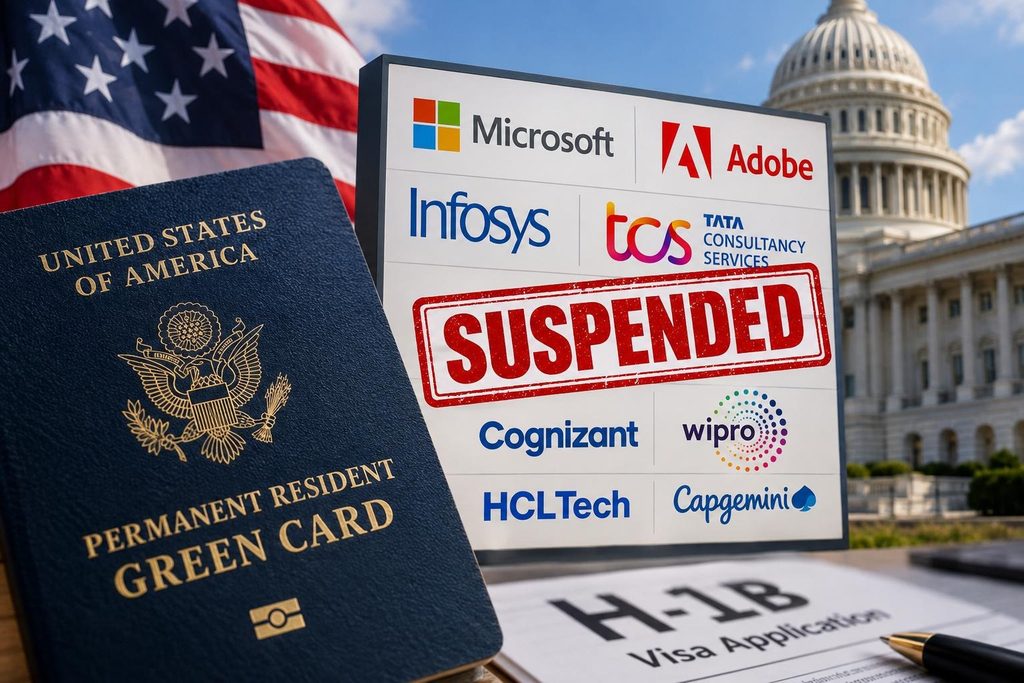
The PERM suspension is DOL’s decision to stop accepting new PERM applications from eight employers and to stop processing the ones they already filed. Labor Secretary Keith Sonderling named the eight companies at a White House press event led by Vice President JD Vance. They are Microsoft, Adobe, Cognizant, Infosys, Tata Consultancy Services, Wipro, HCL Technologies and Capgemini. Sonderling said Microsoft and Adobe face multiple active federal investigations.
The PERM suspension does not cancel anyone’s H-1B status or right to work. It stops the green card step.
How the Crackdown Built Up
This action did not come out of nowhere.
| Date | What happened |
|---|---|
| May 2026 | DOL paused Cloudera’s PERM applications for 180 days in a joint action with the Justice Department |
| August 2026 | OpenAI agreed to a $3.2 million settlement with the Justice Department over its PERM recruiting, admitting no wrongdoing |
| September 8, 2026 | DOL’s Inspector General suspended Cognizant’s PERM filings |
| October 8, 2026 | DOL suspended eight employers from PERM, Cognizant among them |
Vance said the suspension could reach other technology companies. A DOL rule to overhaul PERM recruitment has also sat under White House review since September 14, 2026. If your green card depends on an employer, expect closer scrutiny of PERM cases across the board.
How Long Will the PERM Suspension Last?
DOL has not set an end date or released detailed written guidance. Law firms tracking the case point to 20 CFR 656.31(b), a rule that lets DOL pause PERM cases for an employer under investigation for possible fraud.
Under that rule, the first pause can last up to 180 days. If the clock started on October 8, the 180-day mark falls around April 6, 2027. At that point, DOL can restart some or all cases, or keep them frozen until the investigation and any court case end. Vance said the suspension will last as long as needed.
Two other outcomes matter. If the investigation ends with no fraud finding, the rule requires DOL to decide each pending case on its merits. If DOL finds fraud, it can bar an employer from PERM for up to three years. Nobody has announced a bar so far.
Where Your Case Stands Decides Your Next Move
Find your stage below.
| Your stage | What the PERM suspension means | Your next move |
|---|---|---|
| Employer still recruiting, PERM not filed | Your employer can’t file. PERM job ads must run within six months before filing, so a long freeze may force a new round and push your place in line back | Check how many H-1B years you have left. In year four or later, look at routes you can file yourself |
| PERM filed and pending | Your case is frozen, not denied. A PERM filed at least 365 days ago can still support one-year H-1B extensions past six years, even with a new employer | Get your PERM filing date in writing before you plan any move |
| PERM approved, no I-140 yet | An approved PERM expires if your employer doesn’t file the I-140 within 180 days. DOL hasn’t said how the suspension treats these cases | Ask your employer to file the I-140 now |
| I-140 approved | This is the strongest position. You keep your priority date if you change jobs, and an I-140 approved for 180 days or more survives an employer withdrawal | Use it as your base for any job change |
| Green card application (I-485) pending 180 days or more | You may move to the same or a similar job and keep your case under the portability rule | Speak to an immigration attorney before you accept a new offer |
One rule applies at every stage. Don’t resign first. Your H-1B ties to your current job, and a gap between employers creates risk you can avoid with good timing.
PERM Suspension Risks Most Guides Miss
Your children could age out
US immigration law treats a child as someone unmarried and under 21. A frozen PERM pushes your green card further out. If your child turns 21 before your case finishes, they can lose the right to get a green card with you. The Child Status Protection Act protects some children, though it doesn’t cover everyone. If you have a teenager, run the numbers with an adviser now.
Wage requests are a blind spot
Before PERM, DOL sets the job’s minimum pay through a prevailing wage determination. DOL hasn’t said if wage requests from the eight companies are frozen too. If your case sits at this early stage, ask your employer for a written update.
Losing your job mid-process
If one of these companies lets you go, you generally get up to 60 days, or until your status ends if that comes first, to find a new sponsor, change status or leave. On September 11, 2026, the Department of Homeland Security proposed ending this grace period. The proposal isn’t final, so the current rule still applies today. A new employer must start a new PERM. A pending PERM filed more than a year ago may still help with H-1B extensions, so keep a copy of your filing details.
You hold an offer and live outside the US
Most coverage focuses on people already in America. If you hold an offer from one of these companies, ask how the firm plans to sponsor your green card while it can’t file PERM. A job that brings you in on a temporary visa with no green card plan is a different deal from the one you thought you had. If you already have an approved I-140 and wait abroad, the suspension as announced covers only the DOL step.
Your nationality changes the math
Most PERM suspension coverage centers on Indian nationals, who face the longest EB-2 and EB-3 waits. If you come from Nigeria, Ghana, Kenya, South Africa or another country with a shorter queue, a frozen PERM adds months to a wait that could otherwise move faster. Check the State Department’s monthly Visa Bulletin for your category.
Managers at global firms have another door
Several of the suspended firms move staff between countries on L-1 visas. If you managed people or a key function for a related company abroad for at least one year within the three-year window the rules set, your employer may file an EB-1C green card for you. EB-1C does not use PERM, and the October 8 announcement didn’t name it. Your employer still has to agree to file.
Green Card Routes the PERM Suspension Does Not Touch
The October 8 announcement covered PERM only. It did not name O-1, EB-1A or EB-2 National Interest Waiver petitions. These routes skip PERM because they rest on your record, not on a labor market test.
| Route | Who it fits | Who files |
|---|---|---|
| O-1A | People with extraordinary ability in science, business, education or athletics | A US employer or agent |
| EB-1A | People at the top of their field | You can file for yourself |
| EB-1B | Leading professors and researchers | An employer |
| EB-1C | Multinational managers and executives | An employer |
| EB-2 NIW | Advanced degree holders or people with exceptional ability whose work benefits the US | You can file for yourself |
The O-1 is a temporary visa. USCIS can approve it for up to three years at first and extend it one year at a time, with no cap on extensions. Many people use it while they build an EB-1A or NIW case.
For the NIW, USCIS looks at three things. Your planned work must have real merit and national importance. You must be well placed to advance it. The US must also benefit from waiving the usual job offer requirement.
If the US Feels Uncertain, You Have Options Abroad
The PERM suspension is a US problem. If you don’t want your future to rest on one country’s politics, these four routes reward the same kind of record.
| Route | Who it fits | What you need | How long you stay |
|---|---|---|---|
| UK Global Talent | Leaders or potential leaders in research, arts, culture or digital technology | An endorsement or an eligible prize. No job offer | Up to 5 years at a time, with settlement possible after 3 or 5 years |
| Canada C10 | People whose work brings significant economic, social or cultural benefit to Canada | Strong evidence of benefit. No labor market test | Temporary work permit |
| Canada Global Talent Stream | Specialized talent hired by a Canadian employer | Your employer applies, with a 10 business day processing target | Temporary work permit |
| Australia National Innovation visa (subclass 858) | People with an internationally recognized record of exceptional achievement | An Expression of Interest, an invitation and a nominator with a national reputation in your field | Permanent |
What We Don’t Know Yet
Be careful with anyone who speaks with certainty right now. These questions remain open.
- When the PERM suspension will end
- If DOL will add more companies
- How DOL will treat approved PERMs that haven’t reached the I-140 stage
- If pending wage requests from these employers are frozen
- If any of the eight companies will challenge the suspension in court
We will update this guide as DOL publishes more.
What to Do This Week
- Ask HR for your PERM filing date, I-140 status, and H-1B end date in writing.
- Find your stage in the table above.
- If you have an approved PERM, push for the I-140 filing.
- Don’t resign or travel before you confirm your status and visa stamp.
- Check if your record fits the O-1, EB-1A or NIW. Awards, press coverage, judging the work of others, published work, patents, high pay, and leadership roles all count as evidence.
- Look at the UK, Canada, and Australia routes as a backup plan.
- Walk away from anyone who promises to lift the suspension for a fee. No one can.
How Veripass Helps You Build a Route You Control
Many people who could qualify for the O-1, EB-1A or NIW never apply. They assume they need a Nobel Prize, or they don’t know which evidence counts. Most of them have the achievements and lack a case that presents them clearly.
Veripass works with founders, executives, and skilled professionals to fix that. Here is how it helps you.
- A clear fit check. You learn which route fits your record today across the US, UK, and Australia, and which ones don’t. You stop guessing.
- Case positioning. Veripass shapes how your story reads to an officer, from your planned work in the US to the way your achievements connect to it.
- Evidence building. If your record has gaps, Veripass helps you close them. That includes writing and publishing articles under your name to show your expertise.
- Support from start to finish. You get guidance from your first call until you file, so you never have to work it out alone.
An employer-sponsored green card leaves you waiting on someone else’s file. A self-petition puts your case in your hands. Every month you spend waiting on a frozen PERM is a month you could spend building your own case.
Book your free discovery call with Veripass. In 30 minutes, you’ll learn which route fits your record and what to do first.
Why did the US suspend visas?
The US did not suspend visas. On October 8, 2026, the Department of Labor (DOL) suspended eight employers from PERM, the first step in most employer-sponsored green cards. The eight are Microsoft, Adobe, Cognizant, Infosys, Tata Consultancy Services, Wipro, HCL Technologies and Capgemini. Officials said the companies face federal investigations for possible fraud. Vice President JD Vance also accused Microsoft of laying off US workers while sponsoring foreign ones, a claim Microsoft disputes. Workers at these companies keep their current visas and their right to work.
What is the PERM program?
PERM is the DOL process an employer uses to prove that no qualified, willing and available US worker can fill a job. The employer gets a prevailing wage from DOL, advertises the job, reviews US applicants, then files the PERM application. Once DOL approves it, the employer files Form I-140 with USCIS, and the worker later applies for the green card itself. Most EB-2 and EB-3 cases need PERM. EB-1 and the EB-2 National Interest Waiver skip it.
Did Trump stop green card applications?
No. The PERM suspension blocks green card sponsorship through PERM for eight named companies only. Every other employer can still file PERM, and USCIS still accepts self-petitions such as the EB-1A and the EB-2 NIW. At the eight companies, new and pending PERM cases can’t move forward until DOL lifts the suspension.
What’s the latest news on H-1B visas?
Four developments matter as of October 2026.
1. The $100,000 fee is blocked for now. A September 2025 proclamation added the fee for certain new petitions. A federal court ruled it unlawful on June 8, 2026, and an appeals court kept that ruling in place on July 24. The government’s appeal continues, so the fee could return.
2. Higher pay improves your lottery odds. A wage-weighted selection rule replaced the purely random lottery from the FY2027 cap season. Registrations at higher wage levels get a better chance of selection.
3. The 60-day grace period may end. On September 11, 2026, DHS proposed ending the grace period for laid-off H-1B, L-1, O-1, E, and TN workers. The proposal isn’t final, so the current rule still applies. Comments close around November 10, 2026.
4. The PERM suspension hits H-1B workers indirectly. H-1B status itself is untouched. Workers at the eight companies who need a PERM on file to extend past six years now face a freeze.
This article is general information, not legal advice. Rules can change quickly, so check the official pages linked above before you act.