
The UK ILR new rules could change your settlement timeline from 5 years to 10, 15, or even 20 years. For some migrants, however, the wait could be shorter. Your income, job, visa route and immigration history will now play a bigger role in determining when you can settle permanently.
The UK’s new “earned settlement” system will replace the standard 5-year route with a 10-year starting point for most migrants. But higher earners, certain healthcare and education workers, and some other groups can still qualify sooner. People who have claimed public funds or breached immigration rules could face a much longer wait.
Below, we explain when the new ILR rules take effect, who can still settle in 3 or 5 years, what can push your wait to 10 or 20 years, and what you should do now to protect your route to settlement.
What Is ILR and Why Does It Matter?
ILR stands for Indefinite Leave to Remain. People also call it settlement.
ILR lets you live, work, and study in the UK with no time limit. You stop paying for visa renewals and may also be able to claim some benefits if you qualify.
ILR also opens the door to British citizenship. Today, after 12 months on ILR, you can apply for citizenship if you meet the other rules. So it helps to know how the ILR rules are changing, so you can redesign your personal plan and not be left in the dark.
What Are the UK ILR New Rules in 2026?
The government calls the UK ILR new rules system earned settlement. Under earned settlement in the UK, people who give more to the country will settle faster.
Home Secretary Shabana Mahmood first shared the plan in November 2025. After a public consultation, she confirmed the final version on 2 November 2026. You can read the official consultation page for the full details.
The new indefinite leave to remain rules are broken into two parts:
- Higher basic standards that every applicant must meet.
- Different waiting times based on your income, job, and visa.
When Do the New UK ILR Rules Start?
The rules do not start right away. Here is the timeline:
- 2 November 2026: The government announced the final plan.
- December 2026: The government starts publishing the rule changes.
- 26 March 2027: ILR applicants on several visa routes will need a higher level of English, B2.
- During 2027: The new settlement rules come into force, step by step.
Until the new UK ILR rules take effect, you can still apply under the current rules.
New immigration rules usually take effect unless Parliament formally rejects them. That rarely happens. We could not confirm how this will work for these changes, so it is safest to plan as if the changes will go ahead in 2027.
UK ILR New Rules at a Glance
| Waiting time | Who it applies to | Key condition |
| 3 years | Top earners and some talent visa holders | Earn over £125,140 in 3 of the last 4 years, or hold a Global Talent or Innovator Founder visa (the talent route is still under review) |
| 5 years | High earners, skilled health and education workers, some care workers, BN(O) holders, family of British citizens | Earn over £50,270 in 3 of the last 5 years, or work in an eligible role |
| 10 years | Most migrants on a qualifying visa | Earn at least £12,571 in 5 of the last 7 years |
| 20 years | People with an immigration breach, or specified public funds in the last 5 years | No faster route allowed |
| Refused | Adults with a criminal record | No settlement |
What Are the New ILR Requirements for Everyone?
Every applicant must meet these rules, no matter which route they take:
- No criminal record: This covers far more than prison. Court fines, cautions, community sentences, and conditional discharges you got as an adult can all lead to a refusal. Some overseas convictions count too, if the act would be a crime in the UK.
- Earn at least £12,571 a year: This is just above the point where you start paying income tax. Couples can also add their incomes together to reach £25,142.
- Speak English at B2 level: This is a step up from the old B1 level. The current English language requirement starts at B1, but once the changes are implemented, you will need CEFR level B2 English.
- Owe no money to the government: Unpaid tax counts, so do NHS charges and National Insurance.
- Pass the Life in the UK test: The Life in the UK test assesses your knowledge of British history, culture, traditions, and everyday governance. You can book the test online.
Some people do not need to meet the English, Life in the UK, or income rules. These include children, people aged 65 and over, and people who cannot work because of a physical or mental condition.
The New Settlement Routes Explained
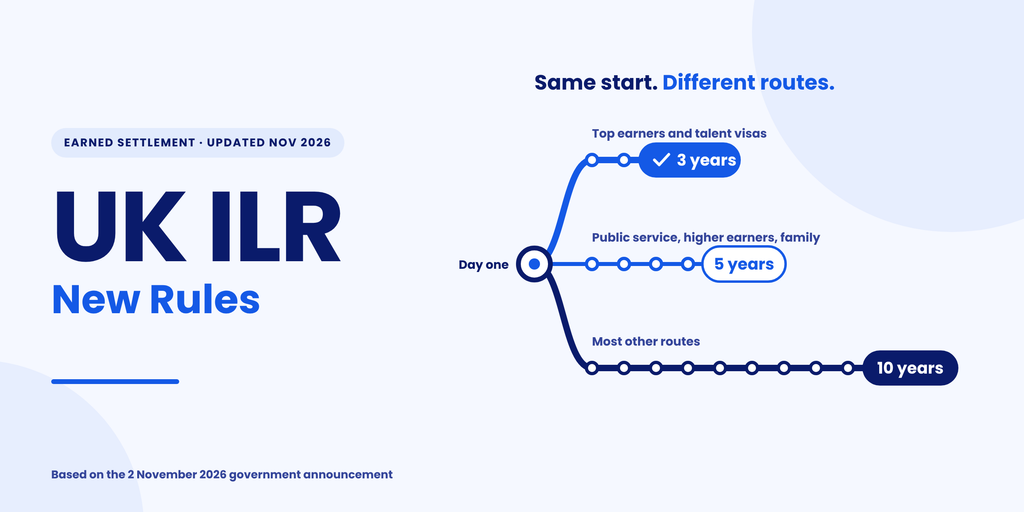
Here’s a breakdown of the new settlement routes:
The 3 Year Route
This is the fastest way to settle in the UK. You qualify if you earn more than £125,140 a year. You need to earn this in 3 of the 4 years before you apply.
You may also qualify without that salary if you hold a high talent visa, such as the Global Talent visa or the Innovator Founder visa. This part is still under review by the Migration Advisory Committee, so details may change. If you apply through one of these routes, your most recent permission needs to be on that route.
This makes the Global Talent visa a strong ILR route. While most migrants wait 10 years, a Global Talent holder could settle in 3, if the route stays as planned.
The 5 Year Route
You can still settle in 5 years if you fit one of these groups:
- High earners: You earned more than £50,270 in 3 of the 5 years before you apply.
- Skilled health and education workers: This covers jobs on national pay scales, such as doctors, nurses, midwives, teachers, and social workers.
- Care workers who arrived before May 2025: You must have stayed in sponsored work and earned at least £25,000 a year.
- Other health and education workers who arrived before May 2025: This covers roles like nursing auxiliaries and teaching assistants. This is a one-time arrangement.
- Hong Kong BN(O) holders: They keep their 5-year route but must still meet the new basic rules.
- Partners, parents, and children of British citizens.
Some care workers got their visa before the cutoff but did not work or earn enough. The government will give them a second chance through a new 5-year Health and Care visa. It is for care work only and does not provide access to public funds.
The 10 Year Rule
The ILR 10-year rule becomes the default for most migrants. You must spend the full 10 years on routes that count toward settlement. Time on a Student or Graduate visa does not count. The separate 10-year long residence route closes.
You must also show steady income. The government has confirmed you need to earn at least £12,571 a year in 5 of the 7 years before you apply.
If your visa ends before you reach 10 years, you can extend it or switch to another visa that counts. Our guide on visa extension rules shows why every extension needs careful prep.
The 20 Year Route
Two things can move your wait to 20 years:
- Claiming specified public funds: If you claimed specified public funds in the 5 years before you apply, you cannot use the 3, 5, and 10-year routes. The government has not yet confirmed which benefits count.
- An immigration breach as an adult: This includes overstaying, breaking visa conditions, or using deception. A high salary will not change this.
Example of How the New UK ILR Rules Affect Different Migrants
These are made-up examples TO EXPLAIN THE NEW UK ILR rules. Each person must also meet the basic rules.
- Ada, a nurse who arrived in 2024. Nurses count as skilled health workers. Ada stays on the 5-year route, as long as she meets the new basic rules.
- Tunde, a software engineer earning £60,000. Tunde earns above £50,270. If he keeps that salary for 3 of the 5 years before he applies, he can settle in 5 years.
- Grace, a care worker who arrived in March 2025: Grace arrived before the May 2025 cutoff. If she earns at least £25,000 and stays in sponsored work, she keeps her 5-year route.
- Emeka, a recent graduate on a Graduate visa: His Graduate visa years do not count. Once he switches to a work visa, his clock starts. His standard wait is 10 years. If he earns above £50,270 in 3 of the 5 years before he applies, he can use the 5-year route.
- Funmi, a product manager in Lagos, is planning to move: Funmi has not chosen a visa yet, so she has the most choice. If she qualifies for the Global Talent visa and that route stays as planned, she could settle in 3 years instead of 10.
What Could Delay Your ILR Under the New Rules?
Small details can change your wait. The good news is that most of them are easy to check ahead of time.
- A small court fine: Even a minor adult fine or caution counts as a criminal record under the new rules. Check your record and get advice if you have one.
- A benefit claim: Claiming specified public funds in the last 5 years can move you to the 20-year route. Which benefits count is not yet confirmed, so check before you claim.
- A past overstay: An immigration breach, even a short overstay, can move an adult to the 20-year route. Get advice if this applies to you.
- Unpaid tax: Any money you owe the government can block your application. Paying it off is a simple fix.
- Gaps in your income: The new rules use a “best years” approach. Short breaks for things like maternity leave, illness, or caring can be allowed. Very long breaks may still make it hard to meet the income rule, so keep good records.
Do the New UK ILR Rules Apply to People Already in the UK?
The new rules affect you if you already live in the UK. People who already hold ILR keep their status. The government did not create a general exemption for people already living here. It made a few limited exceptions:
- Some care, health, and education workers who arrived before May 2025 keep their 5-year route.
- Skilled workers who arrived before April 2024 on the old, lower salary levels can keep extending their visas on current terms until 2035. This gives them time to reach 10 years.
- Hong Kong BN(O) visa holders keep their 5-year route.
- People with status under the EU Settlement Scheme are unaffected.
- Some other groups, such as the Windrush generation and Armed Forces members, keep their own arrangements.
How Do the New ILR Rules Affect Partners and Children?
The family rules stay close to the current system, with a few key changes:
- A partner who arrives with you can settle at the same time as you, if they meet the rules.
- A partner who joins you later must complete their own full waiting time.
- Couples can add their incomes together to reach the £25,142 household threshold.
- Children under 18 can settle with their parents. They do not need to meet the income, English, government debt, or Life in the UK test rules. The criminality rules still apply.
- Young adults aged 18 to 24 who still depend on their family can settle with them. They must meet the adult rules, except the income rule.
- Anyone aged 25 or over when the family becomes eligible must qualify on their own.
What Changed in the UK ILR Rules From the 2025 Plan?
The final plan of the UK ILR new rules is simpler than the first draft. After the consultation, the government dropped several ideas:
- A 15-year wait for care workers and others in jobs below degree level. They now use the standard 10-year route.
- Shorter waits for people who volunteer or speak advanced English (C1). B2 is now the single standard.
- Separate settlement timelines for partners and adult children. Families can now settle together.
The government also added a “best years” approach. It allows for gaps in earnings, such as maternity leave, illness, or caring duties.
Even so, the new system is still a big shift from the 5-year standard most migrants know.
What Should You Do Before the New ILR Rules Take Effect?
The new IRL rules are not law yet. Small steps now will help you feel ready:
- Count your years: Add up your time on a qualifying visa. If you are close to 5 years, look at whether you can apply under the current rules while they still apply.
- Gather your records: Collect your payslips and tax records for the last 5 to 7 years.
- Work on your English: Start preparing for the B2 level now, before March 2027.
- Book your Life in the UK test: Book early, so you are not rushed at the end.
- Clear any government debt: Pay off any unpaid tax or other money you owe.
- Protect your record: Check which benefits count as public funds, and stay within your visa conditions.
- Get support if you are unsure: Citizens Advice explains how rule changes might affect you.
Planning to Move? Choose a Route That Gets You Settled Faster
Most guides on the UK ILR new rules speak only to people already in Britain. But if you have not moved yet, you have a big advantage. The visa you choose today can shape whether you wait 3 years or 10.
Talent-based visas look at what you have already achieved, not just your salary. That is why more professionals now look at talent visas in the UK, Canada, and Australia as their main route abroad.
The same idea works in the US too. The O-1A visa and the EB-1 green card also look at a person’s record. Rules differ by country, so check the details for each one.
So before you choose a visa, find out which talent route fits your profile. Take the free Veripass travel assessment and see your fastest path to settlement.
Frequently Asked Questions
Does the new immigration rule affect people already in the UK?
Yes, for many people who do not yet have ILR. Some groups keep their current routes. People who already hold ILR, and people with EU Settlement Scheme status, are not affected.
What are the new immigration rules for the UK in 2026? T
he government confirmed earned settlement on 2 November 2026. The standard wait becomes 10 years, with faster routes at 3 and 5 years and a slower route at 20 years. The first rule changes start to be published in December 2026.
How long do I need to stay in the UK for ILR?
It depends on your route. It can be 3, 5, 10, or 20 years. Most people will have a 10-year wait.
Can I apply for indefinite leave to remain in the UK after 10 years?
Yes. The 10-year route is the standard route. You must meet the basic rules and spend the full 10 years on routes that count toward settlement.