
The USCIS fee increase October 2026 could cost you more than a few extra dollars if you get the timing wrong. A filing sent with the old fee after the new rates take effect can be rejected, wasting time, money, and momentum at the exact point when your U.S. immigration plans may already be moving fast.
But there is good news: the USCIS fee increase October 2026 does not affect every immigration application, and if you understand exactly what changed, you can avoid paying the wrong amount or making decisions based on misleading headlines.
If you are a founder, executive, researcher, business owner, tech professional, creative, or skilled worker considering the O-1 or EB-2 pathway, this matters because the October update is much narrower than it first appears. Some fees are going up. Some are staying the same. And some major immigration routes are not directly affected by this specific change.
Before you send anything to USCIS, you need to know one thing clearly: does this fee increase actually apply to you?
See Also: October 2026 Visa Bulletin Opens a Golden Filing Window
What changed with USCIS fees in October 2026?
The U.S. Department of Homeland Security published its FY2027 inflation adjustment for certain H.R. 1 immigration-related fees on October 1, 2026.
For the fees administered by USCIS under this notice, the new amounts apply to covered immigration benefit requests postmarked on or after October 16, 2026.
USCIS states that a covered request postmarked on or after October 16 without the proper fee will be rejected.
The adjustment is based on inflation.
The Consumer Price Index for All Urban Consumers, known as CPI-U, rose from 323.048 in July 2025 to 333.918 in July 2026. DHS calculated that as an increase of about 3.36%.
That does not mean every affected fee simply went up by 3.36%.
The law also sets rounding rules, which is why some fees rise while others remain unchanged.

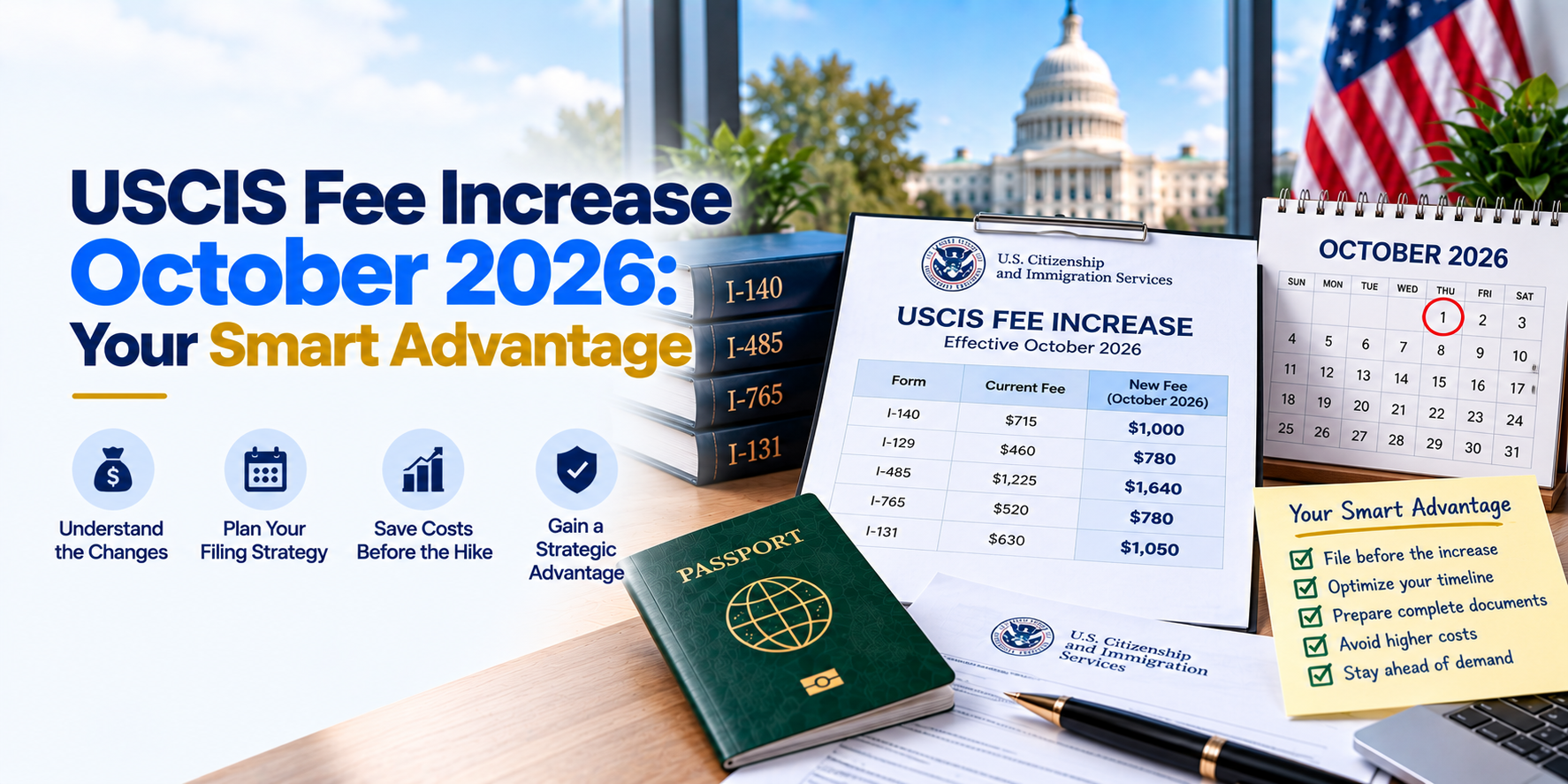
USCIS fee increase October 2026: the full table
Here are the H.R. 1 fees covered by the USCIS FY2027 notice.
| Immigration fee | Previous amount | FY2027 amount | Change |
|---|---|---|---|
| I-589 initial asylum fee | $100 | $100 | No change |
| Annual pending asylum application fee | $102 | $105 | +$3 |
| I-765 initial asylum applicant EAD | $560 | $570 | +$10 |
| I-765 asylum EAD renewal or extension | $275 | $275 | No change |
| I-765 initial parole EAD | $560 | $570 | +$10 |
| I-765 parole EAD renewal or extension | $280 | $280 | No change |
| I-765 initial TPS EAD | $560 | $570 | +$10 |
| I-765 TPS EAD renewal or extension | $280 | $280 | No change |
| I-765 re-parole EAD | $280 | $280 | No change |
| I-821 TPS fee | $510 | $520 | +$10 |
| I-360 Special Immigrant Juvenile fee | $250 | $250 | No change |
| H.R. 1 immigration parole fee | $1,020 | $1,050 | +$30 |
| H.R. 1 I-94 fee | $24 | $24 | No change |
The USCIS notice confirms the asylum, EAD, TPS, SIJ, and related amounts above.
There is one detail worth separating from the rest of the table: the $1,050 H.R. 1 parole fee is not simply another Form I-131 filing charge.
DHS states that this statutory parole fee is generally triggered when parole is actually granted and put into effect, not when the underlying request is filed. The fee has statutory exceptions.
That distinction matters because saying “Form I-131 now costs $1,050” can give readers the wrong idea.
Did USCIS increase every filing fee?
No.
This is probably the most important point in this article.
The October 16 adjustment applies to certain H.R. 1 immigration-related fees. It is not a new price list for every USCIS form.
For example, the October 1 Federal Register table does not create a new standard filing fee for:
- Form I-129 simply because you are filing an O-1 petition;
- Form I-140 simply because you are pursuing EB-2;
- Form I-130;
- Form I-485;
- Form N-400.
That does not mean those forms can never have different fees under other rules.
It means this specific October 2026 inflation notice does not establish new standard filing amounts for them.
Before submitting any immigration filing, use the current USCIS fee schedule for your exact form and filing category.
USCIS specifically tells applicants to use Form G-1055, Fee Schedule, to verify current fee information. USCIS also warns that a filing with the wrong required fee can be rejected.
Check the official USCIS Form G-1055 Fee Schedule
Does this USCIS fee increase affect O-1 applicants?
Not directly through this particular October 16 fee adjustment.
The O-1 classification is used for qualifying people with extraordinary ability or achievement. USCIS guidance covers areas including science, business, education, athletics, the arts, and motion picture or television work.
An O-1 petition generally uses Form I-129, Petition for a Nonimmigrant Worker.
Form I-129 is not one of the forms receiving a new standard filing amount in the USCIS FY2027 table discussed above.
So if your main interest is an O-1 case, do not take a broad “USCIS fees increased” headline and calculate your case from it.
Check the fee that applies to your exact I-129 filing when you are ready to submit.
Read the official USCIS O-1 guidance
What about EB-2 and the National Interest Waiver?
The same warning applies.
The October 16 H.R. 1 adjustment does not itself create a new standard Form I-140 filing fee for EB-2 applicants.
USCIS states that EB-2 classification can apply to members of professions holding advanced degrees and people with exceptional ability.
For some EB-2 cases, a person may request a National Interest Waiver, often called an NIW. USCIS can waive the job-offer and labor-certification requirements when the applicable NIW standards are met, and a person seeking an NIW can file a petition on their own behalf.
That makes EB-2 NIW relevant to some founders, researchers, entrepreneurs, specialists, and other professionals.
But the October H.R. 1 fee table should not be used as your Form I-140 price list.
Read the official USCIS EB-2 guidance
October 15 vs. October 16: which fee should you use?
For the USCIS-administered fees covered by the notice, the postmark date matters.
Here is the simple version.
Your affected request is postmarked October 15
The new October 16 amount has not yet taken effect for that request under this notice.
Your affected request is postmarked October 16
You need the applicable FY2027 amount.
For example, an affected initial I-765 EAD fee that was $560 becomes $570.
You prepared your application on October 10 but mailed it on October 18
Preparing or signing the package earlier does not move your postmark date backward.
For purposes of the rule in this notice, the package is on the new-fee side of the deadline.
That is why checking a filing fee when you start preparing an application is not enough.
Check it again shortly before submission.

What if USCIS receives your package after October 16?
Do not confuse the postmark date with the date USCIS receives or opens the package.
For the covered USCIS requests, the notice uses the postmark date.
So if timing matters, keep your mailing receipt and tracking record.
You should be able to show when the package was sent.
Why did some fees stay the same after a 3.36% inflation adjustment?
Because of the rounding method required by law.
For most of these H.R. 1 fees, USCIS applies the inflation calculation and then rounds the result down to the next lowest multiple of $10.
The annual pending asylum fee uses a different rule and is rounded down to the nearest dollar.
Take a $280 fee.
A 3.36% inflation calculation adds roughly $9.41.
But the applicable rounding rule can bring the adjusted fee back down to $280.
That is why these fees remain unchanged:
- $275 asylum EAD renewal or extension;
- $280 parole EAD renewal or extension;
- $280 TPS EAD renewal or extension;
- $280 re-parole EAD;
- $250 SIJ fee;
- $24 H.R. 1 I-94 fee.
Do not calculate your filing fee yourself by multiplying the old figure by 1.0336.
Use the published amount.
The initial asylum fee and annual asylum fee are different
This is another easy point to miss.
The initial I-589 asylum fee remains $100 under this adjustment.
The separate annual pending asylum application fee rises from $102 to $105.
So a headline saying “asylum fee rises to $105” needs context.
The initial fee did not become $105 under this FY2027 USCIS table. The annual pending fee did.
What happens if you submit an affected request with the old fee?
USCIS says covered requests postmarked on or after October 16, 2026 without the proper filing fee will be rejected.
That can mean having to correct the payment and submit again.
For someone facing a separate filing deadline, expiring work authorization, status issue, or other time-sensitive matter, a rejection may create additional problems.
Do not assume that being short by only $3 or $10 means USCIS will accept the package anyway.
Use the required amount.
Can you get a fee waiver for these H.R. 1 fees?
USCIS makes another distinction here.
Some ordinary USCIS filing fees may qualify for a fee waiver when the applicable rules permit it.
But USCIS states that the additional immigration fees required by Public Law 119-21 cannot be waived. A person may still qualify for a waiver of another USCIS filing fee in some situations while remaining responsible for the separate H.R. 1 fee.
That is another reason to separate the different charges in a filing instead of treating them as one total.
What should you do before sending a USCIS filing?
Use this process.
1. Identify your exact immigration category.
Do not start with a general fee headline. Start with the benefit you are requesting.
2. List every form in your filing.
One immigration case can involve several forms and several different fees.
3. Confirm your filing category.
Two people using Form I-765 may not owe the same amount because their eligibility categories can differ.
4. Check Form G-1055 close to your submission date.
Use the official USCIS fee schedule instead of an old blog post, screenshot, or saved PDF.
5. Read the instructions for your form.
The form number alone may not tell you the complete cost.
6. Check your mailing date.
For these October changes, October 15 and October 16 are not interchangeable.
7. Keep records.
Keep a complete copy of your submission, payment proof, postal receipt, and tracking information.
For founders and skilled professionals, the bigger question is not the $10 increase
If you are a founder, executive, researcher, senior professional, creator, or specialist, your real decision may be much bigger than a USCIS filing-fee adjustment.
You may be deciding which country and immigration route fits your professional record.
The United States is one option, but it is not the only one.
United States: O-1 and EB-2 NIW
For people with strong professional records, O-1 and EB-2 NIW are two U.S. routes worth examining.
They use different legal standards and serve different purposes.
A strong business career alone does not automatically qualify you for either one. Your evidence has to match the rules for the category you choose.
USCIS has also clarified that, in an O-1A case, a separate legal entity owned by the beneficiary, such as a corporation or LLC, may file an O-1 petition on the beneficiary’s behalf. That point may be relevant to some founders.
United Kingdom: Global Talent Visa
The UK Global Talent Visa is open to qualifying leaders or potential leaders in:
- academia or research;
- arts and culture;
- digital technology.
Applicants who have won an eligible prestigious prize may apply directly. Others generally need an endorsement first.
Read the official UK Global Talent Visa rules
Canada: Global Talent Stream
Canada’s Global Talent Stream is employer-led.
Category A can apply where an eligible employer has a referral from a designated partner and seeks to hire a person with specialized talent to help the business grow.
Category B applies to employers seeking highly skilled foreign workers for listed in-demand occupations.
The employer must meet the program requirements, and the Global Talent Stream operates through Canada’s Temporary Foreign Worker Program and LMIA system.
Read Canada’s official Global Talent Stream requirements
Canada: C10 significant-benefit work permits
C10 is better described as an LMIA exemption code, not a standalone Canadian visa.
Canada’s International Mobility Program allows some employers to hire foreign workers without an LMIA when an exemption applies. The government identifies C10 with cases based on a significant benefit to Canada.
The worker still generally needs the appropriate work permit.
That distinction matters if you are comparing Canadian routes.
Read Canada’s official LMIA-exemption guidance
Australia: National Innovation Visa
Australia’s National Innovation Visa, subclass 858, is a permanent visa for people with an internationally recognized record of exceptional and outstanding achievement.
It is invitation-only.
Australia says the program can include established and emerging leaders such as researchers, entrepreneurs, innovative investors, athletes, and creatives.
You first submit an Expression of Interest. If invited, you can then apply for the visa, and an eligible nominator must complete Form 1000 in support of the application.
Read Australia’s official National Innovation Visa information
Where Veripass can help
Reading about five different immigration options can leave you with one basic problem:
Which one actually fits your profile?
That is the question to answer before spending heavily on applications.
Your job title alone is not enough.
The facts that may matter can include your leadership record, business results, professional recognition, publications, awards, media coverage, research, salary, patents, speaking record, industry impact, investment activity, company growth, and other evidence.
Different immigration systems treat those facts differently.
That is where Veripass comes in.
Veripass helps founders, executives, skilled workers, researchers, creatives, and other professionals assess immigration options based on their background, evidence, goals, and preferred destination.
If you are considering O-1 or EB-2 NIW in the United States, UK Global Talent, Canada’s talent or significant-benefit routes, or Australia’s National Innovation Visa, the first step is to understand which options are worth serious attention.
That can help you avoid spending months preparing for a route that does not match your current profile.
It can also show you where your evidence is already strong and where you may need more preparation before filing.
Before you act on the USCIS fee increase October 2026
The USCIS fee increase October 2026 is real, but its scope is limited.
From October 16, several H.R. 1 fees rise:
- the annual pending asylum fee becomes $105;
- certain initial I-765 EAD fees become $570;
- the I-821 TPS fee becomes $520;
- the H.R. 1 parole fee becomes $1,050, with separate rules on when that statutory fee is triggered.
Other listed fees stay unchanged because of the inflation and rounding rules.
If you are mainly considering an O-1 or EB-2 case, this specific October 16 notice does not itself establish a new standard I-129 or I-140 filing fee.
Check the official USCIS fee schedule before filing.
Then step back and ask the bigger question:
Which immigration pathway makes the most sense for your professional record, goals, and timing?
If you want help reviewing your profile against the U.S., UK, Canadian, and Australian options discussed above, book a free Veripass discovery call.
Book your free Veripass discovery call
How much will it cost to get a Green Card in 2026?
There is no single Green Card cost because the total depends on how you apply. If you are already in the U.S. and file Form I-485 for adjustment of status, the standard USCIS filing fee is generally $1,440 for most applicants. Other forms, medical exams, petition fees, or work/travel applications can add to the total.
If you apply through a U.S. embassy or consulate, you may instead pay immigrant visa processing fees, such as $345 for employment-based immigrant visa applications, plus the separate USCIS Immigrant Fee after visa approval.
Do I have to pay $250 to enter the USA?
No, there is not a general $250 fee that every traveler must pay simply to enter the United States.
H.R. 1 created a Visa Integrity Fee for people issued certain nonimmigrant visas. The law set the initial amount at at least $250, but it is tied to visa issuance, not a blanket border-entry charge for every traveler. Current State Department fee tables should be checked before applying because visa fees depend on the visa category.
How much is the immigrant fee for a Green Card?
The USCIS Immigrant Fee is $235 in the current USCIS fee schedule. This fee generally applies to people who receive an immigrant visa abroad and then enter the United States as permanent residents.
USCIS uses the fee to process your immigrant visa packet and produce your physical Green Card. USCIS recommends paying it after receiving your immigrant visa and before traveling to the U.S. You can pay after arrival, but USCIS will not produce your Green Card until the fee is paid.
Did the U.S. citizenship fee increase?
The current standard fee for Form N-400, Application for Naturalization, is $710 when filed online and $760 when filed on paper.
A reduced $380 paper filing fee is available to some applicants who meet the income requirements, and qualifying applicants may also receive a full fee waiver. These N-400 amounts are separate from the October 2026 H.R. 1 fee increases discussed in this article.
This article provides general information and does not replace legal advice for your individual immigration matter.