It is 3am and you are awake again. You check H1B status online, read the same six words you read yesterday, and put the phone face down. Twenty minutes later you pick it up and check H1B status online one more time, as if the page might have moved while you were lying there staring at the ceiling. It has not.
Your job, your lease, your parents waiting for news in another time zone, every plan you have quietly put on hold, all of it sits behind one sentence that has not changed in three weeks.
Now the part that will sting a little. That page was probably never going to tell you what you are looking for. Four separate government systems hold different pieces of your H-1B story, run by two different agencies, and the one everyone refreshes answers the narrowest question of the four. The page you actually need at 3am is usually a different page.
This guide shows you which system to open and when, what each status message really means, how long silence is supposed to last before it counts as a problem, and exactly who to contact when it stops being normal. By the end you will know where you stand, and you will have a reason to stop reaching for your phone.
Read Also: Concurrent H1B Risks: Protect and Boost Your Career
You are probably checking the wrong system
Four systems, four different questions.
- Lottery registration status. Tells you if your employer’s entry was selected. It lives in your employer’s myUSCIS registrant account. There is no receipt number at this stage because nothing has been filed.
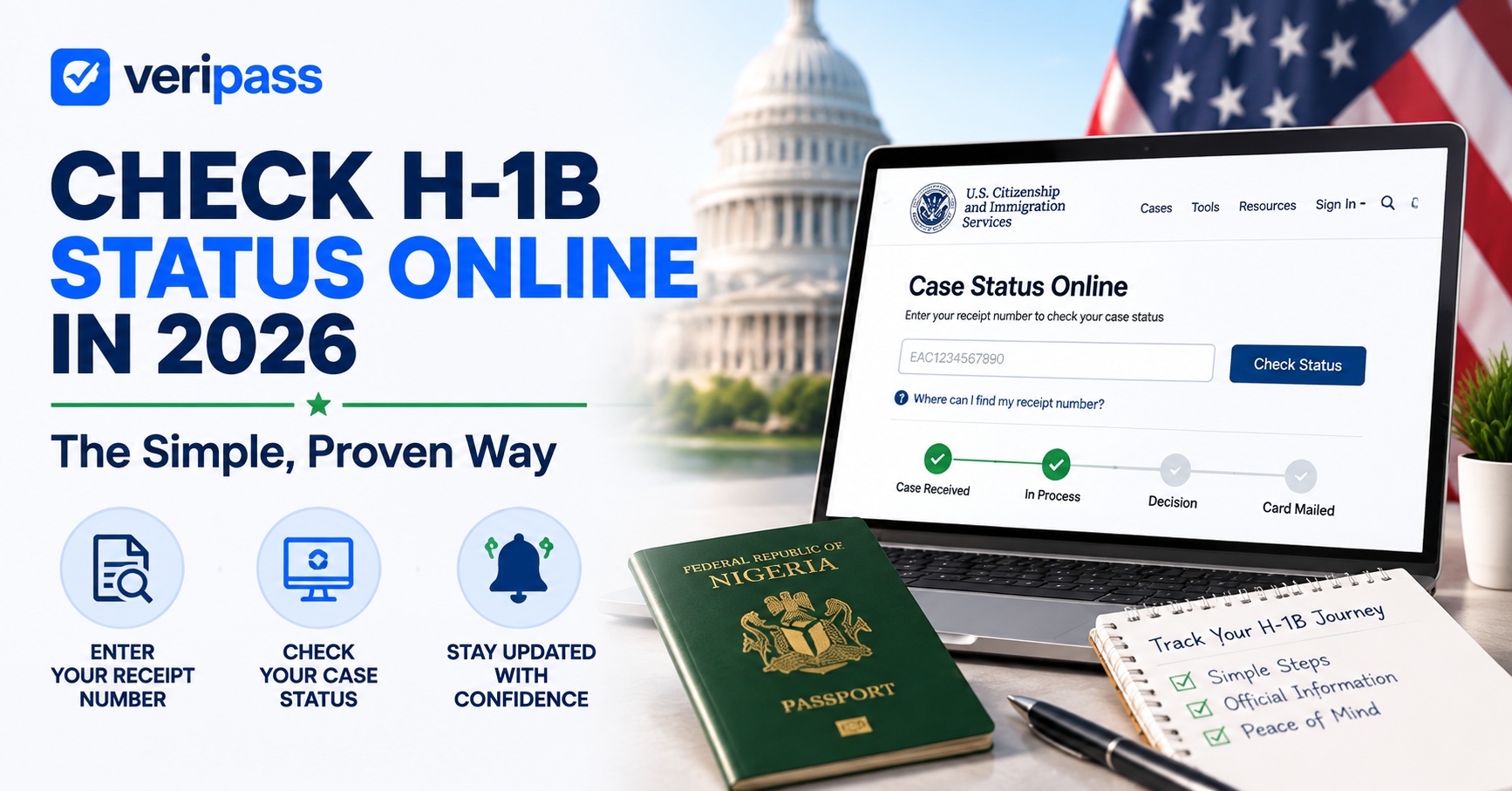
- Petition status. Tells you what USCIS is doing with Form I-129. You check this at USCIS Case Status Online with your receipt number.
- Your I-94 record. Tells you how long you are actually allowed to stay. It lives with Customs and Border Protection at i94.cbp.dhs.gov. This is your legal status, and it is not the same thing as your petition.
- Visa stamp status. Tells you where your visa application stands after your interview. It lives with the State Department at CEAC.
Find yourself in one line. No receipt number and it is before April, you are in registration. Receipt number in hand, you are in petition status. Already in the US and worried about how long you can stay, open your I-94. Petition approved and you are abroad waiting on a stamp, open CEAC.
How to Check H1B Status Online with Your Receipt Number
- Find your 13-character receipt number on the Form I-797 notice USCIS sent your employer. Three letters, then ten digits.
- Enter it at USCIS Case Status Online exactly as printed. No login needed for a basic lookup.
- Create a free account at my.uscis.gov and add the receipt number to case alerts so USCIS emails you when the milestone changes.
That third step is the one people skip, and it is the one that stops the compulsive refreshing.
Read your receipt number properly
The first three letters tell you where your case was assigned. IOE means the electronic system, and it is now the most common prefix by far. EAC is Vermont, WAC is California, LIN is Nebraska, SRC is Texas, MSC and NBC are the National Benefits Center, and YSC is Potomac.
Plenty of articles still list only the older four, which sends people with an IOE number into a panic that their number is wrong. It is not. The prefix does not change your place in line and it does not predict your outcome.
What the status messages mean
- Case Was Received. USCIS has your petition and took the fee. Processing time counts from this date.
- Initial Review Was Completed. An officer looked at it. This is not a signal of approval.
- Case Was Transferred. USCIS moved it to balance workload. It is not a problem on its own.
- Request for Evidence Was Sent. USCIS wants more documents. The deadline printed on your notice is the only deadline that counts. More on this below, because the rules changed recently.
- Intent to Deny Was Issued. USCIS is leaning toward refusal and is giving one chance to respond. Treat it as urgent.
- Case Was Approved. The petition is approved. If you are in the US on a change of status, you have H-1B status. If you are abroad, your next stop is a consulate.
- Case Was Denied. The notice explains why. An attorney should read the specific grounds before you assume the path is closed.
What the tool will not tell you
Set your expectations here and the rest of the wait gets easier.
- USCIS posts updates in overnight batches. Refreshing at 2pm changes nothing.
- There is no queue position. You cannot see how many cases sit ahead of yours.
- Months of silence during active processing are normal, not a warning sign.
- It says nothing about anything happening at a consulate.
- It does not tell you your legal status. Only your I-94 does that.
Your I-94 is the record that matters
Your petition and your permission to stay are two different things. The petition is a decision about paperwork. Your I-94 is the record of how long CBP admitted you for, and it is what an officer, an employer, or a landlord relies on.
Pull it free at i94.cbp.dhs.gov, check your most recent entry, and note the admit-until date. If it does not match what your approval notice says, raise it with your attorney the same week. Mismatches happen, and they are far easier to fix early.
When you have no receipt number
USCIS will not look up a case by your name, your employer’s name, or your passport. There is no workaround, so the task is finding the number rather than avoiding it.
- Ask your employer’s HR team or the attorney who filed. USCIS sends the notice to the petitioner, which is your employer, not to you.
- Before the next filing, give your attorney your USCIS online account number so it goes on the petition itself. Note that USCIS currently says paper-filed Forms I-129 and I-907 cannot be linked to an organizational account, so confirm what is possible for your specific filing.
- If your employer confirms a filing and no receipt notice appears after about four weeks, escalate. A missing notice can mean the petition was rejected for a technical reason, like a wrong fee or the wrong filing address, and never entered processing at all.
Your family has separate cases
H-4 and H-4 EAD filings carry their own receipt numbers and move at their own pace. Your approval does not mean your spouse’s application moved. Track each number separately, and expect the dependent filings to run slower than the principal petition.
Extensions and transfers
Each new petition gets a new receipt number, tracked on its own.
If your employer files an extension before your authorized stay ends, you may keep working for that same employer for up to 240 days past expiration or until USCIS decides, whichever comes first. That rule sits at 8 CFR 274a.12(b)(20) and it applies to the same employer, not a new one.
Transfers work differently. Under H-1B portability you may start with the new employer as soon as they properly file, without waiting for approval, provided your status has not already lapsed. If you lose your job, regulations allow a discretionary grace period of up to 60 consecutive days or until your authorized validity ends, whichever is shorter.
The RFE rules changed on August 5, 2026
This is the update most guides have not caught up with, and it matters more than anything else on this page.
USCIS issued new guidance effective August 5, 2026 that applies to requests pending or filed on or after that date. Three changes.
- Officers now have discretion to deny a case outright, without issuing an RFE, when required initial evidence is missing. You can no longer count on a second chance.
- The 12-week response window is a ceiling, not a default. Practitioners are already reporting RFEs with 30-day deadlines.
- USCIS still adds three days when it serves a notice by mail, and it has removed the extra 14 days it used to give for notices mailed outside the United States.
If you are sitting in Lagos or Nairobi waiting on post, that last change quietly took two weeks off your clock. Read the date printed on your own notice and work from that, never from what an older article told you to expect.
When something looks wrong, escalate in order
- Compare your case against the USCIS processing times tool for your form and office.
- If you fall outside that range, file a case inquiry through your USCIS online account and keep the service request number.
- Call the USCIS Contact Center and ask for a tier two callback if the inquiry produces nothing.
- Submit DHS Form 7001 to the CIS Ombudsman, an independent office inside DHS that sits outside USCIS. They ask that you contact USCIS first, so keep your records.
- Ask your attorney about a congressional inquiry, and about a mandamus action if the delay is extreme.
For anything genuinely time sensitive, premium processing puts USCIS on a 15 business day clock.
The consular stage, and what changed for Nigerian applicants
Once your petition is approved and you need a stamp, tracking moves to CEAC. After your interview the status shows administrative processing, issued, or refused. A 221(g) hold can run from days to months, and USCIS alerts will never reflect it because it is a different agency.
Two things to know if you are applying from Nigeria.
Since September 2, 2025 the State Department has ended interview waivers for nearly all nonimmigrant categories, including H, L, O, F, M and J. The dropbox route many Nigerian professionals used for renewals is closed. You attend in person, and you should book early because that policy pushed wait times up everywhere. Check current requirements at ustraveldocs.com/ng and ng.usembassy.gov/visas.
Separately, Presidential Proclamation 10998 took effect on January 1, 2026 and places Nigeria in a partial suspension group. Immigrant visas along with B-1, B-2, F, M and J categories are suspended for new applicants. Employment categories including H-1B, L-1 and O-1 are not suspended, though officers have been directed to shorten validity and apply closer scrutiny.
Applicants in Ghana, Kenya, India and elsewhere are outside that proclamation and follow the standard consular route, with the same interview waiver rules applying globally.
One more piece of good news that got buried. USCIS had frozen adjudications for nationals of travel ban countries under two policy memos. A federal court vacated them, and USCIS confirmed they should be treated as not in effect. If your case sat untouched through early 2026, that is why, and it should be moving again.
About the trackers everyone actually uses
Plenty of people use Lawfully, Trackitt and similar apps for crowd-sourced timelines by service center. Those timelines are useful for a rough sense of pace and useless as a prediction for your case. Before you hand a receipt number to any third-party app, ask yourself what else that number is tied to. USCIS Case Status Online remains the only authoritative source.
Tracking carefully does not fix the underlying problem
Here is the uncomfortable part. You can do every step on this page perfectly and still be one lottery result, one layoff, or one policy shift away from starting over.
The FY 2027 selection process is now weighted by wage level, so a Level IV registration gets four entries while a Level I gets one. The $100,000 fee from Proclamation 10973 was vacated in June 2026 and the First Circuit refused to reinstate it, though the proclamation itself runs to September 20, 2026 and DHS has proposed a separate $103,265 fee through rulemaking. None of that is settled, and none of it is yours to control.
What you can control is having a second path that does not depend on a lottery or on one employer staying healthy.
The O-1A visa for extraordinary ability has no annual cap and no lottery.
The EB-2 National Interest Waiver lets you petition for a green card yourself, with no employer sponsor at all. Nigeria carries no per-country backlog in the employment-based categories, which means an approved petition moves without a priority date wait. Outside the US route, the UK Global Talent visa and Australia’s skilled pathways run on the same logic, which is that your record qualifies you rather than a company sponsoring you.
Where Veripass comes in
Veripass handles these cases end to end. Not advice you then take somewhere else, and not a referral to a firm you have to brief from scratch.
- Evidence mapping. Most people who assume they do not qualify for O-1A have never had their record tested against the actual criteria. Published work, a thesis, open-source contributions, judging, press coverage and salary evidence all count, and founders and senior operators routinely underestimate what they already hold.
- Full case preparation. Petition strategy, expert letters, exhibit assembly and the filing itself.
- Filing and tracking. Your receipt number, your deadlines and your RFE clock managed by the people who built the petition, which matters more now that a 30-day RFE is a live possibility.
- Multi-country strategy. US, UK and Australia assessed together, so you choose a route rather than defaulting into one.
- An honest answer. Including the answer that a pathway does not fit you yet, and what would change that.
Prior results never guarantee a similar outcome, and no one can promise you an approval. What you can get is a clear read on your own file.
Stop refreshing a page that cannot tell you what you want to know. Spend thirty minutes finding out what your record actually qualifies you for.
Book a free discovery call with Veripass
How do I check my H-1B status online?
Two things make this easier.
1. Create a free account at my.uscis.gov and add your receipt number to case alerts. USCIS then emails you when the milestone changes, so you stop refreshing.
2. Remember that USCIS posts updates in overnight batches. Checking three times during the workday shows you the same screen.
One distinction worth holding onto. This tool tracks your petition, meaning Form I-129. It does not tell you how long you are allowed to stay. That lives on your I-94 record at i94.cbp.dhs.gov, which is a different agency and a separate lookup.
Can I check if my H-1B is approved?
What that approval means depends on where you are.
1. If you are inside the US on a change of status, approval gives you H-1B status directly. Check your I-94 to confirm the new validity dates match the notice.
2. If you are outside the US, approval only clears the petition. You still need a visa stamp, which runs through the consulate and shows up in CEAC rather than in the USCIS tool.
Two situations trip people up. The status can read approved while the paper notice takes weeks to arrive, and if it never arrives your attorney can request a duplicate. Separately, “Initial Review Was Completed” is not approval. It means an officer looked at the file and it passed screening, nothing more.
Can I check my visa status with my passport number?
The State Department side is different.
1. The CEAC status tool uses your visa application ID from the DS-160 or your case number, not your passport number.
2. Passport tracking after a successful interview does run on passport number, through the appointment and courier site for your country. In Nigeria that is ustraveldocs.com/ng.
So the passport number tells you where the physical document is. It does not tell you what decision was made or where the petition stands.
What is the latest news on H-1B visas?
1. The RFE rules tightened on August 5, 2026. USCIS officers can now deny a case without issuing a Request for Evidence when required initial evidence is missing. The 12-week response window became a maximum rather than a default, and 30-day deadlines are already appearing. USCIS also removed the extra 14 days it used to allow for notices mailed outside the United States, which shortens the clock for anyone responding from Lagos, Accra or Nairobi.
2. The $100,000 fee is not collectible right now. A federal court vacated the policy implementing Proclamation 10973 in June 2026, and the First Circuit refused to reinstate it in July. The proclamation itself expires on September 20, 2026 unless the administration extends it, so this position could shift within weeks.
3. DHS has proposed a separate $103,265 fee. Published on August 25, 2026 as a proposed rule on cap-subject petitions, it rests on different legal authority and is not in effect. Nobody should add it to a filing today.
4. The lottery is now weighted by wage level. For the FY 2027 cap, a Level IV registration receives four entries while a Level I receives one. Junior and lower-paid roles face materially worse odds than before.
5. The USCIS adjudication holds were struck down. Two policy memos had frozen benefit decisions for nationals of 39 countries, including Nigeria. A federal court vacated them and USCIS confirmed they should be treated as not in effect. If your case sat untouched through early 2026, that is likely why, and it should be moving again.
For Nigerian applicants specifically, Proclamation 10998 suspends immigrant visas along with B, F, M and J categories. H-1B, L-1 and O-1 are not suspended, though officers have been directed to issue shorter validity and apply closer scrutiny.
Three of these five carry live dates. Add a note to recheck the fee and proclamation position after September 21.
This article is general information, not legal advice. Immigration rules change quickly, so confirm anything you plan to act on with USCIS, the U.S. Department of State, or a licensed immigration attorney.
Last updated September 4, 2026.