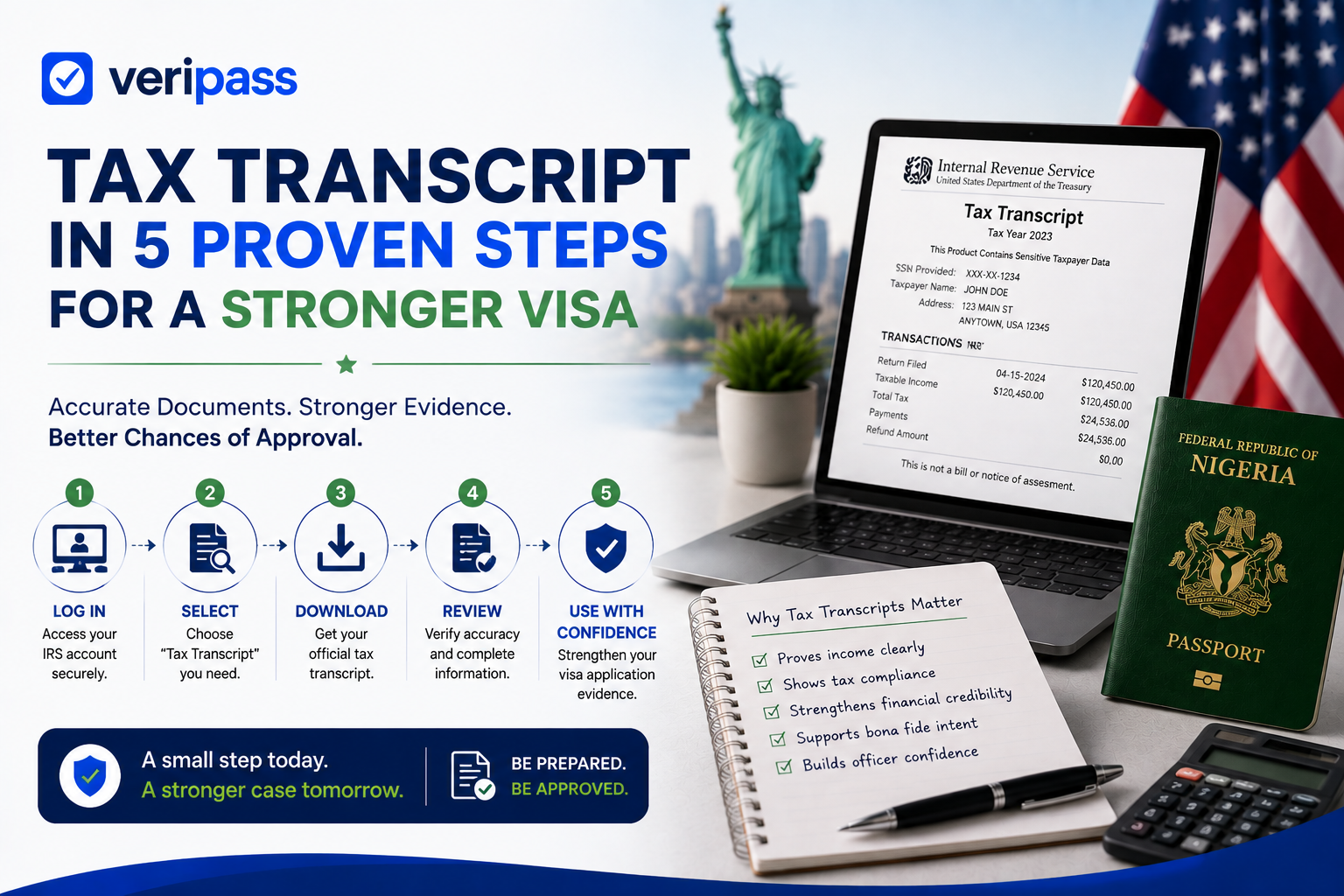
Eight months of work. Recommendation letters from people who took weeks to reply. An advisory opinion, a filing fee, a lawyer on retainer. Then a single tax transcript stops everything, because the IRS has not finished processing your return and the document you need does not exist yet. Your tax transcript is the one piece of evidence in a US visa file that you cannot rewrite, reframe, or talk your way around.
Letters can be strengthened. Evidence can be reordered. Your income record either sits in the IRS system or it does not.
That is why this free, four-page document quietly derails applicants who deserve to win. Some order the wrong type and lose three weeks. Some find the online system locks them out because they have no US phone number in their name. Some send it and get it bounced back because the IRS blacked out their name and the receiving office could not confirm it belonged to them.
Every one of those problems is fixable, and every one of them is far cheaper to fix in week one than in week twelve. Here is what the document proves, which of the five types you actually need, how to get it when you are applying from outside the US, and what to do if you have never filed a US return at all.
See Also: US Credit History for Nigerian Professionals: Building Financial Credibility After Arrival
What a tax transcript actually is
A tax transcript is a summary of what the IRS holds on you for one tax year. It is not a photocopy of your return.
Three things make it useful in an immigration file.
- It is free.
- You can download it in minutes once your identity is verified.
- It carries the IRS name, so no officer has to take your word for your income.
That third point carries the weight. A payslip is something your company produced. A bank statement shows money moving. A tax transcript shows what you reported to a federal agency under penalty of perjury and what that agency accepted. Officers read it differently.
The five types, and the one most people order by mistake
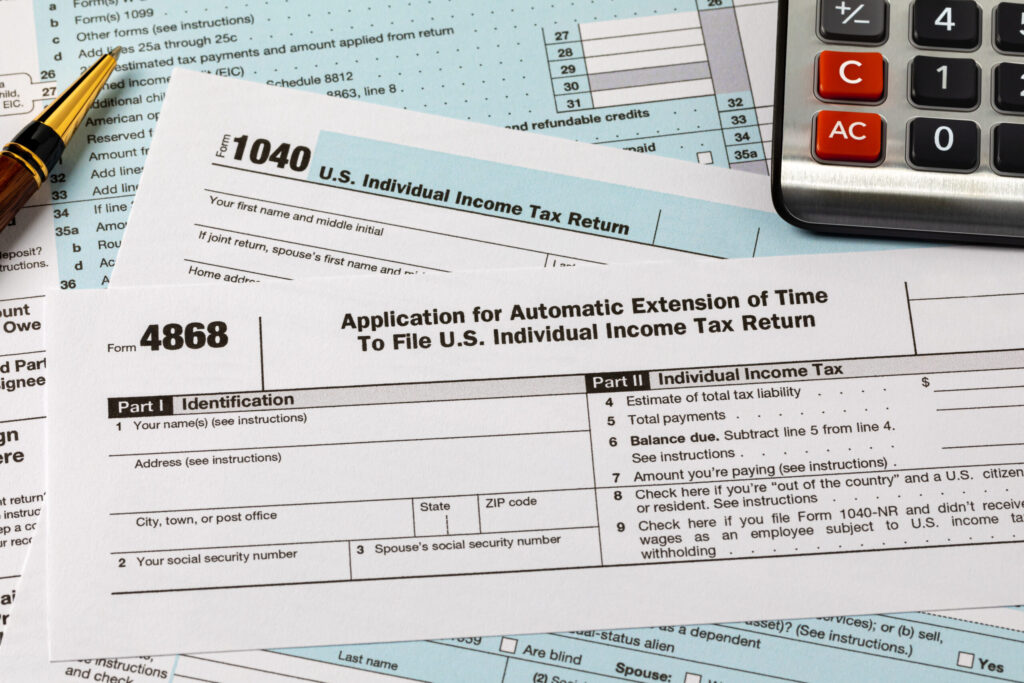
There are five transcript types, and they are not interchangeable. Ordering the wrong one costs you weeks.
| Type | What it shows | Years you can get |
|---|---|---|
| Tax return transcript | Most line items from your original return as filed, with forms and schedules. Does not show changes made after you filed. | Current and 3 prior years |
| Tax account transcript | Filing status, taxable income, payment types, and any changes made after you filed | Current and 9 prior years online; current and 3 prior by mail or phone |
| Record of account transcript | The return and account transcripts combined | Current and 3 prior years |
| Wage and income transcript | Data from the W-2s, 1099s, 1098s and 5498s that payers sent the IRS about you | Current and 9 prior years |
| Verification of non-filing letter | Proof the IRS has no record of a processed return for that year | Prior 3 years anytime; current year only after June 15 |
Two corrections worth having, because a lot of published guidance gets them wrong.
The first is that you cannot get every transcript for ten years. That claim appears on several high-ranking pages. The tax return transcript, the one most requesters ask for, only goes back to the current year plus three prior years. If you need something older, you file Form 4506-T.
The second is the wage and income transcript limit. It caps at roughly 85 income documents. If you have more than that, it will not generate online, and you will get an error telling you to submit Form 4506-T instead. Founders with multiple 1099 sources hit this more often than you would expect.
For most immigration purposes, you want the tax return transcript. For proving you have no filing obligation, you want the verification of non-filing letter. Those are the two that matter.

Where a tax transcript actually shows up in a US talent visa file
Three places, and they are different from each other.
Proving high remuneration. One of the O-1A evidentiary criteria asks for proof that you have commanded, and still command, a high salary or other substantially high pay for your services. USCIS accepts contracts and other reliable evidence, and tax records sit comfortably in that category. Where transcripts earn their place is consistency. A transcript covering three years shows sustained earning, not one good contract. The USCIS O-1A policy guidance sets out how officers weigh this.
Showing financial capacity in an EB-2 NIW. The NIW asks you to show you are well positioned to advance your proposed endeavor. For a founder, that argument leans on funding, revenue, and personal financial standing. Tax records document the personal side without you having to hand over raw bank statements.
The affidavit of support. If your case involves Form I-864, the USCIS instructions say the sponsor must provide either an IRS transcript or a photocopy of the federal individual income tax return for the most recent tax year. The transcript is usually the cleaner choice because it does not carry the bank details and personal information a full return copy exposes. You are not required to have the IRS certify it unless a government official specifically tells you to.
One thing to be clear about. Tax records support a criterion. They do not satisfy one on their own. Income evidence works when it sits beside independent salary data showing where your earnings fall against peers in your field and location.
If you are applying to the UK or Australia, read this part carefully
A tax transcript is an IRS document. It only exists if you have filed a US federal return. So it matters for the UK Global Talent visa and the Australian National Innovation visa in one situation only, which is that you have US income or a US filing history.
For the UK Global Talent visa, you are endorsed on your record of achievement by a body such as Tech Nation’s successor or the Royal Society. Income is not the test. What you have built, published, or led is the test.
The Australian National Innovation visa, subclass 858, is different again. Home Affairs uses the Fair Work high income threshold as one signal of exceptional talent. That figure sits at AUD 183,100 for 2025 to 2026 and is indexed every July. It is a benchmark rather than a hard requirement, and you evidence it with your employment contract, your payslips, and your own country’s tax records. An IRS transcript does nothing for you here if you have never earned in the US.
If you have earned in the US and are now applying to the UK or Australia, the transcript still helps you. It is verified proof of past earnings from a government the assessing body trusts. That is the honest scope of it.
How to get your tax transcript
The fastest route runs through your IRS online account.
- Go to the IRS Get your tax records and transcripts page.
- Sign in to your Individual Online Account. First-time users register through ID.me, which takes 10 to 20 minutes.
- Open the Tax Records page, then the link for transcripts.
- Choose the tax year and the transcript type you need.
- Download the PDF and open it before you send it anywhere. Confirm the year is right and the pages are complete.
If the online route does not work, you have three fallbacks.
- Get transcript by mail. You need the mailing address from your most recent return, entered exactly as you filed it. Delivery runs 5 to 10 calendar days to the address the IRS has on record.
- The automated phone line, 800-908-9946. Same 5 to 10 day window, and it only delivers the return and account transcripts.
- Form 4506-T. This covers every transcript type and every year the mail and phone routes will not reach.
Requesting from outside the United States is allowed. The IRS confirms this in its transcript FAQs. Delivery is the constraint, not eligibility, because mailed transcripts only go to your address of record.
When your transcript is actually ready
This is the timing nobody publishes plainly, and it decides how early you have to start.
| Your original return showed | You e-filed | You filed on paper |
|---|---|---|
| A refund or no balance due | Allow 2 to 3 weeks after submission | Allow 6 to 8 weeks after mailing |
| Balance due, paid in full with the return | Allow 2 to 3 weeks after submission | Processed in June, transcript available mid to late June |
| Balance due, paid in full after filing | Allow 3 to 4 weeks after full payment | — |
| Balance due, not paid in full | Processed mid-May, transcript by late May | — |
Read the bottom row again. If you filed with a balance you did not clear, your transcript may not exist until late May regardless of when you filed. Applicants who owe tax and plan a spring filing consistently underestimate this.
Wage and income data for the current processing year generally appears in the first week of February. If you see “No record of return filed” for the current year, the information has not populated yet. Check back rather than refiling.

When identity verification locks you out
This is the section that matters most if you are applying from Lagos, Nairobi, or anywhere outside the US. ID.me verification assumes a US phone number in your name, a US credit footprint, and a current US address. Plenty of legitimate applicants have none of the three.
Work through these in order.
- Try getting a transcript by mail first. It has a lower verification bar than the full online account. Use the address exactly as it appeared on your last filed return, including apartment numbers and abbreviations.
- If your address has changed, file Form 8822 to update it before you request anything. Mailed transcripts only go to the address of record, so a stale address means your document goes to a home you left.
- If the mail request rejects your details, submit Form 4506-T. This is the route the IRS itself points to when automated matching fails.
- Appoint a US tax professional using Form 2848. An authorized representative can pull your transcripts through the IRS Transcript Delivery System, usually the same day. For applicants abroad on a filing deadline, this is the most reliable option and the one most people learn about too late.
- If you hold an ITIN rather than an SSN, the transcript routes still work. ID.me verification is harder, so plan for Form 4506-T or a representative from the start.
Start this six to eight weeks before you need the document. Not two.
Why your transcript looks censored, and how to fix it
Since 2018, the IRS has masked personal information on transcripts. Your Social Security number shows only the last four digits. Your name shows the first four characters. Your street address shows the first six characters. Every money amount stays fully visible.
This creates a practical problem. An institution receives a transcript with your name partly hidden and cannot confirm it belongs to you.
The fix is the Customer File Number. It is an optional 10-digit field that prints on the transcript. The requesting party assigns the number, often a case or file reference, and you enter it when you request the transcript. It cannot be your Social Security number or any other taxpayer identification number. Every request route accepts it, including the online account, the mail request, the phone line, and Form 4506-T at line 5b.
If a lender, school, or attorney has ever bounced a transcript back to you saying they could not match it, this field is the reason and the answer.
Reading the codes on your account transcript
An account transcript lists three-digit transaction codes. Five carry most of the meaning.
| Code | What it means |
|---|---|
| 150 | Your return posted and the IRS assessed the tax on it |
| 806 | Credit for federal income tax withheld from your wages |
| 570 | Additional liability pending or a credit hold. Something has paused processing |
| 971 | A notice was issued. The meaning depends on the action code beside it |
| 846 | Refund issued |
For an immigration file, the one to watch is 150. It confirms your return has posted and been assessed, which is what makes a return transcript available. A 570 sitting on your account means processing has stalled, and your transcript may not reflect final figures yet.
What to do if you have never filed a US return
Most founders reading this have not. Foreign income does not create a US filing obligation on its own.
If your file needs to address US tax at all, three things apply.
- Order a verification of non-filing letter for any year where you need to show you had no US filing obligation. It states that the IRS has no record of a processed return for that year. It does not say anything about being required to file, so pair it with a short written explanation of why you were not.
- Get an ITIN if you have US-source income but no Social Security number. That runs through Form W-7.
- Build income evidence from your own jurisdiction. Nigerian tax clearance certificates, audited company accounts, signed employment contracts, and board resolutions on your compensation all work. What matters to an officer is that a third party stands behind the number, not that the third party is American.
The mistake here is treating a missing US tax history as a weakness to hide. It is not. It is the normal position of a founder who has never lived in the US. It becomes a problem only when your file implies US earnings you cannot document.
Where this usually goes wrong, and where Veripass comes in
Almost every case above turns on the same failure. Someone assembles their evidence in the order they think of it, then discovers late that one document takes six weeks to produce and the filing window has closed.
Veripass works the other way round. We start from the pathway that actually fits your profile, map the evidence that pathway demands, and sequence the slow documents first. That means the transcript request, the ITIN application, or the Form 2848 authorization goes out in week one rather than week twelve.
For founders and executives specifically, we handle three things that generic advice does not touch.
- We position income evidence rather than just collecting it. A high number means nothing to an officer without comparative data showing where it sits against your field and location. We build that comparison.
- We work the compensation structures founders actually have. Equity, carried interest, board fees, and cross-border consulting income rarely appear cleanly on a single tax document. Presenting them as one coherent picture is the part most applicants get wrong.
- We tell you when a pathway does not fit. If your profile is stronger for EB-2 NIW than O-1A, or if your record suits UK Global Talent better than either, you hear that before you spend money, not after a denial.
Our model is business-led and company-funded, built for people who are running something while they apply. You are sponsored by your own record rather than an employer.
Get a straight answer before you apply, or apply again
Book a free 30 to 45 minute discovery call with a Veripass immigration consultant. Not a sales pitch.
You leave the call knowing which pathway actually fits your profile, what is missing from your evidence, and if you have been refused before, what likely went wrong.
We are opening a limited number of these calls over the next 14 days.
What is a tax transcript?
What does a tax return transcript look like?
What is the difference between an IRS account transcript and a return transcript?
Use the return transcript to prove what you reported. Use the account transcript to see what happened next. Need both? Order the account transcript record.
How long does it take to get a tax transcript?
The bigger delay is the return itself. If you e-filed and were owed a refund, wait 2 to 3 weeks after submitting before the transcript exists. If you filed on paper, 6 to 8 weeks. If you owed tax and did not pay in full, the IRS processes in mid-May and your transcript will not be ready until late May.
Figures and processing times in this article reflect current IRS and USCIS guidance as of September 2026. Tax and immigration requirements change. Confirm details against the linked official pages before you file.