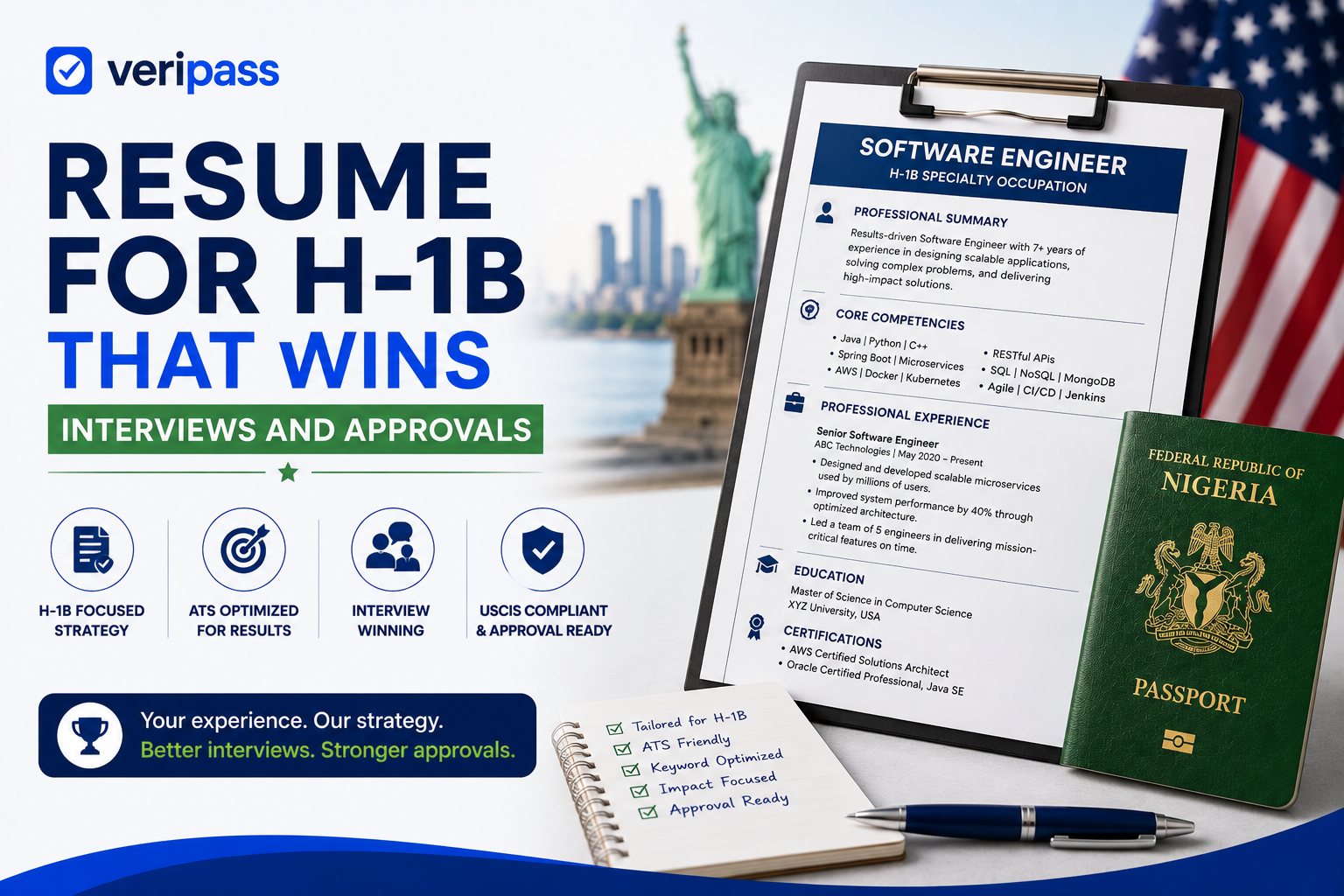
A Nigerian engineer I know cleared five interview rounds at a US company. The offer came. The sponsorship started. Nine months later, a single line on his resume for H-1B triggered a Request for Evidence, the company got cold feet, and the whole thing collapsed. He never went back to fix the line, because nobody had ever told him it mattered. Here is what he did not know, and what almost nobody tells you. Your resume for H-1B gets read twice by two people who want completely different things. A recruiter scans it in ten seconds, looking for reasons to say yes. Months later, a government officer reads the same page looking for reasons to say no.
Almost every guide online prepares you for the first reader and leaves you exposed to the second.
That gap is where good candidates lose years. Not on skill, not on interviews, but on a document they thought was finished. This guide shows you how to write one version that wins both.
Read Also: H-1B Visa Alternatives 2026 Proven to Beat the Lottery
What Changed in 2026 and Why Your Resume for H-1B Carries More Weight
Four things shifted, and each one raises the cost of a sloppy document.
- Selection is no longer a flat lottery. DHS finalized a weighted selection rule effective February 27, 2026. Registrations tied to higher Department of Labor wage levels now get entered into the pool more times. Your seniority and how you present it feed directly into which wage level an employer assigns you.
- Registration costs real money. The fee sits at $215 per person. Employers used to register broadly and sort candidates later. Now they pre-screen harder, so a resume that leaves them guessing gets cut early.
- A $100,000 payment on certain new petitions is currently blocked. A federal court struck down the policy in June 2026, and an appeals court kept it blocked in July. The appeal continues, and the underlying proclamation is set to expire in late September 2026. Employers are still pricing the risk into hiring decisions, which affects how willing they are to sponsor someone based abroad.
- The degree rule got sharper. Since January 17, 2025, the H-1B modernization rule requires the degree field to be “directly related” to the job duties, which DHS defines as a logical connection between the two. Officers can look at your transcripts and coursework. Your resume is where that connection either shows up or does not.
Where to Put Work Authorization on Your Resume for H-1B
The advice online contradicts itself here. One camp says hide your status so you get judged on skill. The other says put it in the header. Both are half right, because the correct answer depends on your situation.
If you are inside the US on OPT, STEM OPT, or an existing H-1B, put a single line under your contact details. Name the exact status and the expiration month and year. “F-1 STEM OPT, valid through August 2028. Requires H-1B sponsorship thereafter.” Vague lines like “visa status” or “will need sponsorship” cost you more than clarity does, because the recruiter fills the gap with the worst assumption.
If you are outside the US with no American status, say so plainly and say it early. “Based in Lagos. Requires H-1B sponsorship. Open to cap-exempt roles.” Hiding it wastes everyone’s time and gets discovered at the first screening call anyway.
If you already hold an H-1B and want to move, lead with it. “Current H-1B holder, eligible for transfer. No lottery required.” That line is a selling point. It removes the employer’s biggest objection before they raise it.
If you are targeting cap-exempt employers, universities, qualifying nonprofit research bodies, and government research organizations can file year-round outside the lottery. Say you are open to those roles. It signals you understand the system.
Never apologize on the page. Sponsorship is an administrative step, not a favor you are begging for.
Make the degree-to-duties link impossible to miss
This is the section every competing article skips, and it is the one that decides your petition.
The officer is asking whether your job genuinely requires a specific degree, and whether your degree matches it. Bullets written purely to impress a hiring manager often destroy that link.
Weak version, written for the recruiter only:
Led cross-functional initiatives to drive business growth and improve customer outcomes.
That sentence describes work any capable person could do without a degree. It quietly undermines the specialty occupation argument.
Stronger version, which serves both readers:
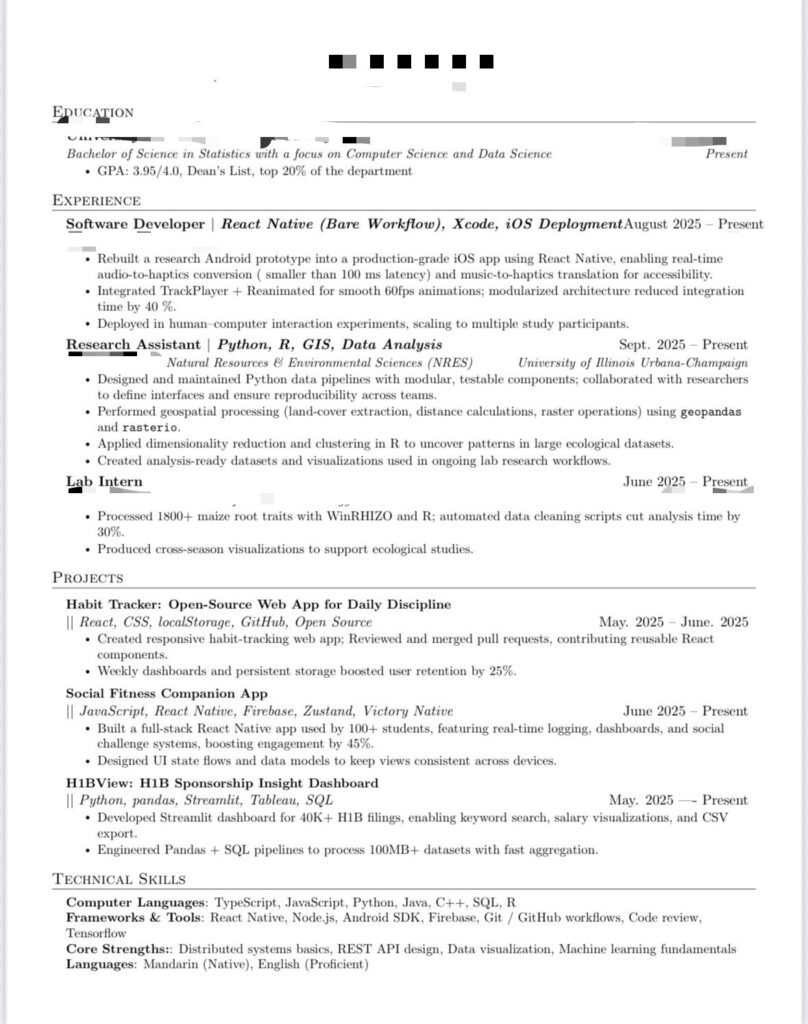
Built and deployed a gradient boosting fraud detection model in Python, reducing chargeback losses by 41 percent across four markets and saving $2.3M in the first year.
The second version names the technical method, which ties back to a computer science or statistics degree. It names the tools. It quantifies the result, which the recruiter wants. Nothing was sacrificed.
Run every bullet through one question. Does this line show work that required specialized knowledge from a specific field of study? If it does not, rewrite it or cut it.
Foreign degrees and the three-for-one rule
Write your degree the way American systems expect. “M.Sc. Computer Science, University of Ibadan, Ibadan, Nigeria” parses correctly. Local abbreviations such as B.E. or B. Tech often do not, and applicant tracking systems drop what they cannot read.
If your degree came from outside the US, a credential evaluation from a recognized service translates it into the American equivalent. Get one before you need it, then reference it on your resume in a short line under education.
If you have no bachelor’s degree, US immigration regulations allow three years of progressive specialized experience to substitute for each year of university study. Twelve years of relevant senior work can equal a four-year degree. That equivalency requires an expert opinion letter to establish, and your resume needs clean, verifiable dates and progressively senior titles for anyone to build that case. Gaps and vague date ranges kill it.
Keep every document telling the same story
Your resume will eventually sit beside your LinkedIn profile, your Labor Condition Application job title, your transcripts, your petition letter, and whatever you say at a consular interview. Officers compare them.
Run this check before you send anything out.
- Do your employment dates match your LinkedIn exactly, month and year?
- Does the job title on your resume match the title your employer will list on the petition?
- Does your stated seniority line up with the wage level your employer intends to file?
- Are your degree name, institution, and graduation year identical everywhere?
- Have you inflated any title or team size that a reference check would contradict?
Rounding a title up feels harmless in a job hunt. Inside a federal filing, a mismatch invites scrutiny you do not want.
The same document opens four other doors
Here is the part worth sitting with. If you are a founder, an executive, or a senior specialist, the H-1B may be the worst route available to you, because it depends on an employer, a lottery, and a wage level you do not control.
Four other pathways let you carry your own case, and every one of them runs on the same document.
The O-1A visa has no cap and no lottery. Since January 2025, USCIS guidance confirms a company you own can file the petition on your behalf. Your record of achievement is the evidence.
The EB-2 National Interest Waiver skips the job offer and the labor certification. USCIS updated its guidance in January 2025, and the bar for showing national importance is now higher. Broad claims about creating jobs no longer carry a petition.
The UK Global Talent visa requires endorsement first, and your CV is a core part of that application. Most endorsing bodies cap it at three pages.
Australia’s National Innovation visa, subclass 858, is invitation only and grants permanent residence directly. The expression of interest turns on a detailed record of internationally recognized achievement.
For these routes, your resume stops being a job-hunting tool. It becomes the spine of an evidence file. Which means you should be writing it that way now, whichever route you take first.
A worked example
Here is a resume header and opening section written to pass both readers, with the reasoning marked underneath.
CHIAMAKA OBI
Senior Machine Learning Engineer
Lagos, Nigeria | +1 (415) 555-0142 | chiamaka.obi@email.com
linkedin.com/in/chiamakaobi
Work Authorization: Based outside the US. Requires H-1B sponsorship.
Open to cap-exempt research roles.

SUMMARY
Machine learning engineer with 8 years applying statistical modeling and
distributed systems to payment fraud across four African markets.
M.Sc. Computer Science.

EXPERIENCE
Senior Machine Learning Engineer
PayCore Limited, Lagos, Nigeria | March 2022 to Present
- Built and deployed a gradient boosting fraud detection model in Python
  and Spark, cutting chargeback losses 41 percent and saving $2.3M in
  year one.
- Designed the feature engineering pipeline processing 4M daily
  transactions, reducing model inference latency from 340ms to 60ms.
- Published findings at the 2024 West Africa FinTech Summit and
  co-authored two peer-reviewed papers on real-time fraud scoring.

EDUCATION
M.Sc. Computer Science, University of Ibadan, Ibadan, Nigeria, 2017
B.Sc. Computer Science, University of Lagos, Lagos, Nigeria, 2014
US equivalency evaluation available on request.
Why each choice works.
- The US phone number removes friction. Recruiters still call, and many will not dial internationally.
- The authorization line names the situation without apology and adds cap-exempt openness, which widens the employer pool.
- The summary states the degree in the first three lines, so the officer reading for specialty occupation finds it immediately.
- Every bullet names a technical method. That is what ties the work to a computer science degree.
- The numbers serve the recruiter. The methods serve the officer. Neither reader is shortchanged.
- The publications line does double duty. It means little for H-1B and a great deal if this person later files O-1A or EB-2 NIW.
- The equivalency note tells an employer’s attorney the credential work is already handled.
- No photo, no date of birth, no marital status, no passport number. American employers do not expect them, and some cannot legally consider them.
Where Veripass fits
Everything above is work you can do alone. The harder question is which route you should be building this document for in the first place, and that is where most people lose a year.
Veripass works with founders, executives, and senior professionals across the exact set of pathways in this guide. US O-1, EB-1A, and EB-2 NIW, the UK Global Talent visa, and Australia’s National Innovation visa. That range matters, because the honest answer for a lot of people reading this is that the H-1B lottery is the least attractive option on their table, and nobody has told them.
What the team actually does is threefold. They assess your existing record against the criteria for each route and tell you where you currently stand, which is different from telling you what you want to hear. They identify the specific gaps between your profile and the standard a decision maker will apply, so you know what to build in the next six to twelve months. Then they manage the case through preparation, filing, and the stages that follow, with a client experience team that stays with you rather than handing you off after the paperwork goes out.
For someone with a real body of work behind them, that assessment usually reframes the whole plan.
Start with the assessment
Veripass runs a free masterclass covering the O-1, EB-2 NIW, UK Global Talent, and Australia NIV routes, including how to read your own record against what each one requires.
Register for the Veripass masterclass.
Bring your resume. You will look at it differently by the end.
Does an H-1B visa require a resume?
What is the latest news on H-1B visas?
Is ICE arresting H-1B holders?
What documents do I need for an H-1B interview?
1. A passport valid for at least six months beyond your intended stay, plus any old passports with previous US visas.
2. Your DS-160 confirmation page and your appointment confirmation.
3. Proof that you paid the visa fee.
4. A photo that meets US visa specifications, in case the digital upload failed.
5. The original or a copy of Form I-797, your approval notice.
6. A copy of the full I-129 petition your employer filed, including supporting documents.
7. The certified Labor Condition Application, Form ETA-9035.
8. A support letter from your employer describing your job duties, salary, work location, and start date.
9. Your degree certificates and transcripts, plus a credential evaluation if your degree is foreign.
10. Your resume, matching the version filed with the petition.
11. Recent pay slips or an employment verification letter if you have worked in the US before.
12. Marriage and birth certificates if dependents are applying with you.
The officer is checking whether your account of the job matches the paperwork. Read the petition before you go, so you can describe your role in the same terms it uses.
This is general information, not legal advice. Immigration rules change often. Confirm anything specific to your case with a qualified immigration attorney.