
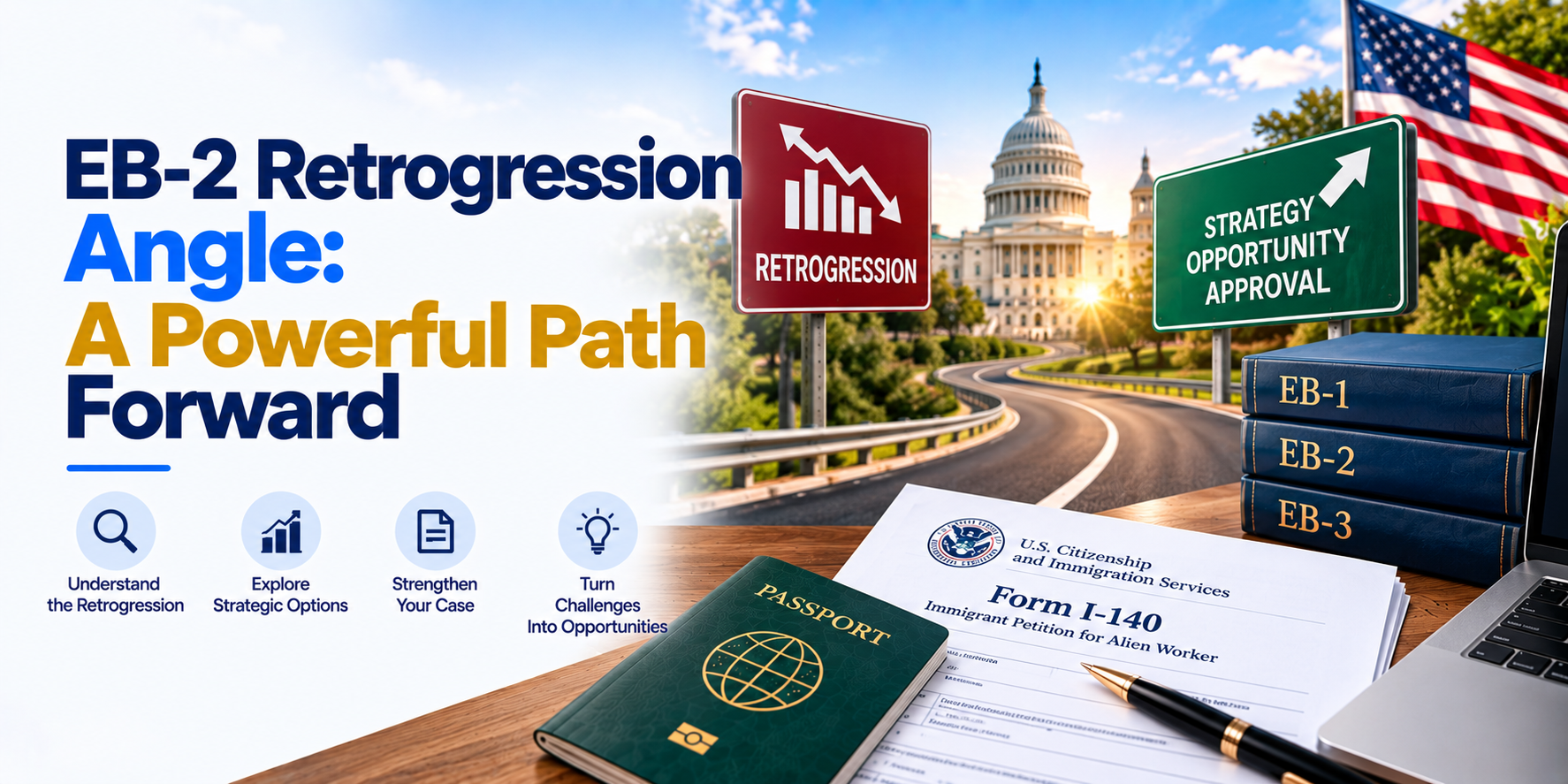
The EB-2 retrogression angle becomes painfully real when you have done everything right, built a strong career, filed your case, waited patiently, and then watched your green card timeline suddenly move backward. One Visa Bulletin update can turn confidence into uncertainty and leave you asking a hard question: How much longer will I have to wait?
For founders, executives, skilled professionals, researchers, and high-achieving workers, that delay can affect far more than immigration paperwork. It can affect when you switch jobs, grow a company, relocate your family, invest, accept new opportunities, or plan the next stage of your life.
But this is where the EB-2 retrogression angle becomes more than bad news. Retrogression can slow your timeline, but it does not have to stop your plans. If you understand what the dates actually mean, know where you stand, and start preparing the right alternatives early, you can use this waiting period to strengthen your position instead of simply watching the calendar.
Read Also: EB-2 NIW Case Filing 2025
What Happened to EB-2 in 2026?
The U.S. government limits the number of employment-based immigrant visas available each fiscal year.
When demand becomes greater than the number of visas available, the Department of State can set or move back a cutoff date. Applicants whose priority dates fall after that date must wait.
That backward movement is called visa retrogression.
We saw a clear example with India in June 2026.
The Department of State moved India’s EB-2 Final Action Date back to September 1, 2013, and said high demand and visa use made the change necessary to stay within the annual limit.
Then came another major change in October 2026.
For EB-2 applicants in countries grouped under “all chargeability areas except those listed,” as well as Mexico and the Philippines, the Final Action Date became January 1, 2025. The Dates for Filing cutoff became March 15, 2026.
USCIS also selected the Dates for Filing chart for employment-based adjustment applications in October 2026.
Those dates tell us something important.
A person may be able to file part of the green card process before USCIS can give that person final permanent residence.
That difference causes a lot of confusion.

EB-2 Retrogression Does Not Mean Your EB-2 Case Has Failed
This is probably the most important point in this article.
Retrogression does not mean USCIS suddenly thinks you are unqualified.
It does not automatically cancel an approved I-140.
It does not mean EB-2 NIW has stopped working.
And it does not mean every applicant should abandon the United States.
You need to separate qualification from visa availability.
Think of the process as four different stages:
Stage 1: You qualify for an immigrant category.
For EB-2, this may involve an advanced degree or exceptional ability. Some applicants may also qualify for a National Interest Waiver, which can remove the normal job-offer and labor-certification requirements.
Stage 2: You file Form I-140.
For many applicants, this is where a priority date becomes important.
Stage 3: You become eligible to file Form I-485 if you are in the United States and meet the applicable requirements.
Your ability to file depends partly on your priority date and the chart USCIS tells employment-based applicants to use that month.
Stage 4: USCIS can approve permanent residence only when an immigrant visa number is available.
That is where the Final Action Date matters.
Retrogression mainly creates trouble between these stages. It can delay filing for some people and final approval for others.
It does not erase your professional record.
The Two Clocks Every EB-2 Applicant Should Watch
A simple way to understand the problem is to think about two clocks.
Clock One: Your Petition
This involves building and filing your immigration petition.
For EB-2 NIW applicants, that includes proving that you meet the EB-2 requirements and that your proposed work meets the National Interest Waiver standard.
Clock Two: Visa Availability
This is controlled by immigrant visa supply, your preference category, your priority date, and usually your country of chargeability.
You can win the first race and still wait on the second.
That is why an approved I-140 does not always lead immediately to a green card.
For founders, executives, researchers, technology professionals, creatives, engineers, healthcare professionals, and other skilled workers, understanding these two clocks can change how you plan the next few years.
Should You Still Start an EB-2 NIW Case During Retrogression?
For some applicants, yes.
Retrogression can actually make the timing question more serious, not less.
If you qualify and file an I-140, you may establish a priority date that determines your place in the employment-based immigrant visa queue.
Waiting for the Visa Bulletin to improve before starting your case can create a problem: other qualified applicants may continue filing while you wait.
That does not mean everyone should rush into EB-2 NIW. Filing a weak petition simply to obtain a date is not a good strategy.
The better question is:
Do you qualify now, and if you do, does filing now fit your wider immigration plan?
If the answer may be yes, speak with a qualified immigration professional and assess the case based on your evidence, career plans, location, family, and alternatives.
What If Your I-140 Is Approved but Your Priority Date Is Not Current?
This is where many applicants become frustrated.
An approved I-140 means USCIS approved the immigrant petition. It does not mean the government can immediately approve permanent residence.
A visa number still needs to be available.
If your priority date falls after the applicable cutoff, you may need to wait.
Use that waiting period properly.
Keep records of your professional progress. Save evidence of major projects, company growth, publications, media coverage, awards, speaking engagements, patents, product launches, revenue growth, research impact, industry recognition, leadership responsibilities, and other relevant achievements.
Your profile may become strong enough for another immigration route while you wait.
That possibility matters.
What If You Already Filed Form I-485?
This creates a different situation.
If USCIS accepted your I-485 while you were eligible to file it, later retrogression does not automatically mean USCIS will reject the pending case simply because the Final Action Date moved backward.
Instead, the case can remain pending until a visa number becomes available for final action.
Applicants with a pending I-485 may also be eligible to apply for employment authorization and, in appropriate cases, Advance Parole for travel. USCIS confirms that people waiting for a final I-485 decision can apply for certain interim benefits, subject to the applicable rules.
Do not assume that Advance Parole gives you unlimited freedom to travel. Your immigration status, travel history, pending applications, and other facts can affect the analysis. Get case-specific advice before leaving the United States.
Filing Date and Final Action Date Are Not the Same Thing
This distinction deserves its own section because many applicants get it wrong.
The Department of State publishes two employment-based charts.
Dates for Filing
This can tell you when you may be allowed to submit documentation or, for adjustment applicants, file Form I-485 when USCIS authorizes use of that chart.
Final Action Dates
This determines when an immigrant visa number can be used for final approval.
For October 2026, EB-2 applicants in many countries face a clear gap:
- Dates for Filing: March 15, 2026
- Final Action Date: January 1, 2025
USCIS selected Dates for Filing for employment-based adjustment applications that month.
So someone with a qualifying priority date could potentially become eligible to file I-485 before becoming eligible for final green card approval.
That is not a contradiction. The two charts do different jobs.
Your Country of Birth Can Matter More Than Your Passport
Another common mistake is focusing only on citizenship.
Employment-based visa limits normally use chargeability, which is generally linked to your country of birth, subject to specific rules and exceptions.
This matters if you have changed citizenship or hold several passports.
Do not look at a Visa Bulletin column based only on the passport you currently carry and assume that column applies to you.
Confirm your chargeability first.
For married applicants, cross-chargeability rules may also matter in some cases. That is another reason to review the full family situation rather than looking only at the main applicant.

Retrogression Is Also a Family Problem
Visa Bulletin articles often treat immigration as if one professional is moving alone.
Many are not.
A founder may have a spouse and two children. An executive may need to choose schools. A skilled worker may have a spouse whose career depends on work authorization.
Longer waits can affect:
- children’s immigration timing;
- aging-out concerns;
- a spouse’s ability to work;
- school decisions;
- where a family lives;
- international travel;
- employment changes;
- housing decisions; and
- long-term financial planning.
Under U.S. immigration law, spouses and qualifying children can generally receive derivative status in preference categories when the legal requirements are met.
So your immigration strategy should include your family from the start.
If EB-2 Slows Down, Should You Consider EB-1A?
Possibly.
EB-1A is an immigrant classification for people who can meet the extraordinary ability standard.
It does not require PERM labor certification or a permanent job offer in the same way as many employer-sponsored categories.
But EB-1A has a high evidentiary standard.
Do not treat it as an automatic “upgrade” from EB-2 NIW.
Instead, ask a better question:
Has your profile grown enough to support an EB-1A case?
A founder who has raised significant capital, built a company with measurable impact, received major press coverage, judged other companies or founders, earned respected awards, created important technology, or developed a strong record of industry leadership may have evidence worth assessing.
A senior executive, researcher, engineer, creative, physician, or technology leader may also build evidence over time.
Your EB-2 waiting period can become a profile-building period.
Do Not Confuse O-1 With EB-1A
This matters for readers exploring several U.S. options.
The O-1 is a temporary nonimmigrant classification for qualifying people with extraordinary ability or achievement.
EB-1A is an immigrant classification that can lead to permanent residence.
The standards and evidence rules are not identical.
USCIS has specifically explained that the legal standards for O-1 and EB-1 extraordinary ability are not the same in every context.
A strong O-1 case can be relevant to long-term immigration planning, but an O-1 approval does not automatically mean you qualify for EB-1A.
Founders and Executives Should Avoid a One-Country Immigration Plan
One of the biggest mistakes high-skilled professionals make is treating immigration as a single application rather than a business and life strategy.
The United States may still be your first choice.
But if timing affects your company, career, investment, or family, assess other routes that fit your actual profile.
For example, the UK Global Talent Visa can apply to qualifying leaders or potential leaders in fields such as academia, research, arts and culture, and digital technology.
Canada also has several work-permit routes for high-skilled talent. The Global Talent Stream is employer-driven and targets qualifying high-skilled workers; the Canadian government currently states a 10-business-day service standard for eligible GTS LMIA applications and a two-week target for certain qualifying work permits, with conditions attached to those service standards.
Canada’s C10 significant-benefit exemption can apply in cases where the proposed work brings significant economic, social, or cultural benefit to Canada. It is not a general founder visa, and the evidence must support the claimed Canadian benefit.
Australia’s National Innovation Visa, subclass 858, is an invitation-only permanent visa for established and emerging leaders with an internationally recognized record of outstanding achievement. Australia lists researchers, entrepreneurs, innovative investors, athletes, and creatives among the groups it may cover.
These routes are not substitutes that fit everyone.
They are options to assess when your profile, plans, timing, and goals support them.
What You Should Be Doing During EB-2 Retrogression
Do not spend every month refreshing the Visa Bulletin and doing nothing else.
Use the time.
First, know your exact priority date and chargeability. Do not rely on memory.
Second, check the Visa Bulletin every month. If you plan to adjust status in the United States, check the USCIS filing-chart page separately. USCIS can change which chart applicants must use from one month to another.
Third, prepare before your filing window opens. A favorable Visa Bulletin does little for you if your documents are not ready.
Fourth, keep building your professional evidence. Your work may support a stronger NIW case, a future EB-1A strategy, an O-1 petition, or an option in another country.
Fifth, review your immigration plan before changing jobs, corporate structures, or countries. Some immigration categories depend heavily on the petitioner, employer, offered position, or continuing work.
Sixth, include your spouse and children in the strategy.
Finally, compare routes before committing years to one plan.
The right question is not simply, “Which visa can I get?”
Ask:
Which immigration structure gives me the best combination of mobility, career freedom, family stability, and long-term residence based on the evidence I have today?
This Is Where Veripass Can Help
If you are a founder, executive, skilled worker, researcher, creative professional, or business leader, you may have several possible immigration routes but no clear way to compare them.
That is where Veripass can become your first step.
Instead of looking at EB-2 retrogression in isolation, Veripass helps you look at your profile as a whole.
Your education matters.
Your work history matters.
Your leadership record matters.
Your publications, awards, media features, salary, funding, patents, judging experience, company growth, research, speaking engagements, and industry impact may matter.
Your family and preferred country matter too.
Veripass can help you assess pathways such as U.S. O-1, EB-1A and EB-2 NIW; the UK Global Talent Visa; Canadian high-skilled and significant-benefit routes; and Australia’s National Innovation Visa, then help you understand which options deserve deeper professional review.
That matters during retrogression because waiting for one immigration queue to move should not stop you from assessing the rest of your options.
You may still conclude that EB-2 NIW is your strongest path.
You may decide to build toward EB-1A.
You may need a temporary O-1 strategy while building a permanent residence case.
Or your goals may fit the UK, Canada, or Australia better.
The answer depends on your evidence and your plans.
The Real Lesson From the EB-2 Retrogression Angle
Retrogression changes timing.
It does not automatically end your U.S. immigration plan.
The bigger risk is spending months or years waiting for dates to move without improving your position.
Know your priority date.
Know which Visa Bulletin chart applies.
Prepare before your filing window arrives.
Keep building evidence.
Review your family situation.
Assess EB-1A or O-1 if your record supports it.
And if your career gives you options in several countries, compare those options before making a long-term decision.
You cannot control the Visa Bulletin.
You can control how prepared you are when it moves.
Ready to Know Which Immigration Path Fits Your Profile?
If EB-2 retrogression has left you unsure about your next move, start by reviewing your full profile instead of guessing from a Visa Bulletin table.
Book a free discovery call with Veripass to discuss your background, immigration goals, and potential pathways.
Which one is better, EB-2 or EB-3?
Neither is automatically better. The right category depends on your qualifications, the job requirements, your country of chargeability, and current Visa Bulletin movement.
EB-2 generally applies to professionals with an advanced degree or people with exceptional ability. EB-3 covers skilled workers, professionals, and certain other workers. EB-2 usually has a higher qualification threshold, but that does not always mean a shorter wait. In some periods, an EB-3 priority date may move faster than EB-2 for a particular country.
The best approach is to compare your eligibility and the current Visa Bulletin before deciding which category makes more sense for your case.
Is an EB-2 visa hard to get?
It can be, because you must meet specific legal requirements and support your case with strong evidence.
For the advanced-degree route, you generally need an advanced degree or a bachelor’s degree followed by at least five years of progressive post-bachelor’s work experience in the specialty. The exceptional-ability route requires evidence showing expertise significantly above what is normally found in your field.
If you apply through EB-2 National Interest Waiver, you must also show that waiving the normal job-offer and labor-certification requirements would benefit the United States. A strong professional profile helps, but approval is never automatic.
What does EB-2 stand for in the context of immigration?
EB-2 means Employment-Based Second Preference.
It is a U.S. employment-based immigrant category mainly for professionals with advanced degrees and people with exceptional ability in the sciences, arts, or business.
Some EB-2 applicants need an employer and labor certification. Others may qualify for a National Interest Waiver, or NIW, which can allow them to request a waiver of the job-offer and labor-certification requirements.
Can I downgrade from EB-2 to EB-3?
In some situations, yes, but it is not as simple as changing the label on an existing EB-2 petition.
Moving from EB-2 to EB-3 may require a separate qualifying Form I-140 petition and supporting documentation. If you already have a pending Form I-485, USCIS also allows some applicants to request a transfer of the underlying basis of the adjustment application to another qualifying employment-based petition.
USCIS states that you must remain eligible for adjustment and must qualify for the new immigrant category. In qualifying EB-1, EB-2, and EB-3 cases, priority-date retention rules may also allow an earlier priority date to carry over.
A downgrade can sometimes make sense when EB-3 has a more favorable Visa Bulletin cutoff than EB-2, but those dates can change. Review the current bulletin and your individual case before making the switch.
This article provides general information and does not replace legal advice. Immigration rules, filing charts, cutoff dates, and individual eligibility can change. Check current government guidance and get case-specific professional advice before filing or making major immigration decisions.