
If you work in tech, research or the arts, and you’ve been wondering whether the UK would take you without a job offer, you’re in the right place. The UK Global Talent visa is one of the few routes that lets you apply on your own merits. You don’t need an employer to sponsor you, neither do you need a minimum salary or an English test.
It’s also easy to misread. Some people assume it’s only for Nobel-level stars, while others treat it like a simple form, and both groups tend to get caught out. This guide walks you through who can apply, how the two stages work, what it costs, how long it takes, and how to tell if it fits you.
Quick Answer: What Is the UK Global Talent Visa?
The UK Global Talent visa lets leaders and potential leaders in academia or research, arts and culture, and digital technology live and work in the UK without a job offer. You first get an endorsement from an approved body in your field (Stage 1). Then you apply for the visa itself (Stage 2). The total government fee is £766 per applicant, plus the healthcare surcharge, and the visa can last up to five years.
Who it’s for: people aged 18 or over who are leaders or potential leaders in their field.
Job offer needed: no.
Language or salary rules: none.
Can your family join you: yes, partners and children can apply as dependants.
Is it a path to settlement: yes, usually after 3 or 5 years, though new settlement rules are on the way (more on that below).
What Is the UK Global Talent Visa?
It’s a UK work visa for people with proven skill or clear potential in a few approved fields. The UK wants people who can lead or shape their field, and it lets approved expert bodies decide who qualifies.
That’s why the UK Global Talent visa works differently from most visas. You don’t need an employer to sponsor you. You can be employed, self-employed or run your own company. You can change jobs without asking the Home Office for permission each time.
The visa has no overall time limit, as long as you keep extending it. You can read the official overview any time to see the latest rules. We’ve checked every fact in this guide against the official pages, and we note the date at the end.
Who Can Apply? UK Global Talent Visa Requirements
You can apply if you’re 18 or over and you’re a leader or potential leader in academia or research, arts and culture, or digital technology. You also need to meet the evidence standard of the endorsing body for your field. There’s no minimum salary, no job offer and no English language test.
Think of the rules in two layers. First, the Home Office sets the broad frame: your field, your age and the two-stage process. Second, the endorsing body in your field decides if your evidence is strong enough. The second layer is where most of the work happens.
Digital technology route
This route is for people who lead or can lead in the tech sector, such as founders, engineers, product leaders and data specialists. Tech Nation is the endorsing body, and it looks at your track record, your impact and your contribution to the field. Endorsement for this route usually takes 5 to 8 weeks. Read the official page for digital technology to see the exact criteria.
Academia and research route
This route is for established researchers and promising early-career researchers. The endorsement usually takes around 2 weeks on the fast-track and about 5 weeks through peer review. The official page for research explains which option fits which applicant.
Arts and culture route
This route covers areas such as film, fashion, music, design and the visual arts. Endorsement usually takes about 8 weeks. The official page for arts and culture lists the fields and the evidence they accept.
Prize winners
If you’ve won an eligible prestigious prize on the official list, you can apply for the visa directly and skip the endorsement. Most applicants don’t fall into this group, so the rest of this guide assumes you need the endorsement.
Exceptional Talent vs Exceptional Promise: What’s the Difference?
Exceptional talent is for people who are already recognised leaders in their field. Exceptional promise is for people early in their career who show they could become leaders. You apply under one of the two, and you can’t pick whichever sounds easier.
Here’s the practical difference:
Exceptional talent is for people with an established record: years of work, recognition and proof of leading in the field.
Exceptional promise is for people earlier in their journey: strong results so far and signs of where you’re heading.
The choice affects the evidence you gather and, under the current rules, how soon you can settle. If you want the full breakdown, our guide on how the UK Global Talent visa works for designers shows how one field handles both levels.
How Does the UK Global Talent Visa Work? The Two Stages
The UK Global Talent visa has two stages: first you get an endorsement from an approved body, then you apply to the Home Office for the visa itself. Stage 1 is where your talent is judged. Stage 2 is mostly identity, background and paperwork.
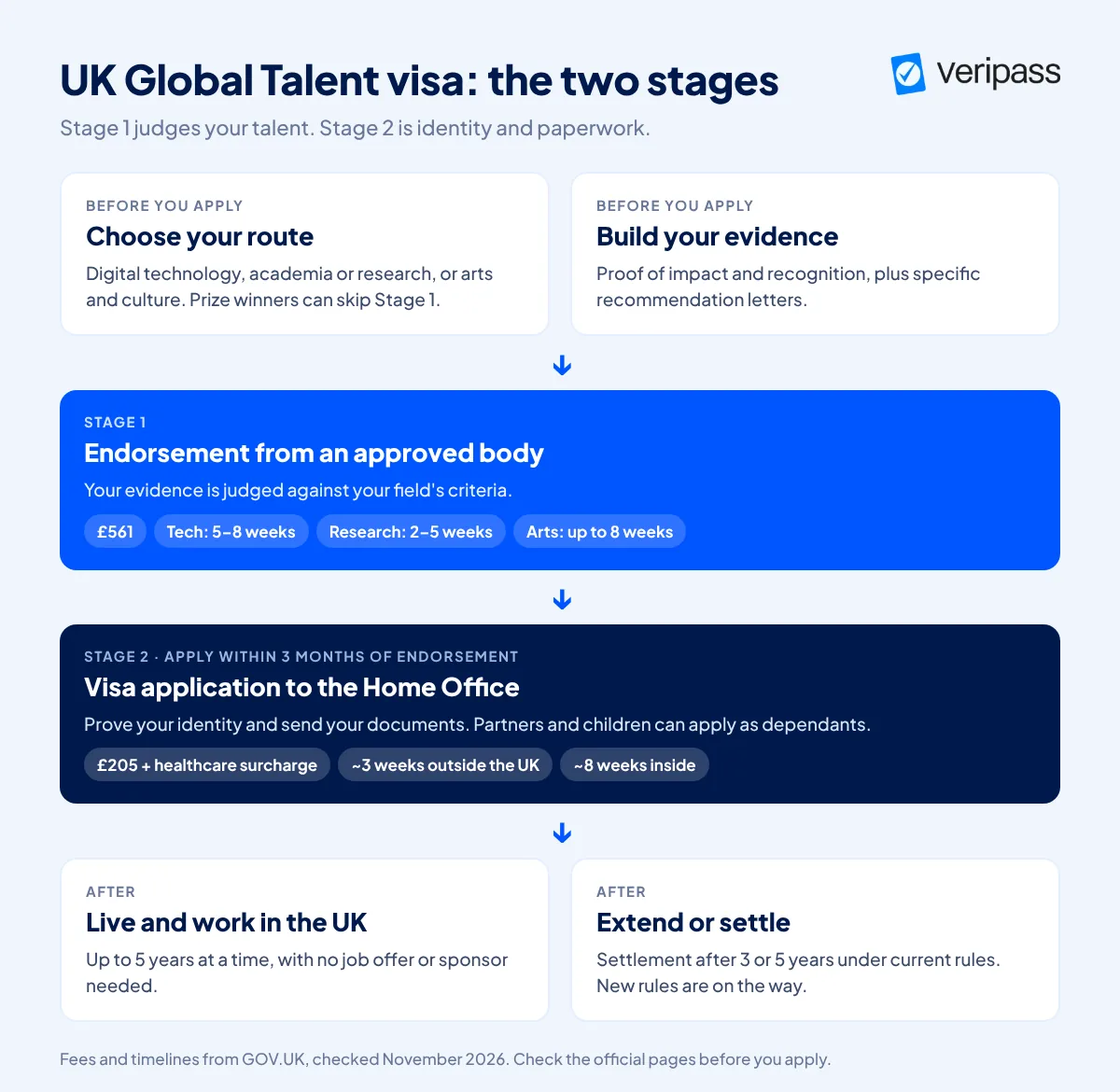
This split matters because people often say their “Global Talent visa was refused” when what really happened is that Stage 1 was refused. You only get the visa after you pass the endorsement. If that’s where you are, our guide to UK Global Talent visa endorsement rejection explains your options.
Step by step
Choose your route. Pick digital technology, research, or arts and culture. Check the prize list too.
Build your evidence. Collect proof of your work, impact and recognition, plus recommendation letters.
Apply for the endorsement (Stage 1). You apply online and pay £561.
Wait for the decision. Timing depends on the route, as covered above.
Apply for the visa (Stage 2). You apply online within 3 months of getting your endorsement and pay £205 plus the healthcare surcharge. On the digital technology and arts routes you can also apply for both stages at once, but the visa may be refused if the endorsement is.
Prove your identity and send documents. You may need an appointment. You’ll find out when you start the application.
Get your decision. This usually takes 3 weeks if you apply from outside the UK, or 8 weeks from inside it.
How long does the whole process take?
Once you submit, expect roughly 5 to 11 weeks in total. That’s 2 to 8 weeks for the endorsement, plus about 3 weeks for the visa decision from outside the UK. These are the official timelines, not guarantees. The longer part is often the preparation. Gathering evidence and good letters can take weeks or months, so start early.
You can apply for the visa up to 3 months before you plan to travel. If you pay for a faster decision, where it’s offered, the visa stage can move quicker.
What Evidence Do You Need for the UK Global Talent Visa?
You need evidence that shows your impact, not just your job titles. The endorsing body wants proof that you lead, build or influence in your field, and that others recognise it. Strong evidence is specific, checkable and tied to results.
Here’s a made-up example to show the difference. This is for illustration only and isn’t a real applicant.
| Weak evidence | Strong evidence |
|---|---|
| “I led the engineering team at a fintech company.” | “I led a team of 12 engineers who built the payments system now used by 400,000 customers. Here is the company’s letter confirming the figures, and a trade-press article about the launch.” |
| A general letter saying “Ada is hardworking and talented.” | A letter from an industry leader who explains how they know your work, names what you built, and says what difference it made. |
The stronger version gives numbers, names and outside proof. Your letters matter a lot here, so read our guide to the immigration recommendation letter before you ask anyone to write one.
Not sure where your profile stands? Our free Veripass assessment gives you a quick, honest view of your strengths and gaps before you spend money on an application.
How Much Does the UK Global Talent Visa Cost?
The government fee is £766 per applicant: £561 for the endorsement and £205 for the visa. You also pay the immigration health surcharge, which is usually £1,035 a year for an adult and £776 a year for a child under 18. These are the official rates we checked on 15 November 2026.
| Cost | Amount |
|---|---|
| Endorsement (Stage 1) | £561 |
| Visa application (Stage 2) | £205 |
| Total application fees per applicant | £766 |
| Healthcare surcharge, adult | £1,035 per year |
| Healthcare surcharge, child under 18 | £776 per year |
A worked example for a family
Say a couple with one young child apply for a 3-year visa. This is an example, so your numbers will change with the visa length and your family.
Main applicant: £766 fees + £3,105 surcharge (3 × £1,035) = £3,871.
Partner: £766 fees + £3,105 surcharge = £3,871.
Child: £766 fees + £2,328 surcharge (3 × £776) = £3,094.
Total: £10,836.
The surcharge is paid in full when you apply, so the whole amount is due upfront. That doesn’t include extras such as a TB test, translations, document fees, or the cost of any expert help. Add a buffer when you plan. Fees change, so confirm the current amounts on the official page before you pay.
Can You Bring Your Family? Global Talent Visa Dependants
Yes. Your partner and your children can apply as your dependants. Each person pays the £766 application fee and the healthcare surcharge. There’s no fee for fingerprints and photos.
Who counts as family:
Partner: your husband, wife, civil partner or unmarried partner. You must show a UK-recognised marriage or civil partnership, or at least 2 years living together, or at least 2 years in a relationship if you can’t live together for a good reason (such as work, study or culture), with proof of ongoing commitment.
Children: under 18, including a child born in the UK during your stay. A child over 18 can apply only if they already have permission to be in the UK as your dependant.
Children must usually live with you, unless they’re in full-time education away from home. They can’t be married or in a civil partnership. You’ll need proof of their address, such as a bank statement.
Can your partner and children work and study?
Yes. Dependants can work (apart from as a professional sportsperson or coach) and study. They can also travel abroad and return, and apply for settlement after 5 years of UK residence under the current rules. They can’t claim most public funds or the State Pension. For many African families, the right to work is a big reason this visa stands out. Your partner doesn’t need a separate job sponsor.
Applying From Nigeria and Other African Countries: What Should You Know?
You can apply from Nigeria or any other African country and the process is the same as anywhere else: you apply online, then prove your identity. You’ll provide your documents as part of the application. You may need an appointment for this, and you’ll find out when you start.
Do you need a TB test?
You may. A TB test is needed if you’re coming to the UK for 6 months or more and you’ve lived in a listed country for 6 months or more. Nigeria, Ghana, Kenya, South Africa and Uganda are all on the list, among many other African countries. Because the Global Talent visa is longer than 6 months, most applicants living in these countries will need one. The certificate is valid for 6 months from the date of your chest x-ray, so book it close to when you plan to apply, and use a clinic on the official approved list. Children must be tested at an approved clinic in a listed country.
Two practical tips for African applicants. First, keep your supporting documents tidy and consistent: names, dates and job titles should match across your CV, letters and certificates. Second, plan for slow document requests, such as employer letters and certificates, which can eat into your timeline.
How Long Does the Visa Last, and Can You Settle in the UK?
The visa can be granted for up to 5 years, and you can extend it for 1 to 5 years at a time with no overall limit. It also leads towards settlement, which is permanent residence.
Under the current rules, you can settle after 3 or 5 years, depending on your field and how you were endorsed. Leaders usually qualify after 3 years and most potential leaders after 5. On 2 November 2026 the government announced its new earned settlement system, which keeps a 3-year path for eligible Global Talent holders, but the detailed rules haven’t been published yet. Check the position before you plan around a date. Our article on the new UK ILR rules for 2026 tracks the changes.
How Hard Is It to Get the UK Global Talent Visa?
It’s demanding, but it isn’t out of reach. You’re asked to prove you’re a leader or potential leader, so a thin application will struggle. That said, it isn’t only for celebrities. Many successful applicants are working professionals with strong, well-documented records.
Outcomes usually come down to the quality of your evidence and how clearly you match it to the criteria. A strong career can still be refused if the application lacks ample evidence, while a more modest one can get through when every claim is backed up.
Common Reasons UK Global Talent Visa Applications Fail
Most failures come from the endorsement stage, and most are about evidence rather than talent. Here are the patterns we see most:
Evidence doesn’t match the criteria. You describe your work well, but it doesn’t answer what the endorsing body asks.
Generic letters. Letters that praise you without showing how the writer knows your work add little.
Claims without proof. Saying you led something isn’t enough without outside confirmation.
The wrong route or level. Applying as an established leader when your record fits potential, or the reverse.
If you’ve already been refused, don’t panic. There’s a review process, and our guide on what to do after a UK Global Talent visa endorsement rejection covers the steps. If you’re comparing options, see how it stacks up in our UK Global Talent visa vs O-1A comparison.
Is the UK Global Talent Visa Right for You?
It’s likely a good fit if you have a strong record in tech, research or the arts, you want freedom to work for yourself or any employer, and you can show proof of impact. It may be less suitable if your record is still very early, or your work doesn’t fit the three fields.
Ask yourself:
Can I show clear results in my field, with documents to back them?
Do I know experts who can write specific, honest letters about my work?
Do I fit one of the three routes?
Can I cover the fees and surcharge for me and my family?
If most answers are yes, you’re in a good position to start. If you’re unsure, take the Veripass smart assessment to see where you stand. You can also read our overview of the UK Global Talent visa service to see how we support applicants.
UK Global Talent Visa FAQ
What is the UK Global Talent visa?
It’s a UK visa for leaders and potential leaders in academia or research, arts and culture, and digital technology. You don’t need a job offer.
Who can apply for the UK Global Talent visa?
Anyone aged 18 or over who is a leader or potential leader in an eligible field and gets endorsed by the right body. Prize winners on the official list can skip the endorsement.
Is the UK Global Talent visa the same as the endorsement?
No. The endorsement is Stage 1 and the visa is Stage 2. You only get the visa after you pass the endorsement.
How much does the UK Global Talent visa cost?
The fees are £766 per applicant (£561 endorsement and £205 visa), plus the healthcare surcharge, usually £1,035 a year for an adult.
How long does the UK Global Talent visa take?
Endorsement takes about 2 to 8 weeks depending on the route. The visa decision usually takes 3 weeks from outside the UK and 8 weeks from inside it.
Do you need a job offer for the UK Global Talent visa?
No. You can be employed, self-employed or a company director.
Is there an English test or salary requirement?
No. The UK Global Talent visa has no language test and no minimum salary.
How long is the UK Global Talent visa valid?
Up to 5 years. You can extend it for 1 to 5 years at a time, and there’s no overall limit.
Can my partner and children come with me?
Yes. They apply as dependants and pay the same £766 fee and healthcare surcharge each.
Can my partner work in the UK on this visa?
Yes, apart from as a professional sportsperson or coach. They can also study.
Can I apply for the UK Global Talent visa from Nigeria?
Yes. You apply online and prove your identity as part of the process. Check whether you need a TB test, since Nigeria is on the official list.
Can the UK Global Talent visa lead to permanent residence?
Yes. Under the current rules you can settle after 3 or 5 years, depending on your field and endorsement. New settlement rules announced in November 2026 keep a 3-year path for eligible Global Talent holders, but check the latest position before you plan.
Ready to Check Your Chances?
The UK Global Talent visa rewards clear evidence and good preparation. If you’d like a straight answer on where you stand, take the free Veripass assessment. It takes a few minutes and shows your strengths and the gaps to close before you apply.
This guide is general information, not legal advice. Immigration rules and fees change, so check the official pages or speak to a qualified adviser before you apply. Facts checked on 13 to 15 November 2026.