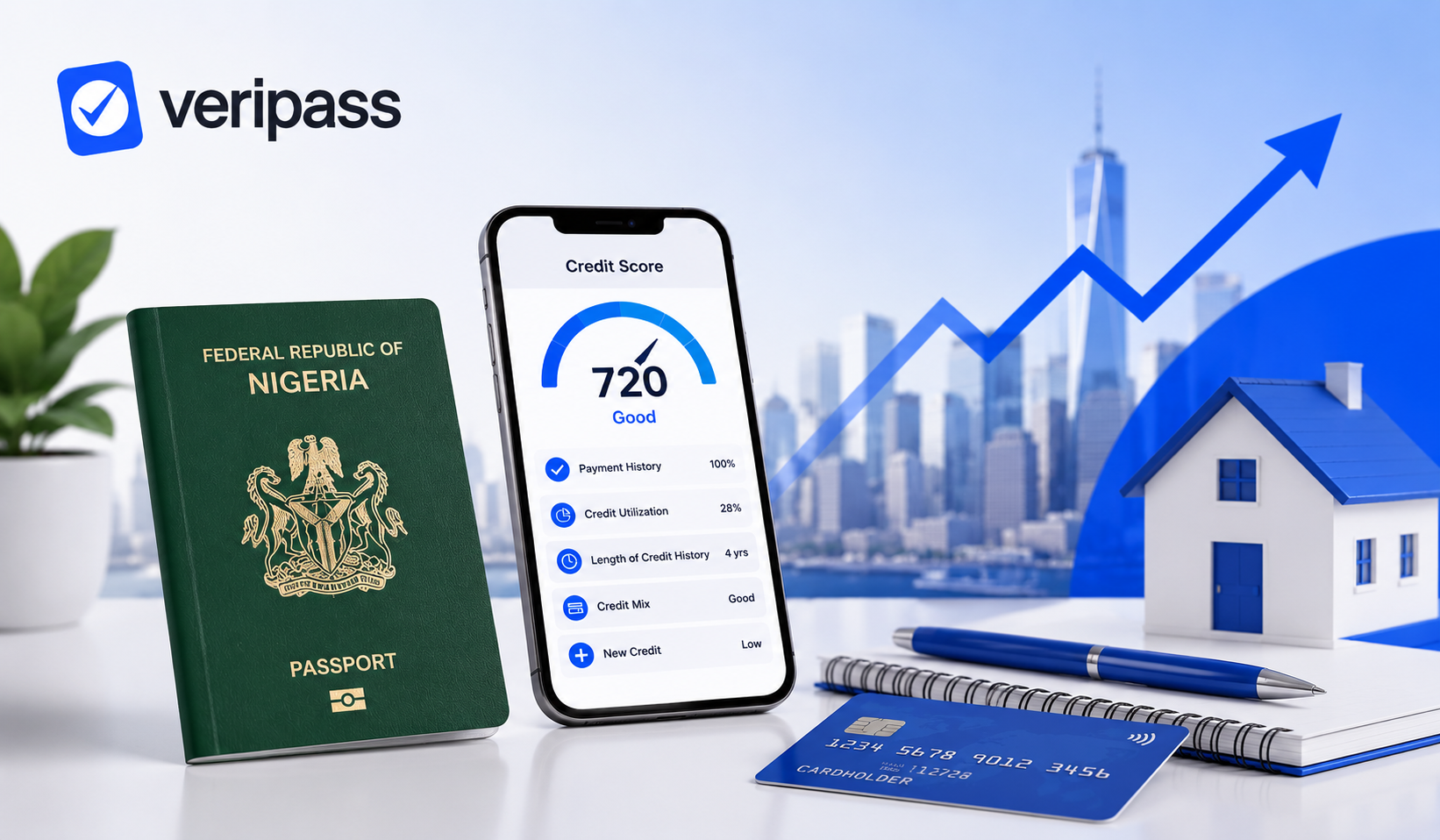
Building a US credit history starts the day you land, except yours starts at zero. Three months in, your spouse tries to rent an apartment in a building she could have bought outright in Lagos. The landlord asks for a US credit score, and there isn’t one. So you pay six months upfront. A US guarantor signs alongside her. The apartment gets secured, but not the way either of you expected.
This happens to almost every Nigerian professional in the first year. It’s not a reflection of your finances; it’s a reflection of a system that has no memory of you yet.
Back home, years of your financial credibility sit on record: mortgage payments, car loans cleared early, a GTBank or Access account held for a decade in good standing. The US system has seen none of it. The gap between what you’ve built and what this country can see is one of the least-discussed parts of the relocation.
The visa was the hard part, or so you thought. There is a second system running quietly in parallel to the immigration one, with its own rules, its own gatekeepers, and a timeline you cannot rush through with effort alone. Most newcomers lose 12 to 18 months figuring this out. This piece is for the ones who would rather not.
Read Also: US Tax Obligations Before Relocating: What Nigerian Professionals Must Know
Why Your Nigerian Credit History Means Nothing in the US
Your Nigerian credit record is held by one of three local bureaus: CRC Credit Bureau, FirstCentral, or CreditRegistry. Nigerian banks pull from these before approving loans, overdrafts, or financing. They are legitimate institutions with real data on you –they just don’t talk to the US system.
There’s no treaty, no data-sharing pipeline, no mechanism by which a US lender can see what you built at home. A bank in New York runs your name and gets a blank file.
The Consumer Financial Protection Bureau has a name for this: credit invisible. The CFPB’s June 2025 update put the number at about 7 million US adults with no credit record at all, plus another 25 million with a credit record too thin to generate a score. Recent immigrants are overrepresented in both groups, regardless of income or how disciplined they were back home. You are not an edge case. You are joining one of the most underserved segments in US consumer finance, and how you close that gap in year one separates a smooth first year from a frustrating one.
There is one partial workaround. Nova Credit partners directly with CRC Credit Bureau, which lets you share your Nigerian credit history with a small group of US lenders. American Express was the first major one to accept it. It does not give you a US credit score, but it can help you get approved for a starter card before your US file exists. It is useful in the first few months and can not substitute for building proper US credit over time.
How the US Credit System Works
Three bureaus run the show: Experian, Equifax, and TransUnion. Every credit card, loan, and qualifying bill payment in your name gets reported to one or more of them, and lenders pull from whichever bureau they prefer. Your file at each bureau is not always identical, which is why one lender might approve you and another might not for the same application.
Your file gets scored on two main models: FICO, used by roughly 90% of US lenders, and VantageScore. Both run on a 300 to 850 scale. What drives the score, in rough order of weight:
- Payment history: whether you pay on time, every time
- Credit utilization: how much of your available credit you’re actually using
- Length of credit history: how old your accounts are
- Credit mix: whether you hold different types of credit
- New inquiries: how recently and often you’ve applied
The one that trips newcomers most consistently is the utilization. You can pay your bill in full every month and still score poorly if your balance is high when the statement closes. The bureau records what you owe on the statement date, not after you pay it. More on this shortly.
You can pull your credit report for free once a year from each bureau at AnnualCreditReport.com. That is the only federally authorized free source.
The Score You Are Actually Aiming For
FICO tiers into five:
- Below 580: Poor
- 580 – 699: Fair
- 670 – 739: Good, this is where most mainstream cards and car loans sit
- 740 – 799: Very good,
- 760+: where the best published interest rates typically begin
- 800+: Exceptional, rates don’t meaningfully improve past here
The average US FICO score in 2025 sat at 713, which is closer to ordinary than elite. Your target at the end of your first year is to clear 670, and by the end of the second year is 740.
This timeline matters because many conventional US mortgage lenders require at least two (2) years of credit history before approving a home loan, not just a high score. If buying a house is on your five-year plan, the credit clock has to start in month one. The professionals who miss this don’t realize it until they are sitting across from a mortgage officer two (2) years later, being told to come back in twelve months.
Your First 30 Days: Three Things That Have to Happen
Your credit file does not start building on its own. Someone has to report activity to a bureau in your name, and before that’s possible, three foundations need to be in place.
Open a US Bank Account, Ideally Before You Land
A few banks let you open before you arrive. HSBC Premier International and Citibank Global both open US accounts from Nigeria, provided you meet their deposit threshold. After arrival, most major banks open accounts for newcomers using a passport, visa stamp, and a US address, with the SSN (Social Security Number) added once it arrives.
The account does not build credit on its own. What it does is give you a US address-of-record for credit applications and the deposit history that secured cards and credit-builder loans pull from.
Get Your Social Security Number Sorted
If you are on an O-1A, H-1B, or EB-2 visa with work authorization, you qualify for a Social Security Number. The Social Security Administration (SSA) recommends waiting at least 10 days after arrival before applying so that your immigration status updates in their system. After application, expect two (2) to six (6) weeks for the card to arrive.
Without an SSN, your credit options are thin. The Individual Taxpayer Identification Number (ITIN) from the IRS exists for tax filing, not credit. A handful of credit unions and lenders like Self accept it, but the options are narrow, and the terms are worse. If you qualify for an SSN, get it and build on it.
For dependents on O-3 status, the system gets harder. O-3 spouses are not permitted to work, which means no SSN, which means no credit accounts in their own name. The practical solution is adding them as an authorized user on your card once you have one, so their file starts building from yours.
Open Your First Credit Account
Almost certainly, this will be a secured card. You deposit a set amount, typically $200 to $500, and that becomes your credit limit. You use the card normally, pay on time, and the issuer reports the activity to the bureaus. After 7 to 12 months of a clean history, most secured cards graduate to unsecured, and your deposit is refunded.
Look for a card with no annual fee, one that reports to all three bureaus, and has a documented graduation path within 12 months. Capital One, Bank of America, Citi, and Discover all offer secured cards that meet these criteria. If you’re already banking with them, start there.
Two rules that matter immediately.
Don’t max the card. Keep your spending below 30% of your limit each month, even if you pay the bill in full. The bureaus see the balance reported at statement close, not after you pay. A $400 balance on a $500 limit looks like 80% utilization on your file and will ding your score even if you clear it the following day.
Do not close the card after it graduates. Your first card is your oldest account. Closing it shortens your average credit age, drops your total available credit, and pushes utilization up across everything else. Keep it open, use it for a small recurring expense, and let it age.

Months 2 to 6: How to Build Faster
A secured card on its own gets you to a respectable score by month 12. These three moves run in parallel and can cut the timeline to six or nine months while adding account depth that matters as much as the score itself.
- Get added as an authorized user.
If you have a relative or close friend in the US who has held a credit card for several years and pays on time, ask them to add you as an authorized user. Their payment history and account age transfer to your credit file, usually within one statement cycle.
You don’t need to use the card or hold a physical copy. The account just needs to report authorized users to the bureaus. Chase, American Express, and Capital One do this; some smaller issuers don’t. Confirm before the favour is asked.
Be very cautious about who you ask. If the primary cardholder ever misses a payment, that mark lands on your file, too. Only do this with someone whose financial habits you trust completely.
- Take a credit-builder loan.
This is the inverse of a normal loan. The lender holds the loan amount in a locked savings account. You pay it off in monthly installments over 6 to 24 months, and at the end, you get the money back minus interest and fees. Every monthly payment gets reported to the bureaus as on-time installment credit, which adds a second type of credit to your file alongside the revolving credit from your card.
The credit mix factor lifts your score a few points, but combined with an authorized user account, it adds account depth that a single card can’t replicate. Self and Credit Strong are the most accessible options for newcomers. Many credit unions offer them locally at lower fees if you have an account.
- Get your rent reported.
Most US landlords do not report rent payments to the credit bureaus by default, which means a Nigerian professional paying $3,000 a month in rent is generating zero credit history from their single largest monthly expense.
Services like Boom, RentTrack, and Rental Kharma report your rent to one or more bureaus for a small monthly fee, and some of them will backfill up to two years of past rent payments at signup. That single move can add 30 to 60 points to a thin file.
If you have been paying rent in the US for any length of time without running this, you have been leaving credit history on the table every month.
Mistakes That Cost You a Year
Living on cash and debit only.
In Nigeria, credit cards carry a reputation as something you only reach for when necessary. That instinct, in the US, actively works against you. Debit card spending does not get reported to the bureaus. Cash is invisible to your credit file. A year of careful spending on debit builds the same credit history as a year of doing nothing: none.
If you are spending the money anyway, run it through a credit card you pay off in full each month, and let the reporting work for you.
Applying for too many cards too fast.
Every credit card application triggers a hard inquiry on your file, which knocks a few points off your score and stays visible to lenders for two years. One or two inquiries do not hurt much. Four or five in a three-month window signals desperation, and lenders read it that way.
Stick with one card for the first 6 months, add a second once you have a track record, and stop there until you have six months of clean payment history behind you.
Closing the first account too early.
When the secured card graduates, the instinct is to close it and move on. Don’t. That card is your oldest tradeline. Closing it only shortens your average account age, drops your total available credit, and pushes utilization up across everything that remains. Keep it open, run a small purchase through it periodically, and let it sit.
What a Built US Credit History Actually Unlocks
At 12 months, mainstream credit cards are open to you. Discover, Capital One, and Chase will start approving you for cards that pay real cash back or travel rewards. Your file is no longer the limiting factor on most consumer financial products. Scores typically sit in the 700 to 740 range.
At 24 months, the mortgage door opens. Many conventional lenders want at least two years of credit history before approving a home loan, which is why the early start matters. A disciplined two-year build puts you in the range where competitive interest rates begin. The difference between a thin file and a well-established one at the mortgage stage is not just approval — it’s the rate you carry for the life of the loan.
The Federal Reserve’s Survey of Consumer Finances documents a persistent wealth gap between foreign-born and US-born households at similar income levels, with homeownership rates and financial asset accumulation both lower for immigrant households. The credit gap is one of the structural reasons. It doesn’t close on its own; it closes because someone started building early.
At 36 months and beyond, the file starts to underwrite your business ambitions. For founders building a US operation, this is where personal credit history begins to matter commercially. A strong personal file makes it easier to get a business credit card without a personal guarantee, to qualify for an SBA 7(a) loan, and to sign a commercial lease without a year of rent in escrow.
Your credit file works the way your visa pathway works. The sequencing in year one shapes what is possible in year five. The newcomers who get this right early are not working harder than the ones who do not. They started building the right things at the right time.
Where Veripass Comes In
Most people treat credit as a separate problem, something to figure out after the immigration work is done. The Nigerian professionals who set up their first year well don’t think about it that way. Credit isn’t separate from the immigration structure; it’s part of it.
Your visa category determines whether your spouse can work, and whether they can build their own file or depend on yours. The timing of your SSN application affects when your first card application is possible. The bank account you open before you land determines which products are available to you in month one.
Veripass works with Nigerian founders, executives, and professionals across O-1A, EB-1A, and EB-2 NIW pathways, treating their entire first year as a connected plan: visa structure, tax exposure, family work rights, and financial setup, because each decision affects the others.
Join a Veripass webinar and get a clear picture of what the first 90 days should look like for your specific pathway and family situation.
Can I open a US bank account before arriving in America?
How long does it take to build a good credit score in the US as a new immigrant?
Can I use my Nigerian bank account in the US?
Do I need to report wire transfers from Nigeria to my US accounts?
Do I need a Social Security Number to build credit in the US?
⚠️ This article is for informational purposes only and does not constitute financial, legal, or tax advice. Credit policies and product terms change regularly. Consult a licensed financial professional for guidance specific to your circumstances.