
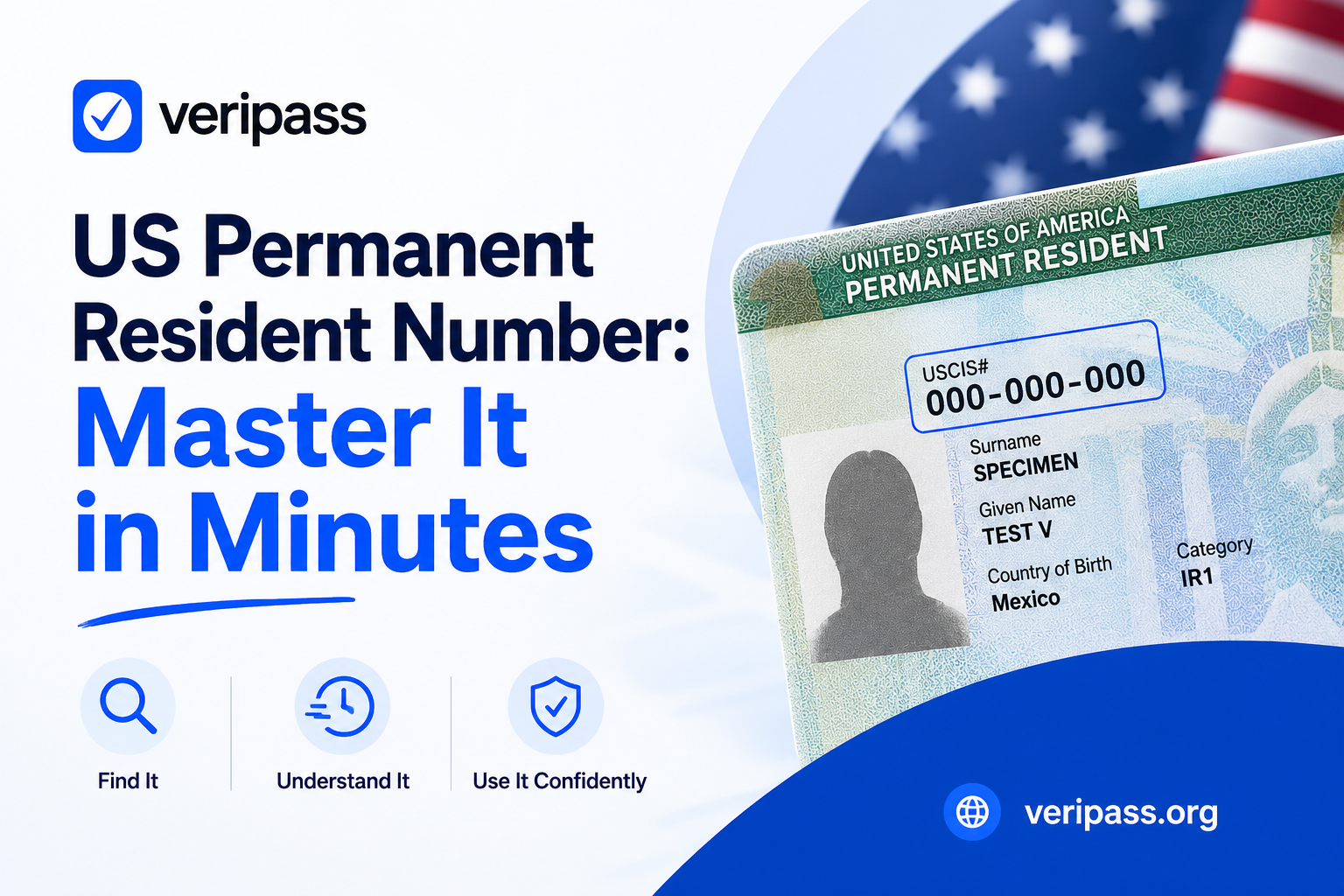
Picture your first day at a new US job. The offer took years to earn. Now HR slides a form across the desk and asks for your US permanent resident number, and you freeze, because your green card has three numbers on it and you don’t know which one they mean. Pick wrong, and the form bounces, the start date slips, and the win you fought so hard for suddenly feels shaky. Here’s the truth almost nobody tells you: your US permanent resident number isn’t one number at all. It’s three.
That one mix-up costs people their jobs, causes delayed forms, and results in rejected applications every day. The phrase sounds official, but the US government never actually prints “permanent resident number” on anything, so when a form, an employer, or a bank asks for it, you’re left guessing.
This guide ends the guessing. You’ll learn the three numbers hiding behind the phrase, how to tell them apart in seconds, which one goes on which form, and how to find yours when your card is lost, stolen, or still in the mail. If you’re working toward a green card through the O-1, EB-2, or another talent route, read this now, and the day your card arrives, you’ll already know exactly what to do.
Read Also: Green Card Renewal: The 2026 Rules Most Guides Still Get Wrong
The Three Numbers Behind “US Permanent Resident Number”
When someone asks for your US permanent resident number, they mean one of these three. Learn to tell them apart, and you’re ahead of most green card holders.
1. The A-Number (Alien Registration Number). This is you. It’s a 7 to 9-digit number that starts with the letter “A,” and the government assigns it once, for life. It never changes. Renew your card, replace a lost one, or become a citizen, and your A-Number stays the same. On a modern green card, it sits on the front, labeled “USCIS#.” Yes, the label says USCIS number, and yes, that’s confusing. Which brings us to the second number.
2. The USCIS Number. On today’s cards, this is the same nine digits as your A-Number, just without the “A” in front. So “USCIS#” on the front of your card is your A-Number. They are one and the same on current cards. People burn hours thinking these are two separate numbers. They aren’t.
3. The Green Card Number (also called the card number, document number, or receipt number). This one identifies the physical card, not you. It’s a 13-character code: three letters followed by ten digits, like SRC2201234567. Because it belongs to the card and not to you, it changes every time USCIS issues you a new card. Lose your card, get a replacement, and this number is different on the new one.
Here’s the one-line rule that keeps it straight: your A-Number identifies you, your green card number identifies your card. One is permanent. The other changes with each card.
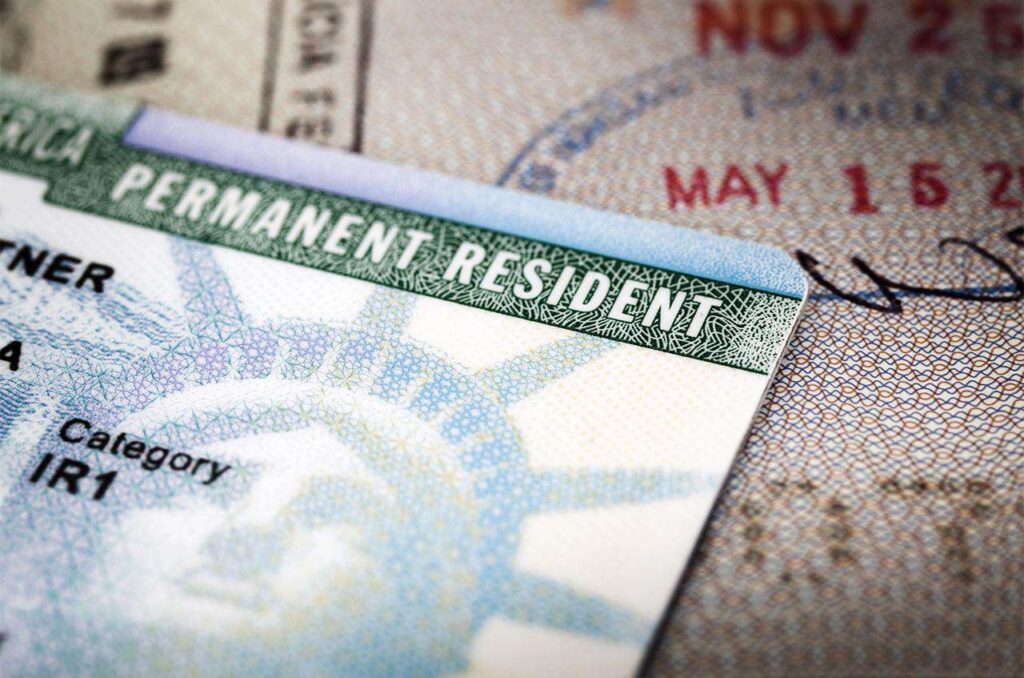
Where To Find Each Number On Your Card
Card designs have changed over the years, so the location depends on when yours was issued. Almost everyone reading this will have a card from the last decade, so start there.
On cards issued after May 2010, including the current version USCIS started printing on January 30, 2023, the split is clean:
- The front shows your photo, name, date of birth, and “USCIS#,” which is your A-Number.
- The back holds your green card number, buried in the machine-readable zone.
The machine-readable zone is the block of letters, numbers, and “<” symbols running across the bottom back of the card in three lines of 30 characters each. Your 13-character green card number appears on the first line, in positions 16 through 28. The “<” symbols are just spacers, nothing more.
If your card was issued before May 2010, the layout differs, and some numbers may appear on the front instead. If you’re holding a card that old, check both sides carefully or confirm with USCIS.
One warning that saves people from real trouble: do not read the “USCIS#” on the front as your green card number. Airline staff, hotel clerks, and even some HR officers make this mistake constantly. The front number is your A-Number. The green card number is on the back.
Which Number Goes On Which Form
This is where guessing gets expensive, and it’s the part almost no guide spells out. Different forms want different numbers. Put the wrong one in, and you create delays at best, and compliance penalties at worst.
- Form I-9 (employment verification): Your employer records the green card number, the 13-character code from the back of your card, in the document number field of Section 2. You enter your A-Number (USCIS Number) in Section 1 when you pick “lawful permanent resident.” Employers who mix these up face real fines per form under federal rules, so it’s worth getting right.
- Form N-400 (citizenship): Uses your A-Number.
- Form I-90 (replace or renew your card): You’ll need the green card number from the card you’re replacing.
- Form I-131 (travel document): Uses your A-Number.
- Driver’s license, Social Security, bank account: These vary by state and institution. When the form says “USCIS Number” or “A-Number,” give the nine digits from the front. When it asks for “card number” or “document number,” give the 13-character code from the back.
The pattern underneath all of it: when a form wants to identify you, it wants your A-Number. When it wants to identify your physical card, it wants your green card number. Read the field label, match it to the right number, and you’ll clear forms that stall other people for weeks.

How To Find Your Number When You Don’t Have Your Card
Every other guide assumes the card is in your hand. Real life isn’t so tidy. Your card gets lost, stolen, damaged, or stuck in the mail while a job start date or a form deadline bears down on you. Here’s where your numbers live when the card doesn’t.
Your A-Number appears on almost every document USCIS has ever sent you. Check:
- Any I-797 Notice of Action
- Your immigrant visa or welcome notice
- Prior USCIS letters and receipts
- Your myUSCIS online account at my.uscis.gov
Your green card number is harder to recover because it belongs to one specific card, but you can still find it on:
- Copies or photos you made of the card, front and back
- Your USCIS online account case history
- Prior USCIS receipt notices tied to that card
If you’ve lost the physical card, file Form I-90 to replace it, and call the USCIS Contact Center at 800-375-5283 if you’re stuck. Don’t hand your numbers to strangers or post a photo of your card online while you sort this out. These numbers open doors in government systems, so treat them like you’d treat a bank card.
A Quick Check: Does Your Green Card Number Even Look Right?
Before you type your green card number into a form, run this three-second check:
- Three letters, then ten digits. Thirteen characters total. If you’re looking at nine digits starting with “A,” that’s your A-Number; wrong field.
- The three letters are a service center code. Common ones include IOE (electronic filing, the most common on modern cards), SRC and TSC (Texas), WAC and CSC (California), LIN and NSC (Nebraska), EAC and VSC (Vermont), MSC and NBC (National Benefits Center), and YSC (Potomac).
- The digits carry meaning. After the three letters, two digits show the fiscal year USCIS received your case, three digits show the workday, and the last five are your case number. You don’t need to decode it, but if those middle digits look nothing like a year, double-check you copied the right string.
If your number fails this check, you’ve likely grabbed the wrong number off the card. Go back to the machine-readable zone on the back.
One More Group: Conditional Residents and People Waiting on a Card
If you got your residency through marriage or investment, you may hold a two-year conditional green card (categories like CR-1). It works the same way for numbers: same A-Number, its own green card number, and you’ll later file to remove conditions and get a new card with a new card number.
And if you’ve just been approved but your physical card hasn’t arrived, you might have an I-551 stamp (also called an ADIT stamp) in your passport. That stamp proves your status while you wait. It carries your A-Number, so you can still complete forms and verify work eligibility before the plastic shows up.

Why This Matters Before You Even Have a Green Card
If you’re reading this while still working toward US residency, you’re doing exactly the right thing. Most people learn these distinctions the hard way, standing at an airport counter or staring at an I-9 on their first day at a new job. You’ll walk in already knowing.
That head start matters more for talent-based paths, because those routes move faster and put you in professional settings where a paperwork slip looks worse. The main US options for founders, executives, and skilled professionals are:
- The O-1 visa, for people with a record of high achievement in their field. USCIS lays out the criteria at uscis.gov.
- The EB-2 National Interest Waiver (NIW), which lets qualified professionals petition for a green card themselves, without an employer sponsor or a labor certification, when their work serves the US national interest. The official page is at uscis.gov.
Outside the US, the parallels are the UK Global Talent visa and Australia’s talent and skilled visa routes at immi.homeaffairs.gov.au. Each rewards the same thing: a well-documented record of what you’ve built and why it matters.
That last point is the whole game. These routes don’t approve the most impressive person who applies. They approve the best-documented one. Two people with the same career get different answers because one turned their achievements into evidence an officer could accept, and the other didn’t.
Where Veripass Comes In
This is the exact problem Veripass solves. Veripass is a consulting firm that guides founders, executives, and skilled professionals through talent-based immigration to the US, UK, and Australia, from the first question of “which route fits me” all the way to an approved case. They hold your hand from start to finish.
The difference shows up in three places. First, pathway diagnosis: many people prepare for the wrong route for months before anyone tells them. Veripass looks at your actual profile and tells you which door- O-1, EB-2 NIW, UK Global Talent, or Australia- gives you the strongest case, usually narrowing five options down to one or two.
Second, evidence positioning: they find the proof already sitting in your career and frame it the way an officer reads it, turning “things you did” into “things that qualify you.” Third, the full build: consultants and licensed attorneys handle the file itself, so you’re not guessing at forms, numbers, or which document goes where. And once your green card arrives, the number confusion in this guide is one more thing they’ve already walked you through.
If your achievements are real but you don’t know how to turn them into an approved case, that gap is exactly what they close.
Take Your Next Step
Veripass runs a live Global Talent Masterclass, August 29th at 6:00 PM WAT. It’s a working session, not a lecture. You bring your CV, and in two hours you score your own profile against all five talent pathways, run an evidence audit on your real career, and leave with your shortlist and your next three moves written down.
If you’re serious about moving through the O-1, EB-2, or a talent route, this is where you stop guessing and get a plan built around your profile.
Reserve your seat for the Global Talent Masterclass
You already know your achievements are real. Saturday is where you learn to prove it.
Where do I find my permanent resident number?
It depends on which number you mean, because a green card has more than one. On cards issued after May 2010, including the current design, your A-Number sits on the front, labeled “USCIS#.” Your 13-character card number (three letters and ten digits) sits on the back, inside the machine-readable zone, the block of letters, numbers, and “<” symbols. Look at the first line, positions 16 through 28. On cards issued before May 2010, the layout differs, and some numbers may appear on the front, so check both sides carefully.
Is my 9-digit A-Number on my green card?
Yes. Your A-Number (Alien Registration Number) is printed on the front of your card, labeled “USCIS#.” On modern cards, the USCIS Number and the A-Number are the same nine digits, just shown without the “A” in front. This number identifies you, not your card, so it stays the same for life, even when you renew or replace the card. Don’t confuse it with the 13-character card number on the back, which is a different number and changes each time USCIS issues a new card.
What is a U.S. permanent resident card?
A US permanent resident card, commonly called a green card, is the official document proving you have the legal right to live and work in the United States permanently. Its formal name is Form I-551. It shows your photo, name, date of birth, your A-Number, the category you were admitted under, the date your residency began, and an expiration date. The card itself expires and needs renewal, but your permanent resident status does not expire when the card does. You use the card to prove your status for jobs, travel, and government services.
What does a permanent residence number mean?
It’s an informal phrase, not an official government term, which is exactly why it causes confusion. The US government never prints “permanent resident number” on any card or form. When someone asks for it, they usually mean one of three numbers: your A-Number (which identifies you for life), your USCIS Number (the same nine digits on modern cards), or your green card number (the 13-character code that identifies your physical card and changes when the card is replaced). Which one you give depends on what the form is asking for, so always read the field label before you fill it in.
⚠️ This article is for informational purposes only and does not constitute legal advice. Consult a licensed immigration attorney before filing any visa petition.