
Green Card renewal sounds like a small errand until the date on your card starts to matter. You have built a career, moved your family, and earned your place. Then you notice the expiration date, and a quiet worry sets in. Can you still work? Can you still travel? Will one missed step put your status at risk?
Here is the good news. Renewing is one of the most manageable parts of living in the US as a permanent resident, once you know the current rules. And the rules changed recently in a way most articles online still get wrong. Let me walk you through what to do, what it costs, and how to hold on to every right you have while you wait.
See Also: I766 EAD Card Made Simple for 2026
What Green Card renewal actually means
A Green Card renewal applies to lawful permanent residents who hold a 10-year card that is expiring or has already expired. You file Form I-90, the Application to Replace Permanent Resident Card, and USCIS sends you a fresh card.
Renewal and replacement are not the same thing, and people mix them up constantly. You renew when your 10-year card runs out of time. You replace when the card is lost, stolen, damaged, carries a mistake, or shows an old name. The form is the same. The reason you select changes your fee and your proof of status while you wait.
One group should stop here. If you hold a 2-year conditional card, Form I-90 is not for you. You file Form I-751 or Form I-829 to remove the conditions instead. Filing the wrong form wastes months. Two years means conditions. Ten years means renewal.
When should you file for Green Card renewal?
File within six months of your card’s expiration date. That is the window USCIS expects, and filing earlier can get your application rejected as premature. Waiting too long carries its own cost, since an expired card makes work checks and travel harder in the meantime.
So mark the date. Roughly 180 days out, start your Green Card renewal. Not sooner, and not the week it expires.
Can you still work and travel while you wait? Yes
This is the question that keeps people up at night, and it has a clear answer most older articles miss.
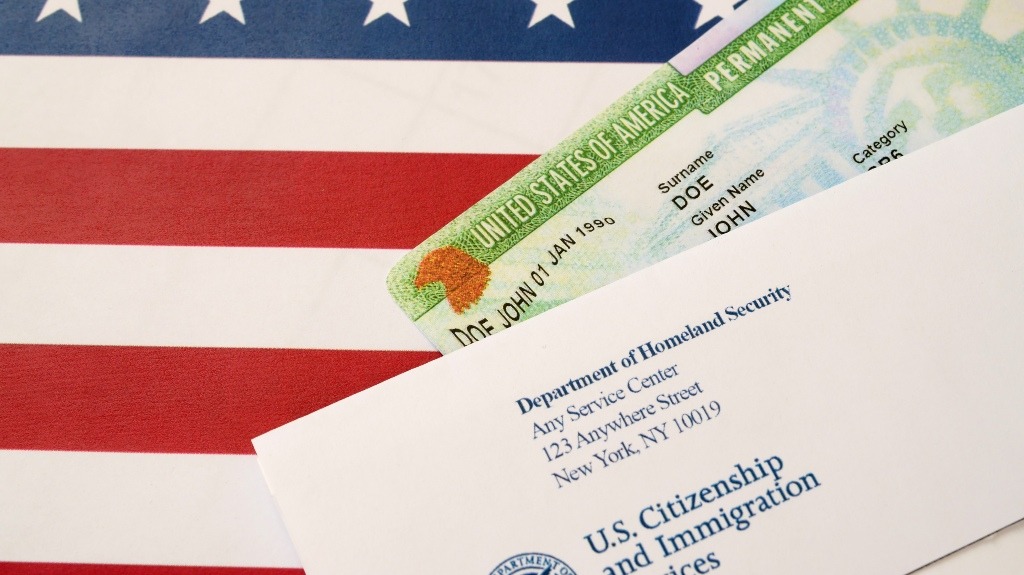
When you file Form I-90, USCIS mails you a receipt notice called Form I-797C within about two to four weeks. As of September 10, 2024, that receipt notice automatically extends your Green Card for 36 months past the printed expiration date. The old rule was 24 months. Many blogs still quote the old number. Trust the 36.
Here is what that means for your daily life. Your expired card, shown together with that receipt notice, works as proof of your permanent resident status for three full years while USCIS processes your new card. You can show both to an employer for your work eligibility check. You can show both when you travel. You keep your job, your salary, and your right to re-enter the country. Nothing about your underlying status changes. You are still a permanent resident. Only the plastic is late.
Keep the receipt notice and your old card together, and carry both when you fly. Some airlines abroad are less familiar with the receipt notice, so give yourself time at the counter and know your rights before you go.
What if your card was lost or stolen?
The 36-month extension leans on you having your expired card to pair with the receipt notice. Lose the card, and that pairing breaks.
If you no longer have the physical card and need to prove your status now, you can book an appointment at a USCIS field office for an ADIT stamp, also called an I-551 stamp, placed in your passport. That stamp serves as temporary proof of permanent residence while your replacement is produced. Call the USCIS Contact Center to request the appointment. This one detail rescues people who are stuck abroad or starting a new job with no card in hand.
How much does Green Card renewal cost in 2026?
Fees have changed, and the old figures are everywhere online, so read this carefully.
The current Form I-90 fee is $415 if you file online and $465 if you file by mail. The separate $85 biometrics fee is gone, folded into that single amount, so you pay nothing extra for fingerprints or photos. Any article quoting “$540” or “$455 plus $85” is out of date. Confirm your exact amount on the official USCIS fee calculator before you pay, since fees do get revised.
Two useful points. Filing online costs $50 less than paper and tends to move faster. And if the fee is a real hardship, you can request a waiver using Form I-912. Some replacements, such as fixing an error USCIS made on your card, carry no fee at all.
How long does it take?
As of 2026, a standard renewal runs roughly 8 to 14 months from filing to the new card arriving, with online filings often at the lower end. The exact time depends on which service center handles your case, USCIS workload, and background checks. Because this number shifts month to month, check the live figure for Form I-90 on the USCIS processing times tool before you plan around it.
The practical takeaway matters more than the exact months. Because your receipt notice now extends your status for 36 months, the wait rarely disrupts your work or travel, as long as you file on time and keep your paperwork on hand.
Documents to have ready
Filing online is straightforward once your documents are in front of you. Have these ready:
- A copy of the front and back of your current or expired Green Card.
- A government photo ID, such as a driver’s license or passport, if you need to prove identity.
- A legal name-change document, such as a marriage certificate or court order, if your name has changed.
- A police report or a written statement, if the card was lost or stolen.
- Any court records tied to your specific situation.
Accurate entries carry the day. A wrong date or a mismatched name is the most common reason a case slows down or draws a Request for Evidence, which is USCIS asking for more proof before they decide.
The situations most guides skip
A few readers fall outside the standard path, and these cases rarely get covered.
Your child is turning 14. Children who reach age 14 usually have to replace their card and register, unless the current card expires before they turn 16. File Form I-90 for the child around that birthday.
You hold a very old card with no expiration date. Some cards issued decades ago never carried an expiry. They are no longer accepted as valid proof today, so replacing one puts current documentation in your hands.
You are outside the US when the card expires. This calls for extra care around travel documents and timing, and the ADIT stamp option above often comes into play. Handle it before you fly, not after.
You move mid-process. USCIS mails your new card and your notices, so a wrong address can lose your card. Update your address fast through your USCIS online account any time you move while a case is open.
Should you renew, or apply for citizenship instead?
Here is a question worth asking before you spend anything on Green Card renewal. If you have held your card long enough, applying for citizenship might serve you better than paying for another 10-year card.
Most permanent residents qualify to apply after five years, or after three years if you are married to and living with a US citizen. If that is you, filing Form N-400 could be the smarter move, since citizenship ends renewals for good and adds a passport, voting rights, and stronger protection of your status. Check your position first with the official USCIS naturalization eligibility tool. If citizenship is close, renewing may be money you do not need to spend.
The harder problem behind all of this
Renewing a card you already hold is the simple end of the story. You file, you keep your rights, you wait, you get new plastic. If you already hold your card, you now know more than most blogs will tell you.
The hard part is getting the card in the first place.
Maybe that is not you. Maybe it is your co-founder still stuck on a visa that owns them, a brilliant hire you cannot bring over, or a sibling who has “someday” penciled in for the third year running. For founders, executives, and skilled professionals, the real obstacle is rarely talent. It is proof. The US built visa routes designed to recruit people exactly like you, with no lottery and no employer sponsorship, through pathways such as the O-1, the EB-1A, and the EB-2 National Interest Waiver. Officers do not approve potential. They approve a case that is documented and positioned correctly.
That is the work Veripass does, and it is the first solution I would point you to for the getting-in problem. Veripass helps African professionals move to the US, the UK, and Australia through Global Talent, O-1, EB-1A, EB-2 NIW, and NIV pathways, and the team handles the case from start to finish. Same career, same achievements, same person, often denied when the file is built alone and approved once it is built properly. Their record includes O-1A approvals, EB-2 NIW approvals for whole families, and UK Global Talent endorsements for people who spent years trying on their own.
Your next move
You do not need another WhatsApp group forwarding half-rumors. You need one evening of structure from a team that files these cases for a living.
Veripass runs a live Global Talent Masterclass with founder and senior strategist Tolu Michael this Saturday, August 29th at 6:00 PM WAT. This is a working session, not a lecture you half-watch with your phone in your other hand. Come with your CV open, because you will use it. In two hours, you score your own profile against all five pathways and walk out with a shortlist of the one or two that fit you. You run an evidence audit on your own career and count the proof already there. You learn the positioning formula and rewrite your own story live. You get real answers in an extended Q&A, not “it depends.” You leave holding your pathway shortlist, your completed evidence audit, and your next three moves written down.
One honest note, because it is the kind of thing that tells you who to trust. No firm can guarantee a government decision, and Veripass does not pretend otherwise. Anyone promising you a visa is lying. What you are getting on Saturday is clarity about your own case, and that is the thing that ends the guessing.
Reserve your seat for the Global Talent Masterclass.
What are the new requirements to renew a green card?
The core requirement has not changed. You file Form I-90, the Application to Replace Permanent Resident Card, to renew an expiring or expired 10-year card. What is new is the paperwork rule and the proof-of-status rule around it. USCIS now rejects forms where the pages come from different editions, so download a fresh copy of Form I-90 from the official USCIS page and confirm every page shows the same edition date at the bottom. The bigger update landed on September 10, 2024, when USCIS began extending your green card automatically for 36 months past the printed expiration date once you file, up from the old 24 months. To renew, have a copy of the front and back of your current card, a government photo ID, and, if they apply, a name-change document or a police report for a lost or stolen card. Filing online is the faster route.
What is the current wait time for green card renewal?
As of August 2026, a standard renewal runs roughly 8 to 14 months from filing to the new card arriving, with online filings often landing at the lower end. The exact time depends on which service center handles your case, current USCIS workload, and background checks. Because this number shifts month to month, check the live figure for Form I-90 on the USCIS processing times tool before you plan around it. The wait rarely disrupts your life, though, since the 36-month automatic extension on your receipt notice covers you for work and travel while USCIS processes the card. You get that receipt notice, Form I-797C, within about two to four weeks of filing.
How much does it cost to renew a green card in 2026?
The fee is $415 if you file online and $465 if you file by mail. The old separate $85 biometrics fee no longer exists as an add-on, since USCIS folded it into that single amount, so you pay nothing extra for fingerprints or photos. Any figure you see quoting “$540” or “$455 plus $85” is out of date. Online filing saves you $50 and tends to move faster. If the fee is a real hardship, you can request a waiver using Form I-912, and a few situations, such as correcting an error USCIS made on your card, carry no fee at all. Confirm your exact amount on the USCIS fee calculator before you pay, since fees do get revised.
How many years do you need to renew your green card?
A standard green card is valid for 10 years, so you renew it once per decade. File within six months of the expiration date printed on the card, which is the window USCIS expects. Filing much earlier can get your application rejected as premature, and waiting past the date makes work checks and travel harder in the meantime. One caution on the number of years. If your card is valid for only 2 years, you hold a conditional card, not a standard one, and Form I-90 is the wrong form. You file Form I-751 or Form I-829 instead to remove the conditions. Two years means conditions. Ten years means a standard renewal.
⚠️ This article is for informational purposes only and does not constitute legal advice. Consult a licensed immigration attorney before filing any visa petition.