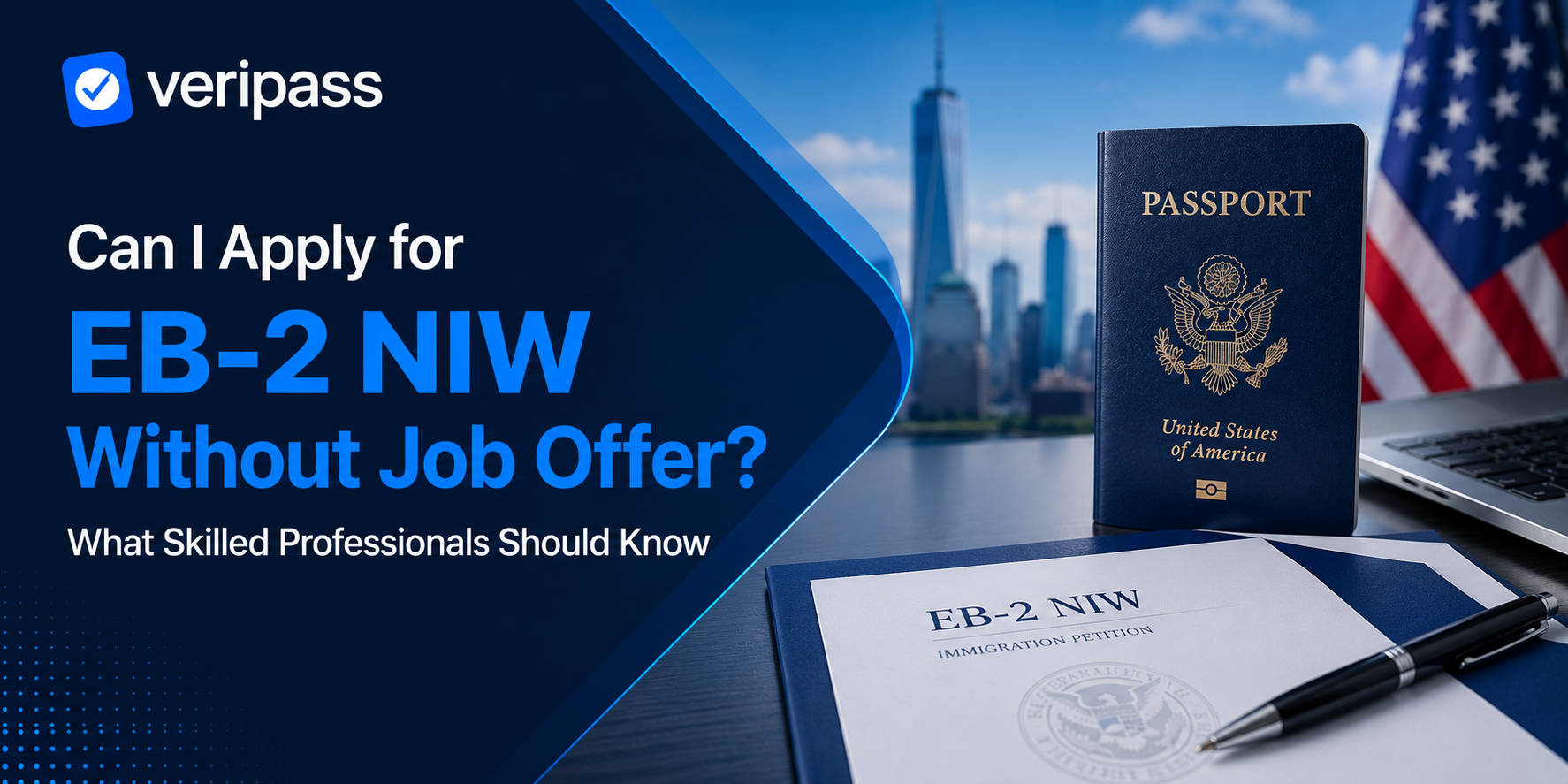
You can get a US green card through the EB-2 NIW without job offer, without an employer, and without anyone in America agreeing to hire you first. You file the petition yourself. That is not a loophole or a rumor. It comes straight from USCIS: people seeking a National Interest Waiver “may self-petition (you do not need an employer to sponsor you).”
If you have spent years refreshing LinkedIn, hoping a US company will notice you and carry you through PERM labor certification, this changes the question. It is no longer “who will sponsor me?” It is “can I build a case strong enough to sponsor myself?”
This article answers that second question honestly. Not the sales version. The real one.
Read Also: EB-2 vs EB-2 NIW: 5 Secrets to Winning Your Green Card
EB-2 NIW Without Job Offer: The Direct Answer
No, you do not need a job offer for the EB-2 NIW. You do not need an employer, an employment contract, or a US company willing to file for you. You file Form I-140 on your own behalf, and USCIS waives both the job offer and the PERM labor certification because your work serves the national interest of the United States.
You can file from Nigeria. You can file while working your current job in Lagos or Abuja. Your spouse and children under 21 get green cards with you.
That is the good part, and it is real. Now here is the part no one tells you.
What “no employer” actually costs you
Every article you will read about the EB-2 NIW without job offer sells the freedom and skips the price. Here is the price: without an employer, you carry the full weight of the petition alone.
When a company sponsors you, the job offer does quiet work in the background. It proves someone in America wants your skills. It gives your petition a ready-made story: this role, this company, this salary. It comes with a lawyer the company pays for.
When you self-petition, none of that exists. You must build the story from scratch, fund the case yourself, and convince a USCIS officer that a stranger from Lagos, with no US employer waiting, will advance work that matters to America. USCIS approved about 55% of NIW petitions in FY 2025, down from 71% the year before, because officers now scrutinize these cases harder than ever.
So the honest framing is this: the NIW removes the employer requirement, then replaces it with an evidence requirement. You win by out-preparing everyone else in the queue.
What you must qualify for before the waiver even matters
Before USCIS looks at your national interest argument, you must fit the basic EB-2 box in one of two ways:
Advanced degree
A master’s degree or higher, or a bachelor’s degree plus at least five years of progressive experience in your specialty. Progressive means growing responsibility, not five years of the same role. Your Nigerian degree counts, but you should get a credential evaluation confirming it equals a US degree.
Exceptional ability
Expertise significantly above what is ordinary in your field, proven through at least three of six criteria USCIS lists, such as a professional license, ten years of full-time experience, a high salary for your market, or recognition from your industry.
One trap from the USCIS Policy Manual worth knowing: your degree and experience must relate to what you plan to do in the US. A chemistry degree followed by five years managing a restaurant does not make you an advanced degree professional in chemistry. The thread between your education, your experience, and your proposed work must be visible.
The three-prong test, in plain language
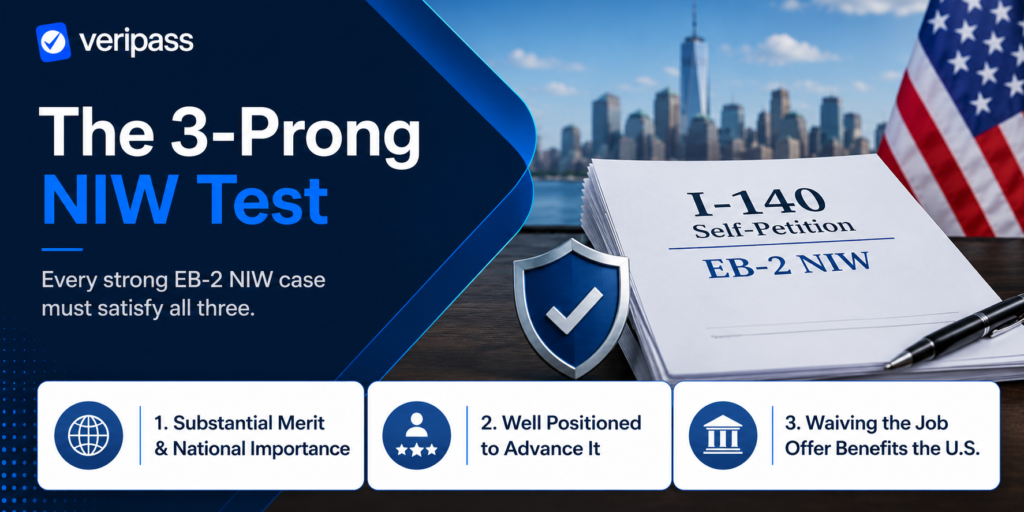
USCIS decides NIW cases using a framework from a case called Matter of Dhanasar. You must prove three things:
- Your proposed work has substantial merit and national importance. Not important to one company or one city. Important to a field, an industry, or the American public.
- You are well positioned to advance it. Your education, track record, and plan show you can actually do this, not just describe it.
- On balance, America benefits from waiving the job offer. It serves the US better to let you in without labor certification than to make you find an employer first.
Every strong petition is built around these three prongs. Every weak one fails at least one of them. And the two places self-petitioners fail most are the proposed endeavor and prong two. Let’s fix both.
Your proposed endeavor: the section that replaces your employer
When you have a job offer, your endeavor is basically your job description. Without one, you must write it yourself, and this single document decides more of your case than anything else. USCIS updated its guidance in January 2025 to put even more weight on the proposed endeavor, and vague ones now attract Requests for Evidence or denials.
Here is the difference between weak and strong, using USCIS’s own logic:
Weak: “I will work as a software engineer and contribute to US technology.” USCIS says this fails. An occupation is not an endeavor. The Policy Manual gives the exact example of a software engineer adapting an employer’s code for clients, and says that person “will have difficulty demonstrating the national importance of that endeavor.”
Strong: “I will build fraud-detection infrastructure for instant payment systems, addressing the rise in real-time payment fraud that US banks and regulators have flagged as a growing threat. My work at [company] processing millions of transactions across African markets produced [specific results]. I plan to [specific first steps], and [named parties] have expressed interest.”
See the pattern? A specific problem America has. A specific plan. Evidence you have solved this problem before. Named interest from real people. The Policy Manual is blunt that benefits to a single employer, or general praise for your profession, are not enough. Your endeavor must show implications for a field, a region, or the public.
Write this section before you gather a single other document. If you cannot write it convincingly, you are not ready to file yet, and knowing that early saves you money.
Proving prong two when your whole track record is in Nigeria
This is where Nigerian applicants lose winnable cases. Your achievements are real, but a USCIS officer in Texas has never heard of your company, your university, or your industry awards. Your job is to translate.
Make your impact legible
Do not write “I led a major payments project.” Write “I led a project that moved 2 million users onto instant card issuance, processing transactions worth over $40 million annually.” Convert naira figures to dollars. Give market context: if your platform serves 15% of a market of 220 million people, say so. Numbers travel across borders. Titles do not.
Get recommendation letters that survive scrutiny
USCIS says letters work when they come from experts with first-hand knowledge of your achievements, describe those achievements with specific examples, and are backed by independent evidence. A glowing letter from your boss saying you are brilliant is weak. A letter from an industry figure explaining exactly what you built, what changed because of it, and why that skill matters to the endeavor you proposed is strong. Letters from people outside your employer, including international contacts, carry extra weight because they show your reputation extends beyond your paycheck.
Anchor every claim to a document
Media coverage, contracts, product metrics, conference talks, patents, government correspondence. A claim without an exhibit is just a sentence.
Handle your credentials properly
A recognized credential evaluation service should confirm your Nigerian degree’s US equivalence. Reference letters from employers should confirm your five years of progressive experience if you are qualifying through the bachelor’s route, with dates, titles, and duties.
One myth to kill: you do not need a PhD or publications. USCIS reviews the totality of evidence. Founders and operators win NIW cases with commercial results, adoption metrics, and industry recognition instead of citations.
NIW vs O-1 vs EB-1A when no one is sponsoring you
If you have no US employer, three self-driven paths exist, and picking the wrong one wastes a year:
| EB-2 NIW | O-1 | EB-1A | |
|---|---|---|---|
| What it is | Green card | Temporary work visa | Green card |
| Needs a US petitioner? | No, self-petition | Yes, employer or agent | No, self-petition |
| Bar to clear | High | High | Highest |
| Best for | Strong professionals with a nationally important plan | People with a US opportunity ready now | People at the very top of their field |
The short version: the O-1 still requires someone in the US to file for you, so it does not solve the “no employer” problem by itself. The EB-1A is a self-petition like the NIW, but the standard is extraordinary ability, a bar most strong professionals do not clear. For a skilled Nigerian founder, executive, or specialist with no US sponsor, the NIW is usually the most realistic green card path. If you are weighing the temporary routes too, our guide comparing the O-1 and H-1B breaks those down.
What the process looks like from Lagos, with real timelines
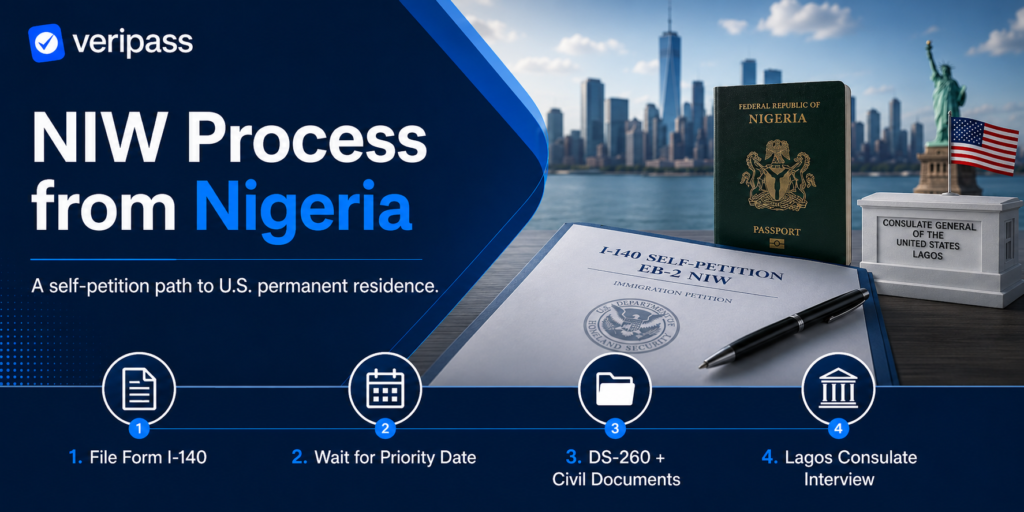
Step 1: File Form I-140 with the NIW request
The filing fee is $715. Standard processing now takes around 24 months based on current USCIS data. Premium processing is available for the NIW: pay $2,965 extra and USCIS must act within 45 business days. For self-petitioners, premium processing has a second benefit nobody mentions: if your case has a weakness, you find out in weeks, not years.
Step 2: Wait for your priority date
The Visa Bulletin controls when green cards can actually be issued. Here is the news that matters to you: as of the July 2026 bulletin, EB-2 is current for Nigeria and most of the rest of the country categories. India’s EB-2 category is unavailable for the rest of the fiscal year, and China is backlogged to 2021, but Nigerian applicants face no country backlog right now. That window is real, and the bulletin itself warns it is not guaranteed to last. Filing sooner locks in your priority date.
Step 3: Consular processing
Since you are outside the US, you file Form DS-260 after I-140 approval, submit civil documents, and attend an interview at the US Consulate in Lagos. Approved, you enter the US as a permanent resident. Your spouse can work immediately. No employer required at any step.
The two mistakes that trigger RFEs
USCIS issued RFEs on a large share of NIW petitions last year, and self-petitions get challenged in two predictable places:
A vague endeavor
If your plan reads like a job description or a wish, expect USCIS to ask what exactly you intend to do and why it matters nationally. The fix is the specific, evidenced endeavor statement described above, filed with the original petition, not patched in later.
Thin prong two evidence
Officers challenge claims that you are well positioned when the file shows general experience instead of a record of results tied to your plan. The fix is documented impact and expert letters that connect your past wins directly to your proposed work.
An RFE is not a denial, but responding well takes months and money. The cheapest RFE is the one your original filing prevents.
The question everyone is afraid to ask: what do I do when I land?
You arrive in America with a green card and no job. Then what?
This is the part every law firm article skips, and it is probably your biggest private fear. Here is the practical picture. Your green card is not tied to any employer, so you can take a job, consult, work remotely for a foreign company, or build the business you described in your petition. The one rule: your actual work should stay broadly consistent with the endeavor you proposed. You do not need to follow it word for word, but a petition about fintech infrastructure followed by a career in real estate invites questions later, especially at citizenship.
Plan a runway before you travel. Most self-petitioners line up income in advance: remote contracts, consulting clients, or savings covering six to twelve months. Founders often begin building their US entity and customer conversations while the petition is pending, which doubles as prong two evidence. The immigrant visa stage also looks at your financial picture, so arriving with a plan is both a legal and a practical advantage.
Where Veripass comes in
Everything above is doable alone. Plenty of people also fail alone, because the NIW is not a form-filling exercise. It is a persuasion exercise judged by a skeptical officer, and the approval rate is falling for exactly that reason.
This is the work Veripass does for Nigerian founders, executives, and professionals every day. Before you spend a naira on filing fees, we assess your profile against the actual Dhanasar standard and tell you plainly if you are ready, close, or better suited to a different route like the O-1. If the NIW is your path, we help you build the case the way this article describes: an endeavor statement written around a real American problem, your Nigerian track record translated into evidence a USCIS officer can weigh, recommendation letters engineered for specificity instead of praise, and a filing organized to prevent the RFEs that stall self-petitions.
We work with Nigerian credentials, Nigerian referees, and the Lagos consulate process because that is who we serve. A US law firm learns your context from scratch. We start from it.
Your move
The EB-2 NIW without a job offer is the rare immigration path where your future does not depend on a recruiter’s inbox. It depends on the strength of your case, and that is something you can control, starting today, while the visa bulletin is still open for Nigerians.
Book a free discovery call with Veripass. In 30 minutes, you will know if your profile can clear the three prongs, what evidence you are missing, and what your realistic timeline looks like. No pressure, no fee, just a straight answer about your strongest path to America.
Can I apply for EB-2 NIW without a job?
Yes. The EB-2 NIW does not require a job, a job offer, or an employment contract in the US. You file Form I-140 yourself as a self-petitioner, and USCIS waives the job offer requirement because your proposed work serves the US national interest. You can apply while unemployed, while running your own business, or while working for a company outside the US. What you cannot skip is the evidence: you still need to qualify through an advanced degree or exceptional ability, and you must prove your proposed work matters to the United States.
Does EB-2 NIW require an employer?
No. This is the main difference between the standard EB-2 and the EB-2 NIW. The standard EB-2 needs a US employer to sponsor you, complete PERM labor certification, and file the petition on your behalf. The NIW removes all three: no sponsor, no PERM, no employer-filed petition. You act as your own petitioner. An employer or a US job offer is optional, and if you have one that matches your proposed work, it can strengthen your case, but nothing in the process depends on it.
Is Nigeria eligible for EB-2?
Yes. Nigerians qualify for the EB-2 and the NIW on the same terms as applicants from any other country, and Nigerian degrees count once a credential evaluation confirms they equal a US degree. Nigeria also has a timing advantage right now: under the July 2026 Visa Bulletin, the EB-2 category is current for Nigeria and most countries, meaning no country-specific backlog, while India is unavailable for the rest of the fiscal year and China is backlogged to 2021. Approved Nigerian applicants complete the process through consular processing at the US Consulate in Lagos.
Is EB-2 NIW hard to get?
It is demanding, and it has become harder. USCIS approved about 55% of NIW petitions in FY 2025, down from roughly 71% the year before, after new guidance in January 2025 raised scrutiny on the proposed endeavor. The cases that fail usually share the same weaknesses: a vague plan that reads like a job description, and thin evidence that the applicant is well positioned to deliver it. The cases that succeed pair a specific, nationally relevant plan with a documented track record. You do not need a PhD or publications; you need a strong, well-organized case, which is why an honest assessment before filing matters.
Sources: USCIS EB-2 page, USCIS Policy Manual Vol. 6, Part F, Ch. 5, Form I-140, Department of State Visa Bulletin. Fees and timelines stated as of July 2026; always confirm current figures on USCIS.gov before filing. This article is general information, not legal advice.