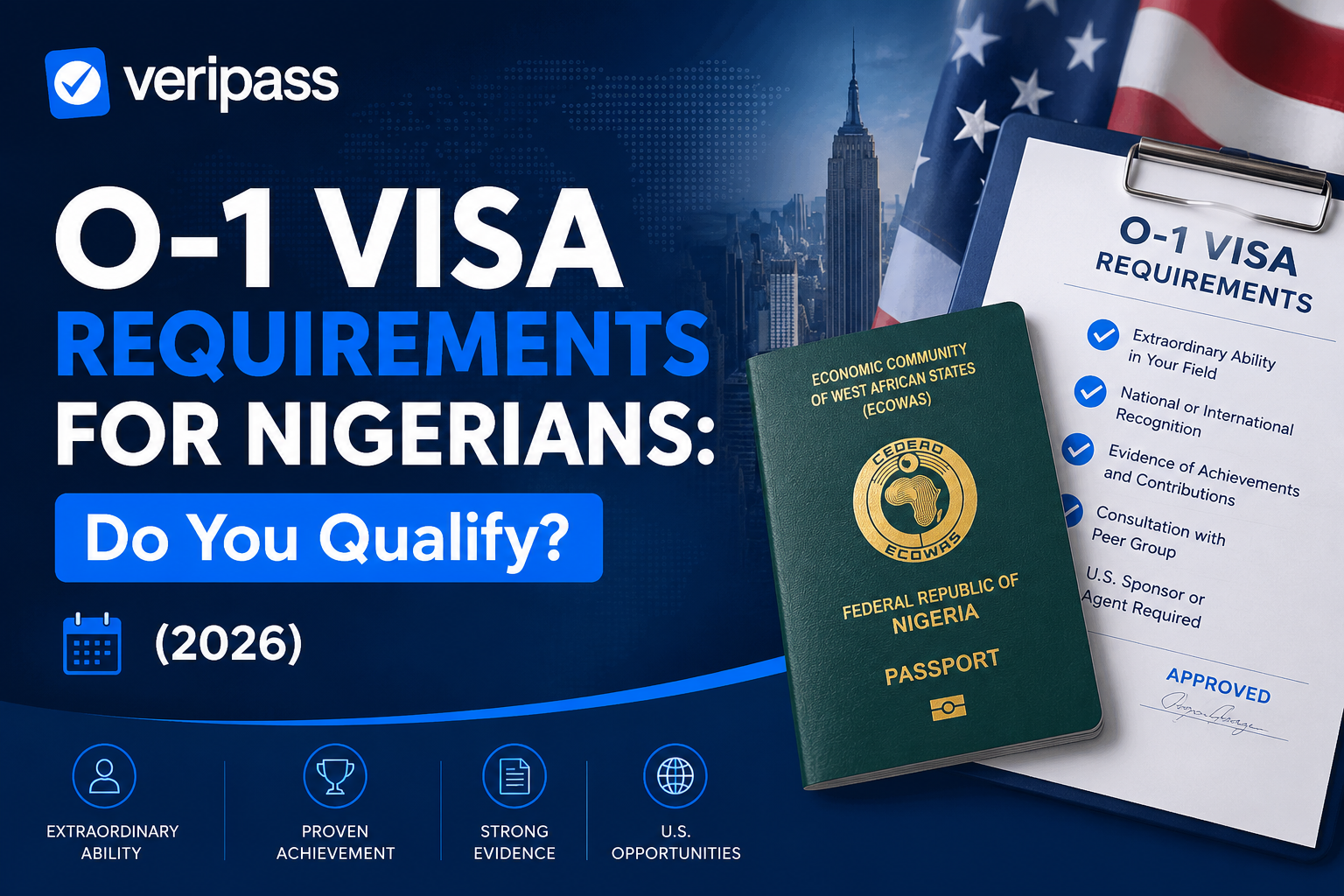
The O-1 visa requirements look simple on paper: prove extraordinary ability, get a US petitioner, file the forms. Then you start the process from Lagos or Abuja and find out the paper version left out half the story.
Most guides online are written for founders already sitting in San Francisco. They explain the USCIS petition and stop there. For you, the petition is only halftime. You still have to face the DS-160, the embassy interview, administrative processing, and a visa stamp rule that changed for Nigerians in 2025 and that almost no article mentions.
This guide covers the full path: what USCIS requires, what the embassy in Nigeria requires, what it all costs in 2026, and what to do if you are not ready yet. Every claim links to an official source, because your visa case deserves better than recycled blog copy.
See Also: How to Choose an O-1 Visa Lawyer or Strategy Partner
What the O-1 visa is
The O-1 is a US work visa for people with extraordinary ability. USCIS splits it into two types:
- O-1A: sciences, education, business, or athletics. This is the route for founders, executives, engineers, researchers, and finance professionals.
- O-1B: arts, motion pictures, and television. Musicians, filmmakers, designers, and creatives apply here.
There is no annual cap and no lottery. You can file any month of the year. The initial approval lasts up to three years, with extensions available in one-year increments for as long as the qualifying work continues. Your spouse and unmarried children under 21 can join you on O-3 visas. Parents do not qualify as dependents, no matter what some websites claim.
The three legs of every O-1 petition
Here is the part most articles get wrong. Meeting the eligibility criteria is one requirement, not the whole requirement. A complete O-1 petition stands on three legs, and USCIS can refuse a case that is missing any of them.
Leg 1: Evidence of extraordinary ability. You either hold a major international award (think Nobel Prize level) or you meet at least three of eight regulatory criteria. Almost everyone qualifies through the second route. The criteria are set out in 8 CFR 214.2(o) and explained in the USCIS Policy Manual, Volume 2, Part M.
Leg 2: A written advisory opinion. Your petition must include a consultation letter from a US peer group or labor organization in your field, or proof that no such group exists. This is a filing requirement, not a nice extra. It takes time to obtain; some organizations charge for it, and petitions filed without it invite delays. Most guides never mention it. Now you know.
Leg 3: A qualified petitioner. You cannot file Form I-129 for yourself. A US employer or a US agent must file it on your behalf. More on this below, because it trips up self-sponsoring founders constantly.
The eight O-1A criteria, with a Nigerian lens
You need three. Aim for three strong ones rather than six thin ones. Here is what each looks like from Nigeria.
1. Awards. Nationally or internationally recognized prizes in your field. Pan-African recognition counts: think The Future Awards Africa, CBN or fintech industry honors, or international competition placements. Document the award body’s selection process and reach, not just the certificate.
2. Membership in distinguished associations. The organization must require outstanding achievement for admission, judged by recognized experts. Paying dues to join does not qualify. Bodies like IEEE senior grades work; a standard professional membership does not.
3. Published material about you. Press coverage of you and your work in major media. Nigerian and international outlets both count. Coverage in Punch, BusinessDay, TechCabal, or Techpoint Africa can qualify if you show the outlet’s reach. Any non-English material needs a certified translation.
4. Judging the work of others. Peer review, competition judging, or evaluating grant and accelerator applications. USCIS increasingly wants proof you actually judged: scorecards, panel reports, or emails confirming your input. An invitation letter alone is weak evidence.
5. Original contributions of major significance. Not just good work, but work others adopted, cited, or built on. A payments product used across banks, a methodology other teams copied, or research cited in later studies. Pair what you built with proof that the field noticed.
6. Scholarly articles. Publications in professional journals or major media in your field. Peer-reviewed work is strongest, but expert commentary in credible trade publications can count.
7. Critical or essential employment. A key role at an organization with a distinguished reputation. If you lead product at a well-known Nigerian fintech or hold a C-suite role at a company with press coverage, funding, or major clients, this criterion is often your strongest. Prove both parts: your role’s importance and the company’s standing.
8. High remuneration. Pay in the top range for your role and market. This is where naira earnings need careful handling. Convert your compensation properly, benchmark it against Nigerian market data for your role and city, and let an expert frame the comparison. USCIS compares you to peers in your market, not to Silicon Valley salaries.
Two rules that cut across all eight. First, your acclaim must be sustained. A prize from 2016 followed by silence raises questions. Show a continuing record. Second, if these criteria do not fit your occupation, the regulations allow comparable evidence: substitute proof that serves the same purpose. Few applicants know this option exists.
Why you cannot file for yourself (and what founders do instead)
Form I-129 must come from a US petitioner. If you have a US job offer, your employer files. If you are a founder, your own US company can petition for you, but USCIS expects the company to be a real, separate entity: incorporated, with an EIN, a genuine business purpose, and ideally some structure showing the company (not just you) controls your employment. A US agent can also file for people who work for multiple clients.
“Self-sponsorship” is real, but it is a structure you build, not a box you tick. Get this wrong, and a strong evidence file still fails.
What it costs in 2026
Budget for these, using current figures:
- Form I-129 filing fee: $1,055 for most employers, or $530 for nonprofits and small employers with 25 or fewer full-time staff, per the USCIS fee schedule. Some petitioners also owe a separate Asylum Program Fee. Confirm your exact total on the fee schedule before filing, because USCIS rejects underpaid petitions.
- Premium processing (optional): $2,965 for petitions postmarked on or after March 1, 2026. It buys a USCIS response within 15 business days, not a guaranteed approval.
- DS-160 visa application (MRV) fee: $185, paid before your embassy interview.
- Visa integrity fee: a $250 charge collected when the visa is issued, introduced under US law in 2025. Rollout has been uneven across posts, so confirm current instructions with the US Mission in Nigeria before your appointment.
- Professional fees: legal and advisory costs vary widely. Treat any provider quoting the old $460 filing fee as a red flag; that figure is years out of date.
Timeline: plan 2 to 3 months to build evidence and secure the advisory opinion, then 2 to 4 months for standard USCIS processing, or 15 business days with premium processing. Add the embassy stage after that.
After USCIS says yes: the embassy stage in Nigeria
An approved I-129 is not a visa. It is permission to apply for one. Here is what the second half looks like from Nigeria:
1. Complete the DS-160. File the online nonimmigrant visa application on the Department of State portal, pay the $185 fee, and print your confirmation page.
2. Book your interview. Appointments run at the US Embassy in Abuja and the Consulate General in Lagos. Wait times shift, so check current availability early and book as soon as your petition is approved.
3. Attend with a complete file. Carry your passport, DS-160 confirmation, the I-797 approval notice, and a copy of your full petition. Be ready to explain your work in plain language. The officer is testing that the person in front of them matches the extraordinary record on paper.
4. Prepare for 221(g). Some Nigerian applicants receive a Section 221(g) notice, which means the case needs administrative processing or extra documents before a decision. It is not a denial, but it can add weeks or months. Build slack into your start date and respond to any document request fast. Our guide on the stamping stage covers this in detail: (US Visa Stamping in Nigeria vs Third Country: What Nigerian Professionals Should Know)
The 3-month visa rule every Nigerian applicant must plan around
Since July 8, 2025, most nonimmigrant visas issued to Nigerian citizens, including O visas, are single-entry and valid for three months, under the State Department reciprocity schedule for Nigeria.
Understand what this does and does not mean. Your USCIS petition can still be approved for three years, and once you enter the US, your I-94 record (not the visa stamp) controls how long you may stay. You can remain and work for the full petition period even after the stamp expires.
The catch is travel. Leave the US for any reason, and you will need a new visa stamp, a new fee, and a new interview before you can return. Every trip home becomes a fresh consular application. Plan your first year of travel around this rule, because no US-focused guide will warn you about it.
A worked example: Adaeze from Lagos
Adaeze leads product at a Lagos payments company. Eight years of experience, no US press, no PhD. Does she have a case? Map her record against the criteria:
- Critical employment: she runs the flagship product at a company with CBN licensing, Series B funding, and coverage in TechCabal and BusinessDay. Strong, with an organizational chart and leadership letters to prove her role.
- Judging: she has reviewed applications for two accelerator programs and judged a national fintech hackathon. She requests her scorecards and panel summaries now, before memories fade.
- Original contributions: the fraud-detection flow she designed was adopted by two partner banks. She gathers adoption data and expert letters explaining why it mattered.
- High remuneration is her backup: her total package benchmarks well against Lagos product leadership pay.
Three solid criteria plus a backup, an advisory opinion, and a properly structured petitioner. That is a real O-1A case, built entirely from a Nigerian career. No Forbes feature required.
Myths that quietly kill Nigerian applications
- “My parents can come on O-3 visas.” False. O-3 covers only your spouse and unmarried children under 21.
- “The filing fee is $460.” Outdated by years. See the current fee schedule above.
- “Raising VC money satisfies the awards criterion.” Not on its own under current USCIS practice. Use funding to support the critical employment and original contributions criteria instead.
- “Getting into an accelerator counts as a membership.” No. Membership requires an association that admits people for outstanding achievement, judged by experts.
- “An invitation to judge is enough proof of judging.” Increasingly not. Keep the scorecards.
- “Once USCIS approves, the visa is automatic.” The embassy makes its own decision, and 221(g) processing is common for Nigerian applicants.
Not ready yet? Build your profile in 12 months
If you meet one or two criteria today, you can close the gap deliberately:
- Months 1 to 3: apply to judge. Nigerian and pan-African hackathons, accelerator cohorts, and industry award panels accept qualified reviewers. Keep every scorecard.
- Months 3 to 6: publish. Pitch expert commentary to credible outlets covering your sector, local and international. One well-placed byline beats ten LinkedIn posts.
- Months 6 to 9: document your impact. Collect adoption numbers, revenue figures, and letters from partners describing how your work changed things.
- Months 9 to 12: pursue recognition. Enter respected industry awards and apply to associations that admit members on achievement.
Each activity doubles as career growth. Nothing on this list is wasted even if your plans change.
The O-1 as a bridge to a green card
The O-1 is a nonimmigrant visa, but it pairs well with a permanent one. Many O-1 holders later self-petition for an EB-2 National Interest Waiver, which needs no employer sponsor, or for EB-1A, the green card equivalent of the O-1. The evidence you assemble for your O-1 becomes the foundation of that later case, which is one more reason to build it properly the first time. See our full breakdown: (EB-2 NIW Self-Petition for Nigerian Engineers and Scientists: The No-Job-Offer Green Card).
Where Veripass comes in
You can see by now that O-1 visa requirements are less a checklist and more a case you construct: the right three criteria, evidence that survives scrutiny, an advisory opinion, a correctly structured petitioner, and a consular strategy built for Nigerian realities like 221(g) and the three-month stamp rule.
That construction is what Veripass does. We work with Nigerian founders, executives, and skilled professionals every day, so we know which evidence USCIS respects, how to benchmark naira compensation credibly, how to turn pan-African recognition into criteria that hold up, and how to prepare you for the interview room in Lagos or Abuja, not a hypothetical one in California.
A Veripass assessment tells you three things upfront: which criteria you meet today, which gaps you can close and how fast, and what your realistic timeline and budget look like. If you are not ready, we tell you that too, along with the plan to get ready. No pressure tactics, no recycled advice built for someone else’s passport.
Your record is stronger than you think. Prove it.
Thousands of Nigerians have built careers that meet the O-1 standard without knowing it. The difference between them and the people already working in the US is not talent. It is a properly built case.
Book a free discovery call with Veripass today. In one session, you will know exactly where you stand against the O-1 visa requirements and the fastest, honest path to your approval.
Who is eligible for an O-1 visa?
You are eligible if you can prove extraordinary ability in your field. For the O-1A, that covers science, education, business, and athletics. For the O-1B, it covers arts, film, and television. In practice, you qualify by meeting at least three of eight USCIS criteria, such as awards, press coverage about you, judging the work of others, a critical role at a distinguished company, high pay, published articles, exclusive memberships, or original contributions your field adopted. You do not need a degree, a US employer of a certain size, or celebrity status. You do need a US employer or agent to file the petition, because you cannot file for yourself.
Is an O-1 visa difficult to get?
It is demanding but predictable. There is no lottery and no annual cap, so approval depends entirely on the strength of your case, not on luck. The standard is high: USCIS wants proof that you sit among the small percentage at the top of your field, backed by documents, expert letters, and a written advisory opinion from a US peer group. Most denials come from weak evidence and poor case structure, not from applicants who genuinely fall short. A well-built petition with three strong criteria has a good chance of approval. A rushed one with six thin criteria usually fails.
How much is the O-1 visa fee?
The Form I-129 filing fee is $1,055 for most employers, or $530 for nonprofits and employers with 25 or fewer full-time staff. Optional premium processing costs $2,965 and gets you a USCIS decision within 15 business days. At the embassy stage, you pay the $185 DS-160 application fee, and a $250 visa integrity fee applies when the visa is issued. Legal and advisory fees come on top of these. Confirm current amounts on the USCIS fee schedule before filing, because fees change and USCIS rejects underpaid petitions.
Is the O-1 better than the H-1B?
For most qualified applicants, yes. The H-1B runs on an annual lottery with low selection odds, has a yearly cap, and ties you to a fixed filing season. The O-1 has no cap, no lottery, and no set filing window, so you apply when your case is ready. The O-1 also allows unlimited extensions, while the H-1B caps out at six years in most cases. The trade-off is the standard of proof: the H-1B needs a relevant degree and a qualifying job, while the O-1 needs evidence of extraordinary ability. If you can meet the O-1 standard, it gives you more control. If you cannot yet, the H-1B remains the wider door.
This article is for general information and is not legal advice. US immigration rules change often. Confirm current requirements at uscis.gov and travel.state.gov, or speak with a qualified advisor about your specific case.