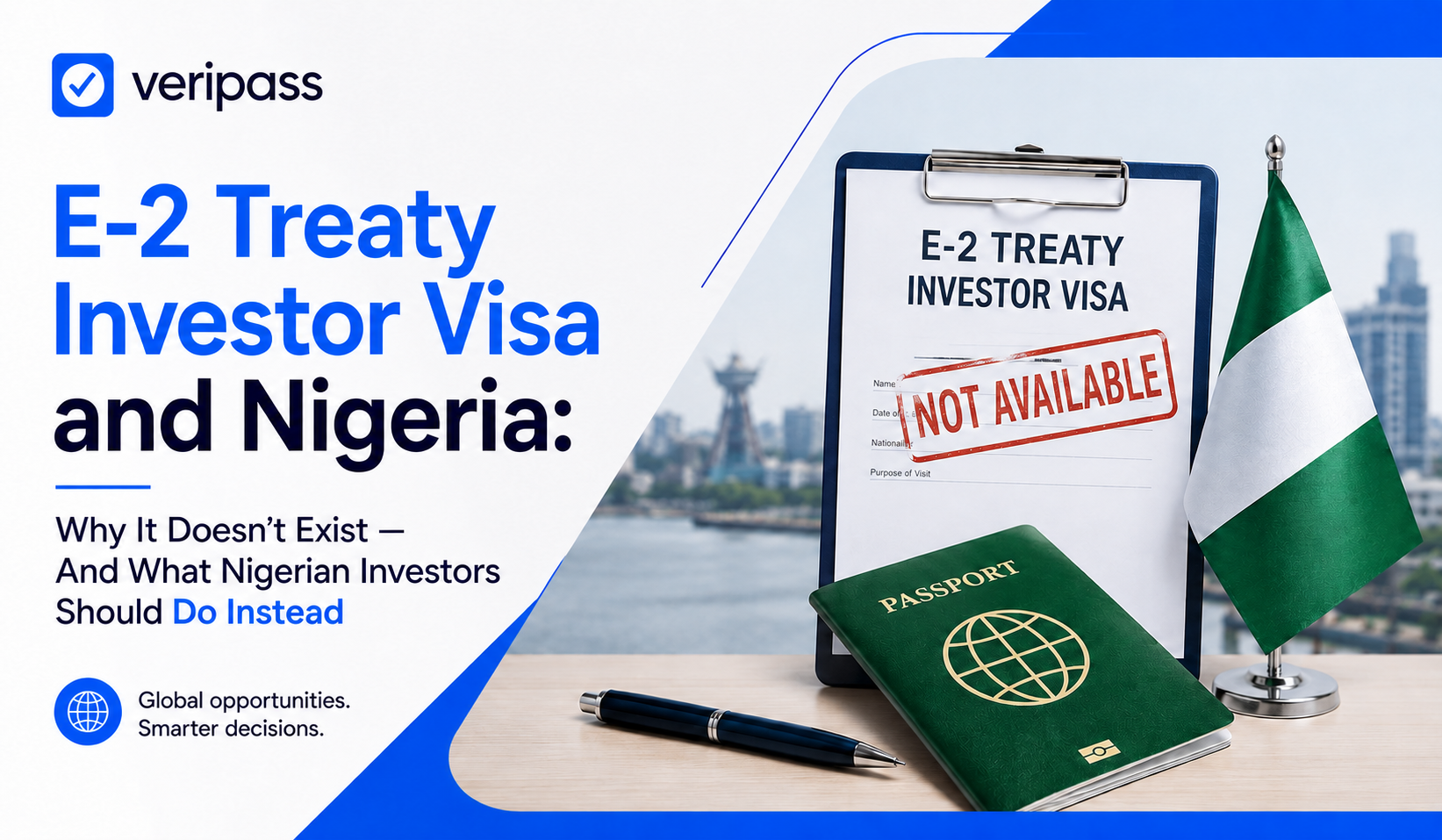
The E-2 treaty investor visa is one of the most flexible US investor visas in the world: open-ended renewals, family work authorization, lower capital than the EB-5, and active control of your own US business. Nigerian passport holders cannot apply for it.
There’s no quiet workaround your immigration agent forgot to mention. Nigeria has no E-2 treaty with the United States, and nothing in motion right now will change that within any timeframe you can plan around. One structured path gets you E-2 access; it takes years, not months, and most of what’s been written about it online is now wrong.
Understanding why this gap exists and what alternatives are actually available is the starting point for any serious Nigerian investor with US ambitions.
Read Also: US Credit History for Nigerian Professionals: Building Financial Credibility After Arrival
What the E-2 Treaty Investor Visa Is and Why It’s So Attractive
The E-2 visa is a non-immigrant visa that allows a citizen of a treaty country to invest in and operate a US business. No employer sponsorship. No annual lottery. No fixed capital minimum by statute, though the investment must be substantial relative to the cost of the business, enough to prove the enterprise is real and not marginal. The proportionality test matters more than any dollar figure.
The flexibility is what most founders find attractive. The visa renews indefinitely as long as your business stays viable and you maintain your treaty nationality. Your spouse gets automatic work authorization in the US, no separate filing required. Your children under 21 can attend US schools and qualify for in-state tuition in many states.
It isn’t perfect. The E-2 doesn’t lead directly to a green card. Your children lose status at 21. The investment has to be genuinely at risk, not parked in a holding account.
The State Department maintains an official list of E-2 treaty countries. It includes most of Europe, Japan, South Korea, Australia, Mexico, Argentina, Pakistan, the Philippines, Turkey, and a small group of African countries: Egypt, Morocco, Senegal, Togo, Cameroon, Ethiopia, Liberia, and both the Republic of the Congo and the Democratic Republic of the Congo. Nigeria is not on the list. Neither is India, China, Russia, South Africa, Ghana, or Kenya.
Why Nigeria Has No E-2 Treaty With the United States
E-2 access requires a bilateral treaty of commerce and navigation or a bilateral investment treaty (BIT) recognized by the US as sufficient for E-2 purposes. Nigeria has no relationship with the United States that meets this bar.
What Nigeria does have is a Trade and Investment Framework Agreement (TIFA), signed with the US in 2000. A TIFA creates a structured dialogue between two governments on trade and investment issues, useful for diplomatic relationship-building, but it confers no visa rights. A TIFA is not a BIT, and it does not trigger E-2 eligibility. The two are often conflated in summaries, but they are not the same instrument.
The historical pattern explains why a change is unlikely. Most E-2 treaties date to the mid-twentieth century, when the US was signing broad treaties of friendship, commerce, and navigation during the early Cold War and post-war decolonization. By the time Nigeria became independent in 1960, the US had shifted toward narrower BITs, which negotiate more slowly and carry stricter standards.
The US-Nigeria relationship has since been built primarily around oil, security cooperation, and AGOA trade preferences, rather than the broad commercial framework that would produce an E-2 pathway. Nigeria has signed BITs with some countries, but never with the United States, and neither government has indicated that this is a priority.
A future BIT isn’t impossible, but it isn’t a strategy you can plan around.
The Third-Country Nationality Strategy for E-2 Treaty Investor Visa Access
This is where most online articles get it wrong, both the cheerful “buy a Caribbean passport, and you’re in” pitches and the generic immigration guides that ignore Nigerian readers entirely.
Of the citizenship-by-investment (CBI) programs around the world, only a small number actually give you E-2 access. St. Kitts and Nevis, Dominica, Vanuatu, and Antigua all have well-known CBI programs, but none has an E-2 treaty with the US. A St. Kitts passport will not get you an E-2 visa.
The two real options are Grenada, with a CBI program and an E-2 treaty in force since 1989, and Turkey, with a CBI program and a higher capital requirement. Montenegro closed its CBI program in 2022, effectively making it off the table for new applicants.
The AMIGOS Act and the End of the Fast Route
If you’ve read older articles claiming “get a Grenadian passport and apply for E-2 in three to six months,” they’re describing a path that no longer exists.
The Advancing Mutual Interests and Growing Our Success (AMIGOS) Act, enacted as part of the National Defence Authorization Act of Fiscal Year 2023 (signed into law December 23, 2022, codified at 8 U.S.C. § 1101(a)(15)(E)), added a three-year domicile requirement for E-visa applicants who acquired their treaty nationality through financial investment.
Three things your attorney needs to work through carefully:
Domicile is not residency. It is a legal concept about where your permanent home is, supported by physical presence, financial activity, and intent to remain. A well-structured case may not require full-time physical presence in Grenada for three years, but it does require evidence of genuine ties. There’s no day-count formula.
The NFT donation route may be exempt. A non-refundable contribution to Grenada’s National Transformation Fund gives you no ownership stake, no capital at risk for return, and no expectation of financial gain. Several attorneys argue this exemption applies because the donation doesn’t constitute a “financial investment ” within the meaning of the statute, but no public refusal has tested it conclusively, and consulate officers retain discretion.
The Grenada spousal workaround still works. Grenada’s constitution allows the spouse of a Grenadian citizen to acquire citizenship through marriage registration with no residency requirement and no investment threshold. One spouse takes the CBI route and accepts the three-year domicile rule; the other later acquires citizenship through marriage; the CBI applicant then applies for a derivative E-2 as the spouse of a treaty national. This path is not available through Turkey, where a foreign spouse must typically complete a period of lawful residence before qualifying for citizenship.
What used to be a six-month strategy is now a multi-year strategy that requires serious legal structuring before any capital is deployed. If anyone is selling you a quick, low-cost Grenada-to-E-2 package in 2026, walk away.
Further reading: Obtaining an E-2 Visa Through Citizenship by Investment in 2026: Grenada, Turkey, and the Amigos Act, Davies & Associates
What Nigerian Investors Should Consider Instead of E-2
For many Nigerian founders, the E-2 isn’t the best fit even with a workaround. The right option depends on your capital level, business profile, and whether you want a non-immigrant visa or permanent residency from the start.
EB-5 Investor Green Card
The EB-5 immigrant investor program gives you a US green card in exchange for a qualifying investment in a US business that creates at least ten full-time American jobs. Unlike the E-2, it leads directly to permanent residency, no treaty nationality required, no domicile period, no dependency on maintaining a foreign passport.
| E-2 Treaty Investor | EB-5 Immigrant Investor | |
| Visa Type | Nonimmigrant (temporary) | Immigrant (leads to green card) |
| Nigeria eligible? | No, requires treaty nationality | Yes, open to all nationalities |
| Minimum investment | No statutory minimum, proportionality test applies | $800,000 (TEA/rural) or $1,050,000 (non-TEA) |
| Green card pathway | No direct path | Yes, the primary purpose of the program |
| Family inclusion | Spouse gets work authorization; children under 21 included | Spouse and unmarried children under 21 become permanent residents with you |
| Children aging out | Dependents lose status at 21 | Permanent residence, no aging-out risk once approved |
| Business control | The investor must actively manage the business | Can be passive (Regional Center) or active (direct investment) |
| Setup speed | Faster once nationality is secured | Longer processing timeline, concurrent filing available since 2022 |
| Renewal | Indefinite as long as the business is viable | N/A, leads to permanent status |
One timing note for 2026: The current EB-5 investment thresholds ($800,000 for TEA projects and $1,050,000 for non-TEA) are set by the EB-5 Reform and Integrity Act of 2022 and remain in effect through fiscal year 2026. Both thresholds are scheduled to increase on January 1, 2027, based on CPI inflation adjustments. Investors who file an I-526E petition on or before September 30, 2026, lock in the current thresholds under the RIA’s grandfather clause. If EB-5 is on your horizon, the filing window matters.
Founder Pathways Without Investor Capital
Not every founder is positioned to deploy $800,000 or more into a US project. Three visa categories work on the strength of your professional record and business structure rather than investment capital:
L-1A Intracompany Transfer: Lets you move yourself as an executive or manager from a Nigerian company to your own US subsidiary or affiliate. No treaty nationality required. You need one year of qualifying employment at the Nigerian parent company within the last three years. The L-1A is the most direct route for founders who already have an established Nigerian operation and want to build the US side themselves.
EB-1C Multinational Executive Green Card: This is the immigrant equivalent of the L-1A. for founders with multinational executive experience who want a direct path to a green card without the EB-5 capital threshold. Requires the same qualifying relationship between a foreign and US entity, and typically follows an L-1A period.
O-1A Extraordinary Ability: This visa works on the strength of your track record as a founder (awards, press, investments raised, board roles, speaking engagements, revenue benchmarks, and peer recognition). No capital required, no employer needed if you use an agent petition. For high-profile Nigerian founders with a documented record of achievement, O-1A is often the most flexible entry point and runs parallel with EB-1A green card planning.
EB-2 NIW (National Interest Waiver): This is for founders and professionals whose work carries demonstrable benefits to the United States, in tech, health, energy, finance, or other nationally significant fields. No US employer required, no job offer, no labor certification.
The E-2 treaty investor visa is closed to Nigerian passport holders. The workaround is harder than every agent’s sales deck makes it look, and for most Nigerian founders, the right answer isn’t the E-2 at all, but a different US investor or founder pathway, chosen deliberately with your capital level, business profile, family situation, and timeline matched to the right tool.
Whichever pathway you end up on, the structure of your case matters more than most agents will tell you. For Nigerian applicants specifically, the Lagos consulate scrutinizes source-of-funds documentation harder than most posts — CBN documentation for FX transfers, naira-dollar paper trails, FIRS tax records, and documentation of any property or business sale that funded the investment all need to line up before you sit for the interview. A US corporate attorney who hasn’t worked with Nigerian source-of-funds documentation will miss what a Lagos officer will catch.
Veripass works with Nigerian founders and executives at the decision point — before you commit capital to a CBI program you haven’t fully costed, before you assume EB-5 is out of reach, before you accept that “no E-2 for Nigerians” means “no US investor visa.” We map your case against the full set of options: third-country E-2 if it’s genuinely the right fit, EB-5 if your capital aligns, L-1A or O-1A or EB-1C if you’re building from a founder profile, and the EB-2 NIW if your work carries US national-interest weight.
Read more: EB-2 NIW recommendation letter tips for a stronger case
A wrong move on a CBI program is six figures of capital tied to a passport you didn’t need. A wrong move on a US visa filing is months of disruption to your business and family.
If you’ve been told the E-2 isn’t an option for Nigerians and left it there, there’s more to the conversation. Book a discovery call with the Veripass team, and let’s map what’s actually available for your capital and your goals.
Does Nigeria have an E-2 treaty with the United States?
No. Nigeria is not on the US E-2 treaty country list. The only way to access the E-2 as a Nigerian is to hold the nationality of a country that does, most realistically, Grenada or Turkey.
Can a Nigerian investor get an E-2 visa through another country’s citizenship?
Yes, in principle. The most-used path is Grenadian citizenship by investment, with Turkey as the second option. Since the AMIGOS Act of December 2022, applicants who acquired treaty citizenship through financial investment must show three years of domicile in that country before applying for E-2. The donation route to Grenada CBI may be exempt from the three-year rule, and the Grenada spousal workaround offers a separate structuring path; both require current legal advice from an attorney who handles post-AMIGOS E-2 cases specifically.
What is the minimum investment for an E-2 visa?
There is no statutory minimum. The investment must be “substantial” relative to the total cost of the business, a proportionality test, not a floor. A larger investment doesn’t guarantee approval, but an underfunded business will struggle to clear the bar.
Is EB-5 the only investor visa for Nigerians?
No. EB-5 is the most direct US investor green card available to Nigerian nationals without third-country nationality. But Nigerian founders also access the US through L-1A, O-1A, EB-1C, and EB-2 NIW, choosing the right one depends on your specific profile.
Can I get US citizenship by investing in a Caribbean country and then apply for an E-2?
Only one Caribbean country qualifies: Grenada. St. Kitts and Nevis, Dominica, Antigua and Barbuda, and St. Lucia all have CBI programs with passport and travel benefits, but none have E-2 treaties with the US. If you’re considering Caribbean CBI specifically for E-2 purposes, Grenada is the only program that works, and only under post-AMIGOS Act rules.
⚠️ This article is for informational purposes only and does not constitute legal advice. Immigration law and policy change regularly. Consult a licensed immigration professional for guidance specific to your circumstances.