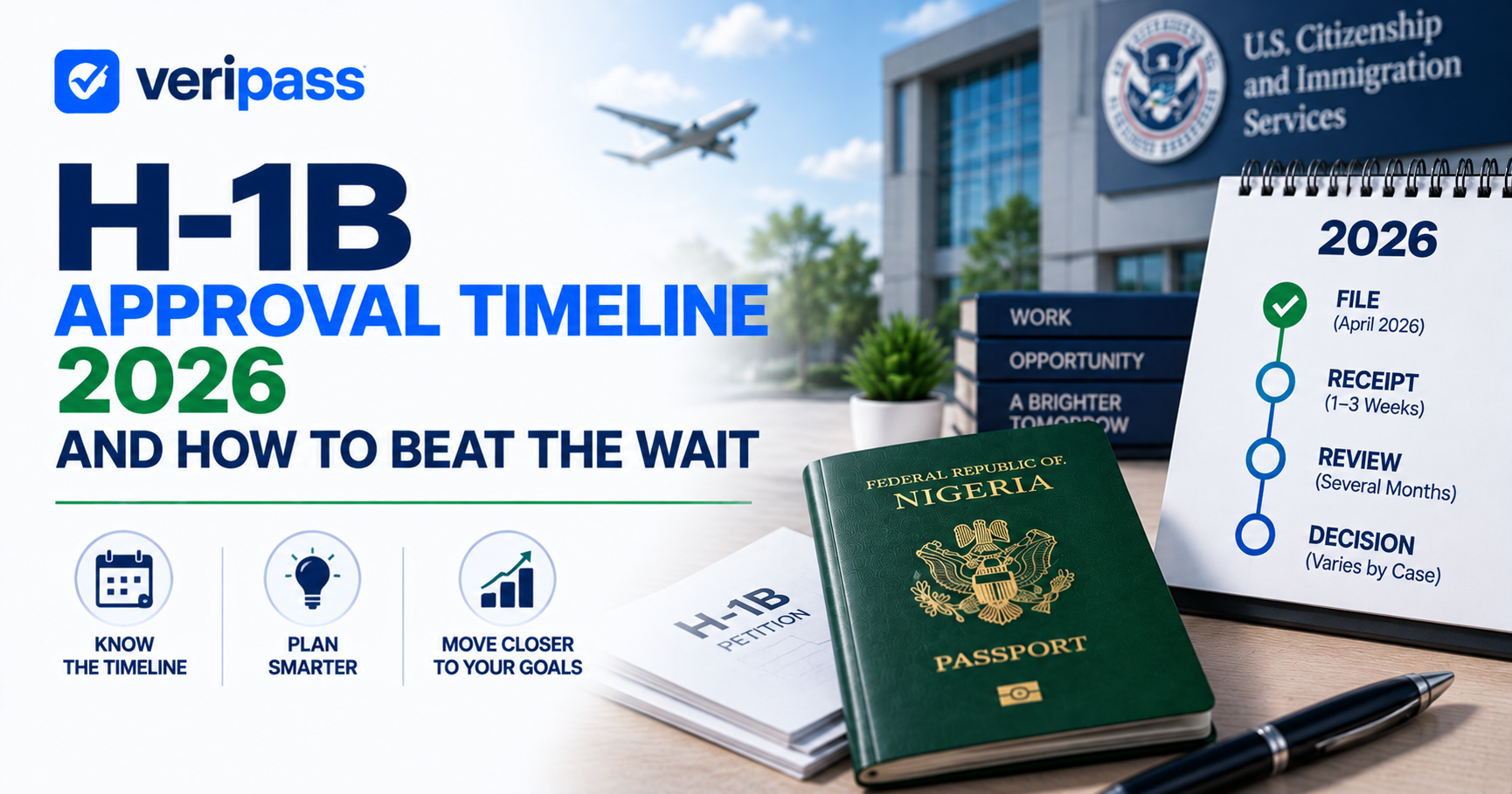
The h1b approval timeline has a cruel little secret. She got the approval. She called her mother in Lagos, cried on the phone, and sent a photo of the notice to the group chat. Nine days later, a lawyer explained that the approval was one agency saying yes, and the visa stamp she still needed came from a different agency, at an embassy where the next interview slot was eight months away. Her start date was gone. Her offer was gone. Nothing about her h1b approval timeline had been wrong, except the part everyone had told her was the end.
She did nothing careless. She read the same guides you have read, and every one of them treated approval as the finish line.
This piece fixes that. You get the real numbers, the three separate dates that decide when you can actually work, and a plain list of what to do at each stage so no one surprises you nine days too late. If you are a founder or a senior professional, you also get the part almost nobody says out loud, which is that the H-1B may be the slowest door available to you, and there are faster ones you already qualify for.
Read Also: H-1B Change of Status: Your Smartest Move in 2026
The numbers, as of September 2026
| What you are filing | Current wait |
|---|---|
| Form I-129, H-1B change of status | About 10 months |
| Form I-129, H-1B for someone abroad | About 10 months |
| Form I-129, H-1B extension | About 11 months |
| Premium processing (Form I-907) | 15 business days, $2,965 |
| Lottery registration fee | $215 per person |
The source is the USCIS processing times tool, which is the only figure that updates with reality.
Why you keep seeing different numbers
Search this topic, and you will find “3 to 8 months” on one site and “10 to 11 months” on another. Both are quoting something real. They are just not quoting the same thing.
The USCIS figure is the time the agency took to finish 80% of cases in that category over the past six months. It is not an average, and it is not a promise. Two out of ten cases take longer than the posted number, sometimes much longer.
The shorter ranges you see floating around are older service center estimates that stopped matching the backlog a while ago. When a site publishes them without a date attached, treat the whole page as stale.
What to do
- Pull your own number from the USCIS tool rather than trusting any article, this one included.
- Select Form I-129, then the H-1B subtype that matches your filing.
- Note the “receipt date for a case inquiry” the tool shows you. That date is what gives you the right to ask USCIS why your case is sitting.
Three dates decide your life, not one
Almost every guide collapses this into a single number. That is the mistake that costs people jobs.
Date one, petition approval. USCIS says yes to the I-129. If you are already in the United States on a change of status, this one matters most.
Date two: visa issuance. The stamp in your passport from a U.S. consulate. Only applies if you are abroad or if you plan to travel later. This is a separate agency on a separate clock.
Date three: lawful start. The day you can legally be on payroll. For cap-subject hires, that day is never earlier than 1 October, no matter how fast the approval came.
Approval is the middle of the process for anyone outside the country. Plan around all three dates, or you will book a flight you cannot use.
Which timeline is actually yours
There are four versions of this process, and they barely resemble each other. Find yours before you read anything else.
1. Cap-subject, changing status inside the U.S.
The standard path for students moving from F-1. For the FY2027 season, registration ran from 4 to 19 March 2026, selections were announced by 31 March, the filing window ran from 1 April to 30 June, and approved workers could start on 1 October 2026.
One change worth knowing. The lottery is no longer random. A rule that took effect on 27 February 2026 weights selection by wage level, so higher-paid roles get more entries in the pool. If your offer sits at Level I, your odds dropped.
2. Cap-exempt
Universities, affiliated nonprofits, and qualifying research organizations file all year. No lottery, no March window, no 1 October wall. You only wait on the I-129 itself.
If you are choosing between two offers and one is cap-exempt, that difference is worth more than a raise.
3. Extension with your current employer
The posted 11 months sounds alarming and mostly is not, because of the 240-day rule. If your employer files the extension before your current status expires, you keep working for up to 240 days past that expiry date while the case is pending, or until USCIS decides, whichever comes first.
After 240 days with no decision, you stop working. You may stay in the country.
4. Moving to a new employer
This one is the outlier. Under H-1B portability, you can start work the day USCIS receives the new petition. Not the day it is approved. The receipt notice is your proof, so keep it.
That turns a ten-month wait into a few days. Most articles never mention it.
What happens while you wait
Cap-gap, if you are on OPT
Cap-gap automatically extends your F-1 status and your work authorization when a timely cap-subject petition requesting change of status is filed for you. Under the current rule, it runs to 1 April of the relevant fiscal year, not 1 October as it used to.
Two traps. A petition asking for consular processing does not qualify. And leaving the country before your change of status is approved causes USCIS to treat the petition as abandoned. Read the DHS explanation before you book anything.
An RFE stops the clock
A Request for Evidence pauses the premium processing guarantee. The 15 business days do not keep running while you gather documents. The clock restarts when USCIS receives your response.
That is how a two-week promise becomes three months. It is also why a thin filing costs more time than a slow one.
You can add premium processing later
Form I-907 can be filed after the petition is already pending. If your cap-gap is about to lapse in March and the case is still sitting, this is the lever. Nobody tells you it exists mid-wait.
Note that 15 business days is roughly three calendar weeks, not two. Weekends and federal holidays do not count.
Do not travel on a pending change of status
Worth repeating on its own line, because it is the single most expensive mistake in this process.
After the approval, if you are abroad
Here is where the timeline quietly doubles.
You file the DS-160, pay the fee, and join the queue for an interview. That queue is set by demand at your specific post, and the spread is enormous. Some European posts schedule within days. Lagos, Abuja, and several Indian consulates have run into the hundreds of days.
Check your own post on the State Department wait times tool. Do not use a number from an article.
After the interview, some cases go into administrative processing under section 221(g). This is not a refusal. It is additional review, often security or technology screening, and it is open-ended. The State Department asks applicants to wait 180 days from the interview before making inquiries.
What to do
- Check your post’s wait time before your employer picks a start date.
- Complete the DS-160 carefully, since clerical errors are a common trigger for 221(g).
- Track your case at CEAC using your DS-160 barcode.
- Hold off on non-refundable flights until the passport is physically back in your hands.
The fee fight, briefly
You may have read about a $100,000 H-1B fee. Here is the honest position as of early September 2026.
Proclamation 10973, signed 19 September 2025, imposed that payment on certain new petitions for workers abroad. A federal court in Massachusetts vacated the implementing policy on 8 June 2026, calling it a tax the executive branch had no authority to impose. The First Circuit declined to reinstate it on 24 July 2026. So the fee is not currently collectible.
Two things keep this live. The proclamation expires by its own terms on 20 September 2026 unless renewed. And on 25 August 2026, the Department of Homeland Security published a proposed rule seeking a $103,265 fee on cap-subject petitions through regulation instead.
None of this is settled. Confirm the current position on the USCIS H-1B page before you file, and do not pay a fee that is not currently in force.
When it goes past the posted time
- Check your receipt date against the case inquiry date on the USCIS tool.
- Submit a case inquiry once you pass that date.
- Consider an expedite request if you meet a listed criterion, such as severe financial loss to a company.
- Ask your employer’s counsel about a congressional inquiry through the office covering the worksite.
- For a consular case stuck in 221(g), wait the 180 days before inquiring, because earlier contact rarely moves anything.
If you are the one sponsoring
The timeline is a hiring constraint, so treat it like one.
- Identify candidates in January, not February. Job descriptions, worksites, and wage levels all have to be settled before registration opens in early March.
- Model the wage level early, since weighted selection means a Level I offer materially lowers the odds.
- Get the certified LCA from the Department of Labor before the petition, because that step sits ahead of USCIS and is easy to underestimate.
- Build the specialty occupation argument at filing rather than saving it for an RFE response.
- Budget premium processing for anyone with a hard start date or an expiring status.
- For anyone abroad, price in the consular queue at their post, not the USCIS number.
The part most guides will not tell you
If you are a founder, an executive, or a senior professional with a real track record, the H-1B is probably the slowest and least certain door available to you.
Look at what it asks. A U.S. employer has to sponsor you. You have to win a lottery that now favors higher wage bands. You wait through a ten-month adjudication. You cannot start before 1 October. And the whole thing sits under active litigation and proposed six-figure fees.
Now look at what you are competing against.
The O-1A has no cap and no lottery. Petitions are filed year-round and premium processing gives a decision in 15 business days. It rewards what you have already built.
The EB-2 NIW and EB-1A let you self-petition. No employer, no sponsor, no lottery. You are arguing your own record.
The UK Global Talent visa runs on endorsement by a recognized body rather than a job offer. The Australian National Innovation visa and Canada’s Global Talent Stream work on similar logic, rewarding demonstrated ability instead of a sponsor’s willingness to gamble on a lottery.
The catch is real, so say it plainly. These routes are harder to qualify for. They ask you to prove standing in your field, and a weak file gets refused rather than delayed. A strong file, framed properly, moves faster than an H-1B ever will.
Where Veripass fits
Veripass builds cases for exactly this group. Founders, executives, and skilled professionals who have the substance and need it presented the way an officer reads it.
The work covers O-1A and O-1B, EB-1A and EB-1B, EB-2 NIW, the UK Global Talent visa, and the Australian National Innovation visa. Consultants handle profile development and evidence strategy, and in-house immigration lawyers prepare and file the petition.
What that looks like in practice.
- An honest read of your profile. You find out which route your record actually supports before you spend money, and you find out if the answer is none of them yet.
- Evidence architecture. Most refused petitions fail on framing rather than merit. Work that a founder writes off as ordinary often carries real weight once it is documented and positioned against the right criteria.
- Gap closing. If your file is close, the team works on what is missing, including press coverage, judging roles, and documented impact, so you file from strength instead of hoping.
- Route sequencing. Many people take the O-1A first for speed, then move to EB-2 NIW or EB-1A for permanence. Planning both together saves a year.
- Filing. The lawyers prepare the petition, so strategy and legal accuracy come from the same place.
Veripass is a consulting company working with in-house immigration lawyers, not a law firm, and nobody can guarantee an outcome from USCIS or the Home Office. What you can control is the strength of the file and the choice of route, and those two things decide most cases.
Your next step
If you have been waiting on a lottery, or watching the h1b approval timeline stretch while your career sits still, the useful question is not how much longer. It is whether you were ever in the right queue.
Find out in a conversation.
Book a free discovery call with Veripass
Bring your CV. You will leave knowing which route fits your record, what your realistic timeline looks like, and what is missing from your file.
What is the 240 day rule for H-1B?
What is the timeline for H-1B approval in 2026?
Can I travel after H-1B is approved?
What are the chances of H-1B approval?
Nothing here is legal advice. Processing times, fees, and rules change often, and several items on this page are under active litigation. Confirm current figures with USCIS and the State Department before you act.