The public charge rule 2026 has produced more worry than any single immigration change this year, and most of that worry is aimed at the wrong people. On July 16, 2026, the Department of Homeland Security announced a final rule that reinstates a stricter public charge test, and it takes effect on September 18, 2026. Headlines have framed it as a broad new threat to every green card applicant.
For skilled professionals, founders, and executives, the accurate message is calmer and more useful. The rule changes how immigration officers weigh financial self-sufficiency, and it hits lower-income, family-sponsored households hardest. A well-documented EB-1A or EB-2 NIW self-petitioner is usually well-positioned. What matters for you is preparation and one filing deadline, not panic.
This guide explains what the new public charge rule green card change actually does, who it genuinely affects, why a strong self-petitioner profile is usually fine, and the concrete action worth taking before September 18.
Read Also: EB-1A Visa Requirements: Your Proven Path to a Green Card
What Changed on September 18, 2026
A Rescission, Not a Replacement Rule
The most common error in early coverage is calling this a brand-new rule that replaces the old one. That is not what happened. DHS is removing the 2022 public charge regulation rather than replacing or amending it, which returns officers to the underlying statute and broad discretion.
The stricter standard then arrives through policy guidance in the USCIS Policy Manual instead of a detailed new regulation. That distinction matters, because there is no fresh checklist of banned benefits. Officers weigh circumstances case by case.
The 2022 rule had narrowed the analysis to a short list, mainly public cash assistance for income maintenance and long-term institutionalization at government expense. Removing it reopens the wider review that existed before.
What the Totality-of-Circumstances Review Now Means
Under the restored approach, an officer looks at the whole picture rather than a single factor. That includes age, health, family status, assets, financial resources, education, and skills, alongside any Affidavit of Support where one is required.
Receiving a means-tested benefit does not automatically trigger denial. It becomes one factor among many in a discretionary judgment about whether someone is likely to become a public charge at any time in the future.
For a high-earning applicant with high income, savings, and private health coverage, a totality review is usually a strength rather than a risk. The factors that concern officers are the ones a self-sufficient professional already answers well.
New Form I-485 September 2026 and the Guidance Behind It
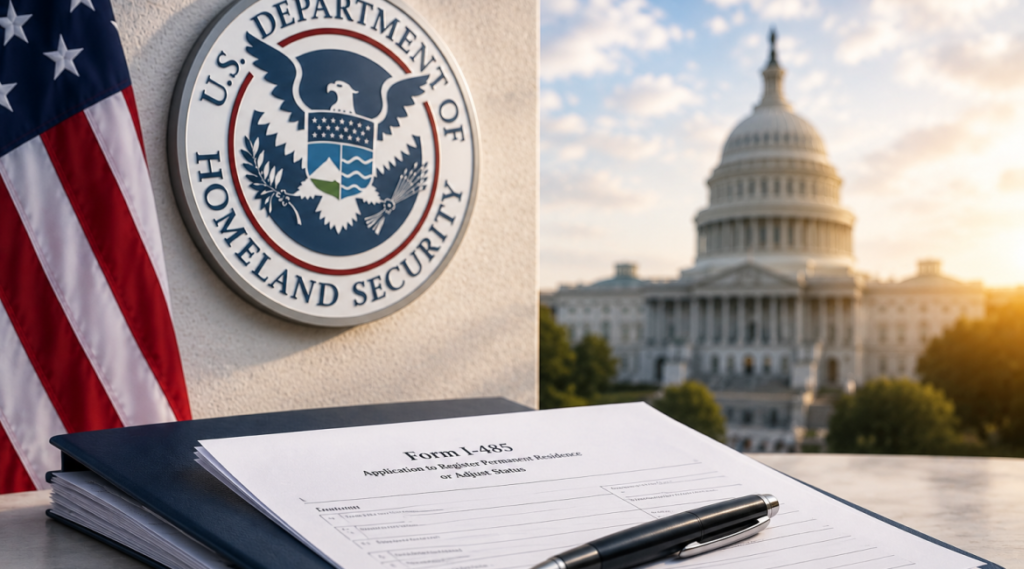
USCIS is issuing a revised edition of Form I-485, the application to register permanent residence or adjust status, keyed to the new standard. From September 18, 2026, the new edition is mandatory for adjustment applicants.
This is a practical trap worth flagging early. Older editions of Form I-485 submitted on or after September 18 will not be accepted, so anyone filing close to the date needs the correct version. Further operational detail sits in the USCIS Policy Manual, which officers will follow when they weigh the statutory factors.
If you plan to file an adjustment case, confirm the form edition on the official USCIS Form I-485 page before you assemble the packet.
Public Charge Rule EB-1A and EB-2 NIW Applicants Face a Two-Stage Question
Petition Eligibility and Adjustment Admissibility Are Separate
Skilled applicants often assume that an approved petition settles everything. It does not. Your case moves through two separate legal questions, and the public charge rule touches only the second.
The first question is eligibility, whether you qualify for the category. That is your I-140 for EB-1A or EB-2 NIW, judged on your achievements, your record, and the national interest. The public charge rule does not change how USCIS decides these petitions.
The second question is admissibility, whether you may be admitted or adjust to permanent residence. Public charge lives here. A strong petition and a clean admissibility record are different things, and the new rule asks you to satisfy both.
How Public Charge Affects Skilled Immigrants at the Green Card Stage
The practical effect for skilled immigrants is narrow. Your petition strength does not shield you from the totality review at the green card stage, so you still document financial self-sufficiency even with an approved I-140 in hand.
Consider a worked contrast. A family-sponsored applicant whose household used Medicaid or SNAP after September 18 now sees that benefit weighed in the discretionary review, where the 2022 rule would have ignored it. An EB-1A self-petitioner with a six-figure income, meaningful savings, and private insurance carries none of that exposure and presents a straightforward self-sufficiency case.
Same rule, very different impact. The change lands on the household profile the 2022 rule was built to protect, not on the self-funded professional.
What DHS Itself Says About Employment-Based Applicants
You do not have to take our word. DHS has stated that most employment-based adjustment applicants should see little practical change beyond using the revised Form I-485.
The rule also restates longstanding precedent that a healthy person in the prime of life who is employed or holds a firm offer is not ordinarily likely to become a public charge. For a working founder or senior professional, that precedent describes your situation directly.
Market anxiety is real, and business coalitions have warned that talented workers may look to Canada or the EU rather than risk a denial. That fear is understandable, though for a documented, self-sufficient applicant it is largely misplaced.
Public Charge Rule Self-Sufficiency Requirements for Self-Petitioners
The Form I-864 Exemption for EB-1A and EB-2 NIW Applicants
Here is the fact that almost no general article mentions. Self-petitioners in EB-1A and EB-2 NIW are statutorily exempt from Form I-864, the Affidavit of Support. You have no sponsor to vouch for you, so you establish self-sufficiency on your own record.
That exemption changes your relationship to this rule. Much of the alarm elsewhere concerns how officers now weigh a sponsor’s affidavit. If you never file one, that part of the debate does not reach your case.
You still address the public charge ground, and the revised Form I-485 asks you to state your Affidavit of Support category directly. For a self-petitioner, that means confirming the exemption rather than supplying a sponsor.
What Self-Sufficiency Evidence Looks Like for a Founder or Executive
Self-sufficiency is a documentation task, and for this audience it is usually a comfortable one. The goal is a clean, current picture of your ability to support yourself and your household without public assistance.
Strong evidence typically includes:
- Employment income shown through recent pay records and an offer or continuation letter, or business income shown through company financials and distributions for founders.
- Assets and savings, including bank statements, investment accounts, and property.
- Private health insurance or clear ability to cover medical costs.
- A recent tax history that matches your stated income.
- Education and professional credentials, which already sit in your petition and reinforce future earning capacity.
Assemble these as a short, coherent file rather than a pile of documents. The picture you want an officer to reach is that your finances are stable now and likely to stay that way.
The One Change Sponsored Applicants Feel That You Mostly Will Not
The rule removes the automatic favorable weight that a sufficient Form I-864 used to receive. Under the old approach, a qualifying affidavit counted as a guaranteed positive. Now an officer may treat it as positive, or may look past it based on the circumstances.
That shift matters for family-based and employer-sponsored cases that lean on an affidavit. For EB-1A and EB-2 NIW self-petitioners, it barely registers, since you are exempt from the affidavit and were never relying on that presumption.
The result sharpens the point of this guide. The mechanism generating most of the anxiety is one that self-petitioners sit outside of.
New Public Charge Rule Green Card Timing Before September 18, 2026
File Green Card Before September 18, 2026 and What That Protects
The single most actionable fact is the filing date. Cases filed before September 18, 2026 are judged under the current, narrower framework, while cases filed on or after that date fall under the new standard.
If your case is ready and you were planning to file soon, filing before the deadline keeps you under the more predictable rules. This is preparation, not a scramble, and it only helps if your packet is complete and correct.
For many self-sufficient self-petitioners, the difference is modest, since a strong financial record fares well under either standard. The timing hook matters most where a household has any means-tested benefit history to consider.
Which Filing Date Controls, and Why Accepted Is Not the Same as Mailed
The date that counts for adjustment of status is the postmark or electronic submission date, not the date an officer eventually decides the case. That is good news, because a case submitted before September 18 locks in the older framework even if adjudication runs long.
There is a catch worth taking seriously. A package must be accepted, not merely mailed. If USCIS rejects your filing for a wrong fee, a missing signature, or an outdated form edition, the date is not preserved, and a refiling after September 18 falls under the new rule.
The lesson is to file a complete, approvable case rather than rushing an imperfect one out the door to beat the clock.
How Benefits Received Before and After the Date Are Treated
The rule applies going forward. Benefits received before September 18, 2026 continue to be judged under the older, narrower standard, so past use of cash assistance or long-term institutionalization is the relevant history there.
Benefits received on or after September 18 can be weighed more broadly under the totality review, which is where programs like Medicaid or SNAP may enter the analysis. The rule is prospective and does not retroactively penalize applicants for earlier benefit use.
For most skilled self-petitioners, this section is academic, since there is no benefit history to weigh in the first place.
What to Document Now
Income, Assets, and Financial Standing
Start with a clean income and asset file. Pull recent pay records or business financials, current bank and investment statements, and your latest tax return, and make sure the numbers reconcile with each other.
Aim for a snapshot that shows both present stability and likely future earnings. A consistent story across documents is more persuasive than a single large figure.
Health Coverage and the Health Factor
Health is one of the totality factors, so document your coverage. Evidence of private health insurance, or clear resources to meet medical costs, answers the health factor directly and removes a common source of officer concern.
If you are moving between jobs or countries, plan continuous coverage so there is no gap to explain.
A Note on Benefits: Inform Rather Than Disenroll on a Headline
One caution matters more than any tip. The rule does not require anyone to give up benefits, and dropping coverage out of fear can cause real financial harm without improving a case.
Some benefits used by exempt family members, such as US citizen children, may not affect your application at all. Before changing anything, get advice on your specific facts rather than acting on a headline. If you are unsure how a program interacts with your case, that is exactly the kind of question to raise with an advisor.
How Veripass Helps
Most of the fear around the public charge rule 2026 comes from reading a general-audience story and assuming it describes your case. For EB-1A, EB-2 NIW, and O-1 professionals, it usually does not.
Veripass works with founders, executives, and skilled professionals on exactly these pathways, translating a broad rule into a clear read on your own exposure. That means confirming your self-petitioner exemption, shaping a clean self-sufficiency file, checking your form edition, and helping you decide whether filing before September 18 is right for your case.
If you want a straightforward answer on where you stand, book a free discovery call with Veripass, and we will walk through your situation and your options.
Key Takeaways
The public charge rule 2026 restores a broader, discretionary test from September 18, and it lands hardest on lower-income, family-sponsored households. For skilled self-petitioners, the change is mainly a documentation and timing matter.
Treat petition eligibility and admissibility as separate questions, build a clean self-sufficiency file, use the correct Form I-485 edition, and file before September 18 if your case is ready. Handled that way, a strong EB-1A, EB-2 NIW, or O-1 profile remains well-positioned under the new rule.
Does the public charge rule 2026 apply to EB-1A and EB-2 NIW applicants?
Yes, public charge applies at the admissibility stage for these categories, though self-petitioners are exempt from Form I-864 and establish self-sufficiency through their own record. A strong financial profile usually satisfies the totality review.
Should I file my green card before September 18, 2026?
If your case is complete and you are ready to file, filing before September 18 keeps you under the current narrower framework. Only file early if the packet is correct, since a rejected filing loses the earlier date.
Do I need the new Form I-485 from September 2026?
Adjustment applicants filing on or after September 18, 2026 must use the revised edition of Form I-485. Older editions submitted on or after that date will not be accepted, so confirm the current version before filing.
Will using Medicaid or SNAP cause my green card to be denied?
No single benefit triggers an automatic denial. Benefits received on or after September 18 can be weighed as one factor in the totality review, and most self-sufficient skilled applicants have no such history to consider.
Does a strong EB-1A or NIW petition protect me from public charge?
A strong petition settles eligibility, not admissibility. These are separate questions, so you still document self-sufficiency at the green card stage even with an approved I-140.
Should I stop receiving benefits because of the new rule?
The rule does not require you to drop benefits, and doing so on fear alone can cause financial harm. Seek advice on your specific facts before making any change.
This article is general information and not legal advice. For guidance on your specific case, speak with a qualified immigration professional.