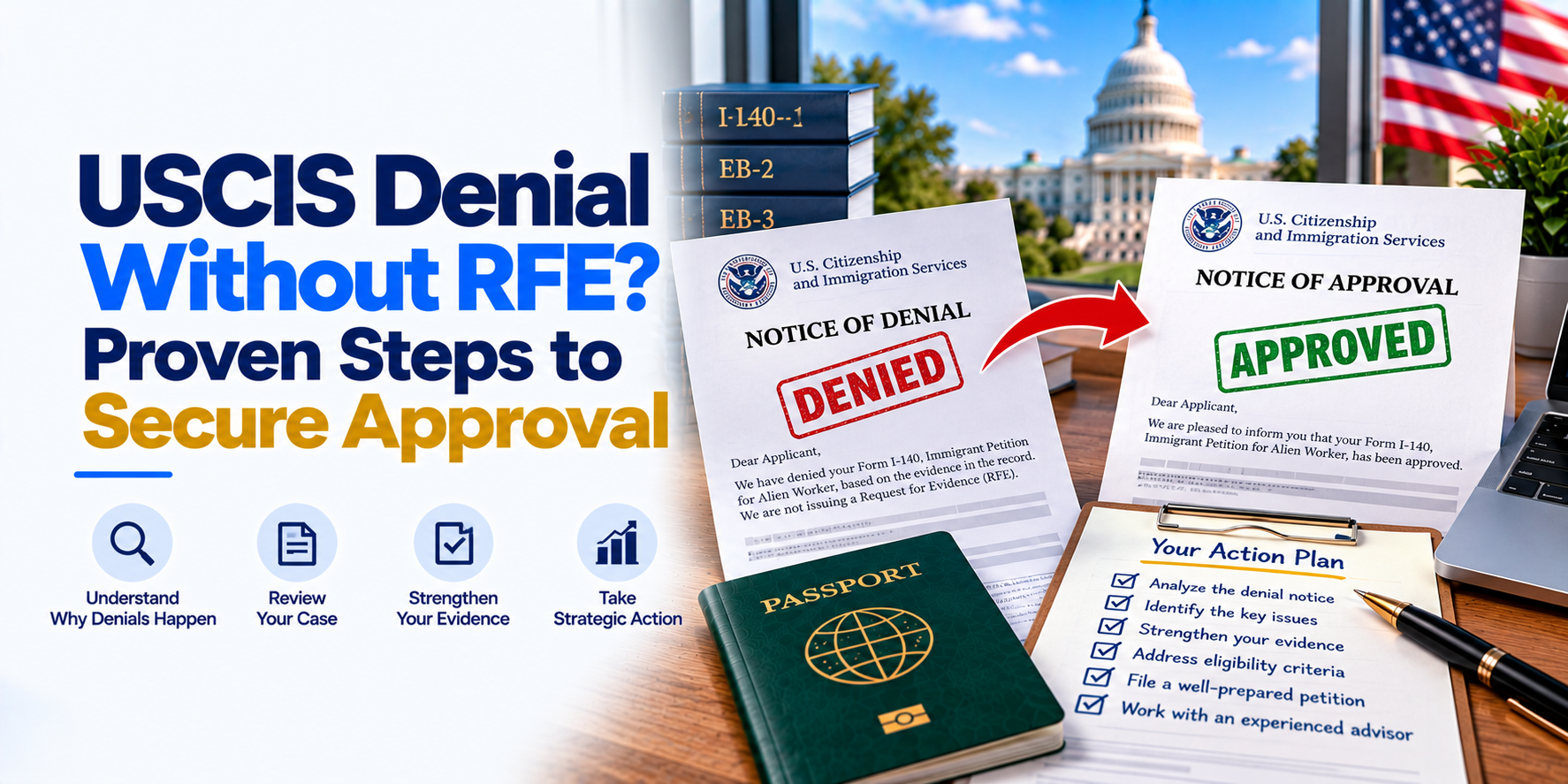
You open your USCIS account and see one word. Denied. No warning letter. No chance to send the missing page. Your fee is gone, and so are the months you spent building your case. Since August 5, 2026, a USCIS denial without RFE can happen to any O-1, EB-1A, or EB-2 NIW applicant who files with a gap.
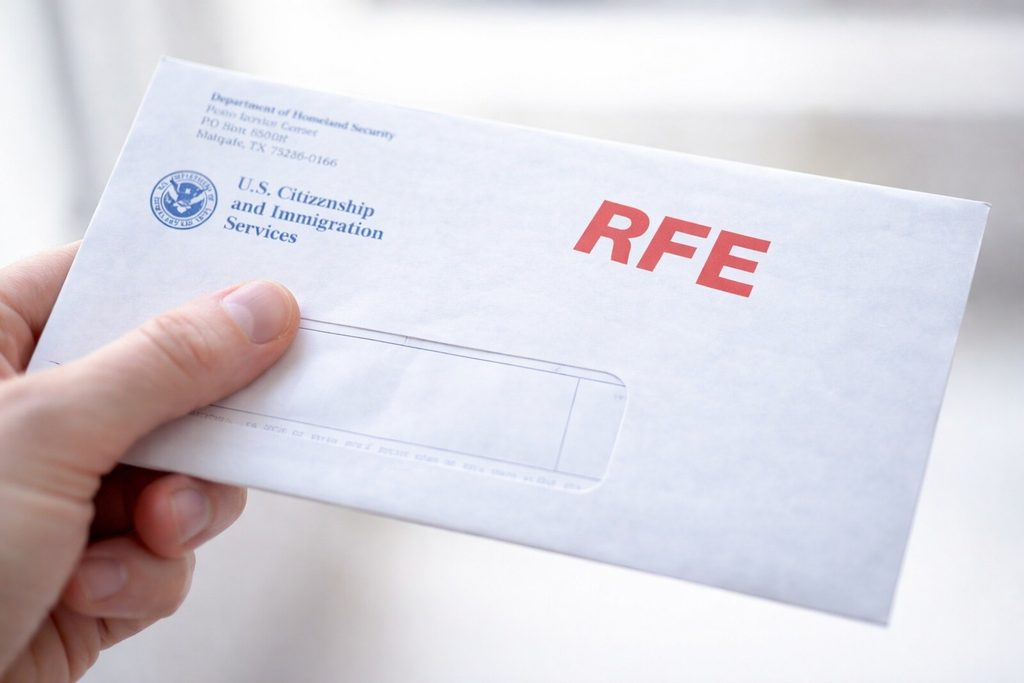
Before this change, most applicants got a Request for Evidence (RFE) and a second chance. That safety net is gone. The good news is that a USCIS denial without RFE usually comes down to missing or weak evidence, and you can fix that before you file. This guide shows you how.
See Also: What Happens After an RFE Approval?
What Changed on August 5, 2026
On August 5, 2026, USCIS issued Policy Alert PA-2026-05. It gives officers full discretion to deny your case without first sending an RFE or a Notice of Intent to Deny (NOID) when your filing is missing required initial evidence or does not show that you qualify.
The policy rests on a regulation that already existed, 8 CFR 103.2(b)(8). The same regulation says you must be eligible on the day you file and stay eligible until USCIS decides.
Three points matter most for you.
- The policy covers cases that were already pending on August 5, 2026, as well as new filings.
- Officers can still send an RFE. You just can’t count on one.
- The deadlines for answering an RFE or NOID are now tighter.
| What | The rule now |
|---|---|
| Time to answer an RFE | Up to 12 weeks, and the officer can give you less |
| Time to answer a NOID | Up to 30 days |
| Extensions | None |
| Extra time for mailed notices | 3 days |
| Extra time for notices mailed outside the US | Removed (it used to be 14 days) |
| Sending only part of what USCIS asked for | USCIS treats it as a request to decide your case as it stands |
| Deadline to file an appeal or motion after a denial | Usually 30 days, or 33 days if USCIS mailed the decision |
Why This Hits You Harder if You Live Outside the US
Most articles on this policy are written for US employers. If you are a founder in Lagos, an engineer in Nairobi or a researcher in Accra, the risk looks different.
USCIS used to add 14 days to deadlines on notices it mailed abroad. That extra time is gone. A paper RFE mailed to an address in Africa could take weeks to reach you, and the clock starts from the date on the notice, not the day it lands on your desk. You could lose most of your response window to the post office.
Two steps reduce this risk.
- Where USCIS lets you file your form online, do it. Under 8 CFR 103.2(b)(19), USCIS sends notices for online filings to your online account instead of by post.
- If you file on paper, link the case to a USCIS online account using the access code on your receipt, and check it often.
Your documents also face more questions. Civil records from many countries are harder for USCIS to verify, which brings us to the part most guides skip.
Rejection and Denial Are Not the Same Thing
Many applicants mix these up. The difference decides if you lose your fee.
| Rejection | Denial | |
|---|---|---|
| What triggers it | Missing signature, wrong fee or a form filed the wrong way | Missing initial evidence or failure to show you qualify |
| What happens to your fee | You get your package back | You lose the fee |
| Filing date | Not kept | Kept, and the denial stays on your record |
| Can you appeal? | No. You fix it and file again | Often yes, through a motion or an appeal |
Under the new policy, a missing document no longer pauses your case. It can end it as a denial, and filing fees are generally non-refundable under 8 CFR 103.2(a)(1)(v).
What “Initial Evidence” Means for Your Visa
Initial evidence is the evidence the regulations and form instructions say you must send with your filing. Each USCIS form page has a list. Treat that list as the floor, not the ceiling.
O-1 (Form I-129). Check the O-1 page and the Form I-129 page. Applicants most often leave out the written advisory opinion (the consultation letter from a peer group or expert), a copy of the contract or a summary of the oral agreement, and an itinerary when you will work for more than one client.
EB-1A (Form I-140). Check the EB-1A page. You must show a major one-time achievement or meet at least three of the ten listed criteria. Each claimed criterion needs its own evidence. Claiming five criteria with proof for only two is a common way to fail.
EB-2 NIW (Form I-140). Check the EB-2 page. You need proof of your advanced degree or exceptional ability, evidence for each part of the national interest test, and the required parts of Form ETA-9089 (Appendix A and the signed Final Determination page). That form trips up many self-petitioners.
One rule catches people out. Under 8 CFR 103.2(b)(12), evidence you send later must show you qualified on the day you filed. An award, publication or press feature dated after your filing date cannot rescue that filing. If your strongest evidence is still on its way, waiting to file can be the smarter move.
Foreign Documents That Sink Good Cases
This is where many strong applicants from Africa lose cases they should win.
Translations. Under 8 CFR 103.2(b)(3), every document in a language other than English needs a full English translation and a translator’s certificate stating that it is complete and accurate and that the translator is competent. This matters if your degree, birth certificate or company papers come from a French-, Portuguese- or Arabic-speaking country.
Missing primary documents. If a required document does not exist or you cannot get it, you must prove that and send secondary evidence, such as school or church records. If those also don’t exist, you need at least two sworn statements from people with direct knowledge. PA-2026-05 tells officers to treat these affidavits as the weakest tier of evidence and to test them for detail, consistency and credibility.
So don’t just attach an affidavit. Explain why the original is unavailable, show what you did to get it, and show why the substitute is reliable.
Know what your country issues. The State Department’s Reciprocity and Civil Documents by Country pages list the accepted documents for each country. The Nigeria page, for example, names the National Population Commission as the issuer of birth certificates and the Attestation of Birth for people born before the national system began. It also warns that officials treat Nigerian civil documents with extra caution. Expect scrutiny and support each document well.
What a Denial Really Costs You
The lost filing fee is only the start.
- Premium processing fees. If you paid for premium processing, you lose that fee too. USCIS refunds it only when it misses its own deadline.
- Your status. If your I-94 expired while your extension or change of status was pending, a denial can leave you without lawful status. Unlawful presence can start counting the day after the denial.
- Removal proceedings. Under a February 2025 USCIS policy memo, USCIS issues a Notice to Appear in immigration court when it denies a request and the person is no longer lawfully present.
- Your family. Applications for your spouse and children that depend on your case usually fall with it.
- Your work permit. A pending work permit linked to the denied case goes with it.
- Your record. A denial stays in your immigration history, and future officers can see it.
Where USCIS Still Has to Warn You
The new policy expands officer discretion. It does not remove every protection. Under 8 CFR 103.2(b)(16)(i), if USCIS plans to deny your case based on negative information you don’t know about, it must tell you and give you a chance to respond before it decides. This can include information from a database check or a third party, with narrow exceptions for classified material. If you receive a denial based on information you never saw, raise this with your attorney right away.
Premium Processing Speeds Up the Answer, Not the Approval
Premium processing for Form I-129 (O-1) and for EB-1A petitions on Form I-140 means USCIS acts within 15 business days. For EB-2 NIW, it is 45 business days. The fee is $2,965 as of March 1, 2026. Confirm current timeframes on the USCIS premium processing page.
Under the new policy, that “action” can be a denial. Premium processing helps a complete case get approved faster. It also helps an incomplete case get denied faster. Pay for speed only when your package is ready.
If Your Case Is Already Pending
The policy applies to your case even if you filed before August 5. Here is what to do now.
- Get a copy of everything you filed.
- Compare it, item by item, against the current form instructions and the initial evidence list.
- Mark every gap, such as a missing translation, an unsigned letter or a criterion with weak proof.
- If your case is linked to a USCIS online account, you can upload additional evidence while it is pending. Send only documents that fill a real gap, with a short cover note, and do not use this tool to answer an open RFE.
- Plan for a denial. If your status ends soon, work out your next legal step before the decision arrives.
If You Receive an RFE or NOID
- Note the deadline printed on the notice. It may be shorter than the maximum, and USCIS will not extend it.
- Start gathering documents the same day, especially anything from schools, past employers or government offices abroad.
- Answer every point in one complete package. A partial answer counts as a request to decide your case as it stands.
If USCIS Denies Your Case
Read the denial notice closely. It lists the reasons and tells you your options. You usually have 30 days, or 33 days if USCIS mailed the decision, to file Form I-290B.
| Option | When it fits | What you need |
|---|---|---|
| Motion to reopen | You have new facts or evidence | The new evidence with your motion |
| Motion to reconsider | The officer applied the law or policy wrongly | A clear legal argument with citations |
| Appeal to the Administrative Appeals Office | You believe the decision is wrong on the record | A brief explaining the errors |
| File a new petition | The gap is easy to fill and you qualify today | A complete new filing and new fees |
A new filing must show you qualify as of the new filing date. For an I-140, it also gets a new priority date.
This Policy Has Changed Before
USCIS has swung on this issue for more than a decade. A 2013 policy memo told officers to send an RFE unless no extra evidence could fix the case. In 2018, USCIS let officers deny without an RFE. In 2021, it switched back. Now the 2018 approach has returned.
After 2018, many business immigration lawyers saw fewer outright denials than they feared. That history offers little comfort today. USCIS has added more screening, more fraud checks, and a stronger focus on discretion since 2025. Plan as if the first filing is the only one you get.
How Veripass Helps You File a Decision-Ready Case
Most denials under this policy will not come from weak careers. They will come from gaps in how a strong career was documented. That is the problem Veripass solves.
Veripass works with founders, executives and skilled professionals on O-1, EB-1A and EB-2 NIW cases from first assessment to filing. Here is what that looks like.
- Case positioning. Veripass matches your achievements to the right visa and the right criteria before you spend money on a filing. You avoid claiming criteria you can’t prove.
- Evidence building. If your profile has thin areas, Veripass helps you strengthen them before you file, including writing and publishing articles under your name to build proof of your expertise. Given the eligibility-on-filing-date rule, this has to happen first.
- Pre-filing gap check. Veripass reviews your package against the initial evidence list and the regulations, so missing items are caught before USCIS sees them.
- Foreign document support. Veripass helps you organize translations, secondary evidence and the explanations officers now expect when a primary record is unavailable.
- Support from start to finish. You get one team that knows your case, keeps your timeline on track and stays with you through every stage.
The goal is simple. Give the officer no reason to deny your case without an RFE, because there is nothing missing.
Your Next Step
A USCIS denial without RFE can cost you your fees, your status and months of your life. You can prevent most of these denials before you file.
If you are preparing an O-1, EB-1A or EB-2 NIW case, or you have one pending and want to know where it stands, book a free discovery call with Veripass. In 30 minutes, you will learn where your case is strong, where the gaps are and what to fix before USCIS decides for you.
Can a visa be approved after a denial?
Yes. A denial is not always the end. You can file a motion to reopen if you have new evidence, a motion to reconsider if the officer applied the law wrongly, or an appeal to the Administrative Appeals Office. You file all three on Form I-290B, usually within 30 days, or 33 days if USCIS mailed the decision. You can also file a new petition that fills the gap. If the missing piece is easy to get, a new filing can be the quicker route.
What percentage of RFEs are approved?
USCIS does not publish one approval rate for all RFEs. Its most recent published breakdown for work visas covers fiscal year 2020. That year, USCIS approved about 67% of O visa petitions that received an RFE, and about 73% of H-1B petitions. It does not publish the same figures for EB-1A or EB-2 NIW. These numbers show that a strong RFE response often works. Under the new policy, you may not get the chance to send one.
Why would USCIS deny my application?
The most common reasons are these.
1. Required initial evidence is missing.
2. Your evidence does not prove each requirement, such as fewer than three EB-1A criteria.
3. You did not qualify on the day you filed.
4. Your forms, letters, and documents contradict each other.
5. The officer doubts that a document is genuine.
6. You missed an RFE deadline, sent a partial answer or missed your biometrics appointment.
For some benefits, the officer decides you do not merit a favorable use of discretion.
Does USCIS still send RFEs?
Yes. The new policy does not end RFEs. Officers can still send an RFE or a NOID, especially when you filed all the required initial evidence and it falls short of proving eligibility. The difference is that an RFE is now the officer’s choice, not something you can expect. Plan as if you will not get one.
This article is for general information only and is not legal advice. It reflects USCIS rules and policies as of October 8, 2026, and these change often. Check the official USCIS pages linked above and speak with a licensed US immigration attorney about your own case before you file.