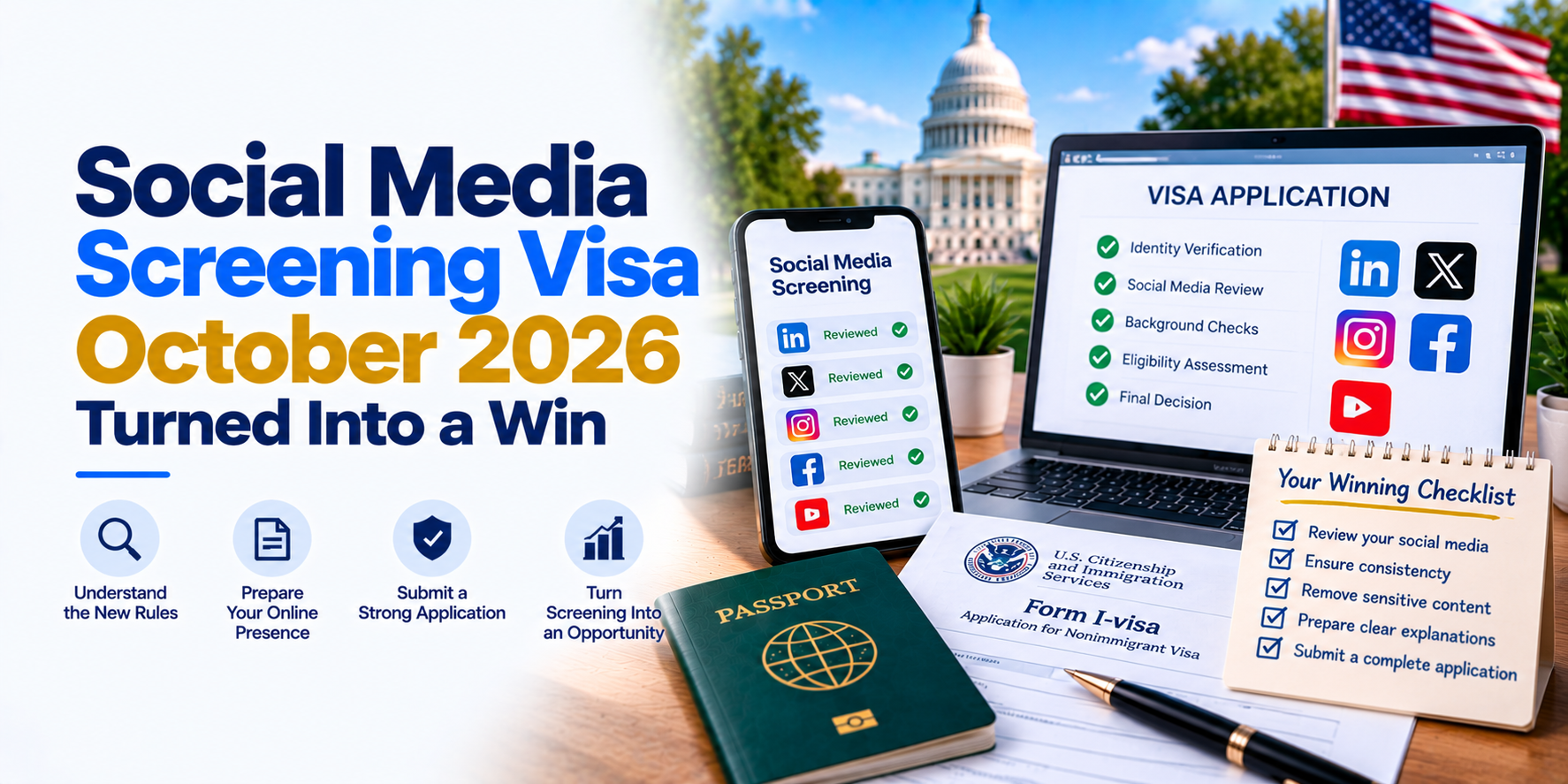
Your U.S. visa decision may start with your last post. Under the social media screening visa October 2026 expansion, the U.S. Department of State now tells more applicants to make every social media profile public so officers can review them before deciding a case. If you plan to move on an O-1 or EB-2 pathway, the social media screening visa October 2026 changes affect you more than the headlines suggest.
Your visa type is not on the new list, and officers still check your online presence. One forgotten account, one careless post, or one LinkedIn title that does not match your petition can delay your case or end it. The good news is that you can fix every one of these before you file, and this guide shows you how.
Read Also: USCIS Now Requires Social Media on Visa Applications
What the Social Media Screening Visa October 2026 Update Changed
The State Department expanded its online presence review to three more visa types. These are I visas for foreign media representatives, TN visas for Canadian and Mexican professionals under USMCA, and TD visas for their dependents. The Department told everyone in these groups to set the privacy settings on all their social media profiles to “public” or “open.”
These three groups join a list that already includes F, M and J students and exchange visitors, H-1B workers and their H-4 families, K fiancé visas, R religious workers and several others. The Department says it uses every available source of information to spot applicants who may be inadmissible, and it describes a U.S. visa as a privilege the government grants at its discretion.
Three Rules That Already Reach O-1 and EB-2 Applicants
It is easy to read your absence from the social media screening visa October 2026 list as a free pass. Three existing rules already apply.
Your visa form asks for five years of handles
Since May 31, 2019, the DS-160 (used by temporary visa applicants such as O-1) and the DS-260 (used by green card applicants who interview at a U.S. embassy or consulate) ask you to list every handle you used on the listed platforms in the past five years. The State Department’s official FAQ says officers will not ask for your passwords. It also says a false or inaccurate answer can lead an officer to deny your visa. If you have never used social media, you can answer “None” without penalty.
USCIS weighs your online activity
In August 2025, USCIS updated its Policy Manual to treat support for anti-American or terrorist views, including social media content, as a heavily negative factor in decisions that involve officer discretion. USCIS also widened the types of applications that receive social media review. Law firms that reviewed the update noted it names national interest waiver petitions and green card applications among the affected cases, which covers EB-2 NIW applicants and anyone filing Form I-485 inside the United States.
Green card forms are next in line
In March 2025, USCIS proposed adding social media questions to nine forms, including Form I-485 for adjustment of status and Form N-400 for citizenship. The White House Office of Management and Budget approved that collection in February 2026. Expect these questions to show up on new form editions.
Where Your Visa Type Stands Today
| Pathway | List handles on the form? | Told to make profiles public? |
|---|---|---|
| O-1 (visa at a consulate) | Yes, on the DS-160 | No |
| EB-1 or EB-2 (visa at a consulate) | Yes, on the DS-260 | No |
| EB-1 or EB-2 (Form I-485 inside the U.S.) | Approved for future form editions | No, and USCIS may still review public posts |
| H-1B, H-4, F-1, J-1 | Yes | Yes, since 2025 |
| I, TN, TD | Yes | Yes, from October 1, 2026 |
What Happened When Earlier Groups Were Added
Students went first, in June 2025. University advisers who reviewed the State Department cable reported that it let officers issue a temporary refusal under section 221(g) while they finished reviewing an applicant’s online presence. The same cable warned that limited visibility could look like an effort to hide something. Within weeks, news reports described students who left their interviews with 221(g) slips because an officer could not see an account or found one missing from the DS-160.
A 221(g) slip is not a final denial. It places your case in administrative processing with no fixed end date, which can wreck a start date, a funding round or a client launch. The lesson is simple. Your forms and your public profiles must tell the same story before you walk into the interview.
What the Government Has Not Said Yet
Some answers are still missing, and you should plan around them.
- How long profiles must stay public. The announcement gives no end date. If your category falls under the rule, keep your accounts public until the visa is in your passport.
- What counts as a problem post. No official list exists. Ignore viral lists that claim to know which posts cause refusals.
- Which group comes next. The public-profile list grew in June 2025, again in December 2025, and again on October 1, 2026. Prepare as if your category could join before your interview date.
Your Social Media Screening Visa October 2026 Checklist
- List every handle from the past five years. Include old usernames, business pages you post from, Reddit, YouTube, TikTok, and accounts you no longer use. An account you deleted still counts if you used it within the five-year window.
- Match that list to your DS-160 or DS-260. A missing account usually causes more trouble than an awkward post.
- Do not delete accounts to hide them. Deleting an account does not remove your duty to declare it, and a sudden gap can look like concealment.
- Review your content as a stranger would. Read your posts, reposts, comments, and tagged photos. Archive content you no longer want to carry, and keep anything your petition relies on.
- Line up your facts. Your job titles, employers, dates, degrees, and awards on LinkedIn, your company website, and your speaker bios should match your petition, CV, and forms. If you want a second pair of eyes on this step, a social media and visa form check such as VizaCheck compares your profiles with your visa documents and flags mismatches before you submit.
- Check your family’s accounts. Every family member who applies fills out a separate form, so a teenager’s accounts count too.
- Save a private record. Keep a copy of every handle and answer you submit so your interview answers stay consistent.
How to make your main profiles public
On Instagram, open Settings, go to Account privacy, and switch off Private account. On X, open Settings and privacy, go to Privacy and safety, then Audience and tagging, and untick Protect your posts. On TikTok, open Settings and privacy, go to Privacy, and switch off Private account. On Facebook, set your profile details and post audience to Public and turn off Profile lock if you use it. On LinkedIn, open Edit public profile and URL and set your profile visibility to public.
Apps rename menus often, so open each profile in a logged-out browser afterward to confirm what a visitor sees.
Your Online Presence Is Part of Your Evidence
For talent-based visas, your public profile does more than pass a security check. It supports or weakens your claims.
An O-1 petition argues that you have extraordinary ability. An EB-2 NIW petition argues that your work matters to the United States. When an officer searches your name and finds a thin LinkedIn page, no published work, and a title that differs from your petition, your evidence looks weaker. When the officer finds articles under your name, press coverage of your company, and a profile that matches every date in your file, your case reads as consistent and credible.
You control which version an officer finds, and you have time to build the stronger one before you file.
Applying to the UK, Canada or Australia
The October 2026 rule is a U.S. policy, so it doesn’t change the UK, Canadian, or Australian routes. Each route still rewards an accurate, visible record.
The UK Global Talent visa relies on an endorsing body to assess your achievements, and much of that proof lives online. Canada’s C10 significant benefit work permit asks you to document the economic, social or cultural benefit your work brings, and the Global Talent Stream runs through your Canadian employer. Australia’s National Innovation visa is for people with an internationally recognized record of exceptional achievement, and Home Affairs may ask you to complete Form 80 for a detailed character assessment.
In all three countries, mismatched dates, titles, and claims cause problems. The same checklist protects you.
Your Visa Is Not the Last Check
A visa gets you to the U.S. border. U.S. Customs and Border Protection then decides if you can enter, and it has authority to search electronic devices, including phones and laptops. CBP says only a small number of travelers go through this. Travel with the expectation that what is on your phone should match what you told the consulate.
How Veripass Helps You Get Ready
Most applicants treat social media as an afterthought and find out at the interview window that it mattered. Veripass works with founders, executives, and skilled professionals on O-1, EB-1A, EB-2 NIW, UK Global Talent, Canada C10 and Global Talent Stream, and Australia NIV pathways. We build your case so every piece of it agrees with every other piece.
- Case positioning and building. We map your achievements to the criteria for your visa and guide you through each step from strategy to filing.
- Online presence review. We check your public profiles against your petition, CV, and forms, flag gaps before an officer finds them, and help you list every handle correctly.
- Published proof of expertise. We help you write and publish articles under your name, which gives officers and endorsing bodies public evidence of your expertise.
The public-profile list has grown four times in 15 months, and your visa type could be next. If you want your online record working for your case instead of against it, start now.
Book your free discovery call with Veripass and leave with a clear plan for your profile and your visa route.
How much is the U.S. visa fee in Nigeria in 2026?
The fee depends on your visa type. The State Department’s official fee schedule sets the application fee at $185 for visitor, student, and exchange visas, $205 for petition-based work visas such as O-1, H-1B, and L-1, and $265 for K fiancé visas. If you apply for an employment-based green card at the embassy, such as EB-1 or EB-2, the immigrant visa fee is $345 per person.
Nigerians pay no extra reciprocity fee right now, according to the Nigeria reciprocity schedule. The same schedule shows that most visas for Nigerians are now single-entry and valid for three months, including O-1. Separately, a new $250 Visa Integrity Fee, created by a 2025 law, applies to most temporary visas at the point of issuance, and university advisers report that posts started collecting it at different times. Green card applicants do not pay it. Confirm the current amounts on the embassy’s payment page before you pay, since all fees are non-refundable.
What do visa officers check on social media?
Officers check two things. First, they confirm your identity and look for anything that makes you ineligible under U.S. law. The State Department’s social media FAQ also says officers compare what they find with your application, and false or missing answers can lead to a denial.
Second, a June 2025 State Department cable, reported by The Free Press and reviewed by immigration lawyers, told officers to look for signs of hostility toward U.S. citizens, culture, government, institutions, or founding principles, and for support of terrorist groups. The review covers your whole online presence, so search results and news mentions count too. In practice, officers also notice mismatches, such as a job title on LinkedIn that differs from your visa form.
What are the 19 countries listed for green card review?
In November 2025, USCIS ordered a full review of green cards held by people from 19 “countries of concern,” taken from the June 2025 travel ban proclamation. The countries are Afghanistan, Burma (Myanmar), Burundi, Chad, Cuba, Equatorial Guinea, Eritrea, Haiti, Iran, Laos, Libya, the Republic of the Congo, Sierra Leone, Somalia, Sudan, Togo, Turkmenistan, Venezuela and Yemen.
Nigeria is not on that list of 19. A December 2025 proclamation expanded the travel ban to 39 countries from January 1, 2026, and placed Nigeria under partial restrictions. Lawyers note it is unclear if the green card review now covers the expanded list, so check with an immigration professional if this affects you.
How to avoid visa rejection in 2026?
1. Check if your visa type is open to you. Nigeria’s partial restrictions suspend most immigrant visas and B, F, M, and J visas, with some exceptions. Temporary work visas such as O-1 remain available, so pick a pathway that fits.
2. Apply where you live. The State Department now expects most applicants to apply in their country of residence.
3. Fill out your DS-160 or DS-260 honestly and completely. List every social media handle from the past five years, every past trip, and every visa refusal.
4. Keep your story consistent. Your forms, CV, petition, LinkedIn, and company website should show the same titles, dates, and employers.
5. Use genuine documents only. The State Department flags Nigerian civil documents for extra fraud review, so get certificates from the correct issuing authority.
6. Build strong evidence for talent visas. For O-1 or EB-2 NIW, show press coverage, published work, awards, and expert letters that prove your claims.
7. Prepare for the interview. Know your application well, answer briefly and truthfully, and bring documents that back up what you say.
This article is for general information only and is not legal advice, so speak with a qualified immigration professional about your case.