Your petition is approved. You’ve told your family. You can almost see the embassy door. Then one missing address on your DS-260 stalls your case for months, and the wait you thought was over starts again. The DS-260 is the last big form before your green card interview, and it’s the one that catches careful people off guard.
This guide is for founders, executives, and skilled professionals across Africa moving to the United States on an EB-2 or EB-2 NIW green card through a US embassy. It shows you how to fill out the form in one pass, fix it after you submit, list your company correctly, and avoid the one rule that can end your case if you go quiet for a year.
Read Also: US Visa Denied? Here’s What to Do Next
What Is the DS-260?
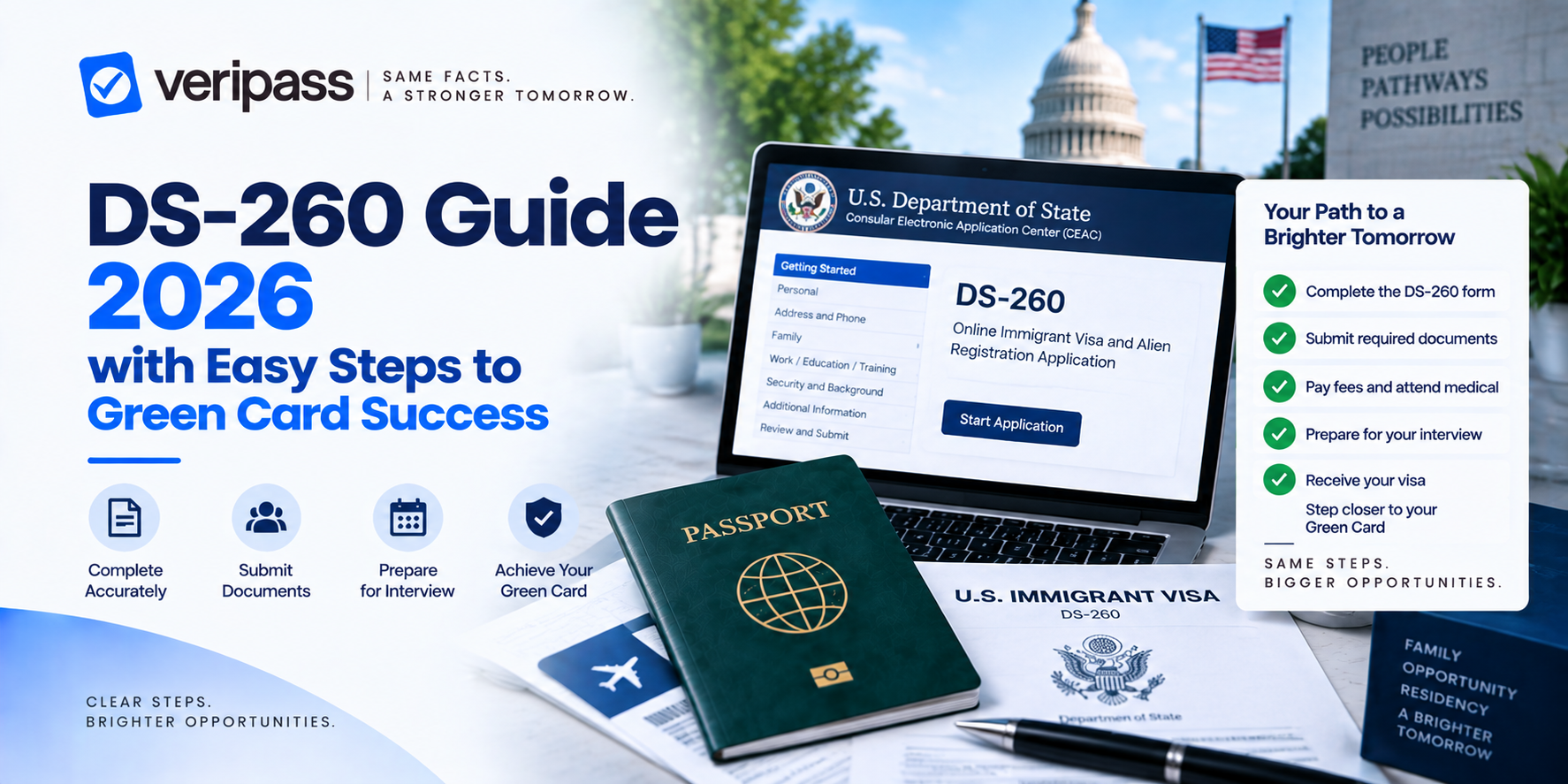
The DS-260, officially the Immigrant Visa and Alien Registration Application, is the State Department’s online green card application for people applying from outside the United States. You fill it out on the Consular Electronic Application Center (CEAC) after USCIS approves your immigrant petition.
You file a DS-260 if you live outside the United States and plan to get your green card through a US embassy or consulate. This is called consular processing. If you already live in the United States and qualify to adjust status, you file Form I-485 with USCIS instead.
Every family member moving with you needs their own DS-260, including your spouse and each child.
People often confuse the DS-260 with the DS-160. The DS-160 is for temporary visas, including the O-1. If you are on the O-1 path today, you will only meet the DS-260 later, if you apply for a green card from abroad.
Where the DS-260 Fits in Your Green Card Timeline
Here is the order for an EB-2 case processed abroad.
- USCIS approves your Form I-140, filed by an employer or self-filed under the EB-2 NIW.
- The National Visa Center (NVC) creates your case and sends you a Welcome Letter with your case number and invoice ID.
- Your priority date becomes current in the Visa Bulletin. EB-2 often has a waiting list, so check it monthly.
- You pay the immigrant visa fee in CEAC. For employment-based cases, it is $345 per person. The DS-260 stays closed until the fee shows as “PAID.”
- You complete a DS-260 for each person on the case.
- You upload your civil documents.
- NVC reviews your file and marks it documentarily complete. It then schedules your interview when the embassy has space. The IV Scheduling Status Tool shows how far each embassy has reached.
- You complete your medical exam and attend the interview.
- After you receive your visa, you pay the $235 USCIS Immigrant Fee so USCIS can produce and mail your green card.
Most EB-2 applicants do not need an Affidavit of Support (Form I-864). You need one if a relative filed your petition or a relative owns 5% or more of the company that filed it. Check your NVC instructions to confirm what your case requires.
Get These Ready Before You Log In
CEAC logs you out after about 20 minutes of no activity, and you lose anything you did not save. The fastest way to finish is to gather everything first.
| What to gather | Why you need it |
|---|---|
| Current and old passports | Passport details and travel history |
| Every address you have lived at since age 16 | The form wants where you actually lived, including school housing and national service postings |
| Full work history with start and end dates | It must match the evidence in your I-140 |
| School and degree records | Education history |
| Names and birth dates of your parents, spouse, former spouses and all children | Family section |
| Social media handles from the last five years | The form asks for them |
| Past US visas, refusals and any overstays | Immigration history and security questions |
| A US mailing address | USCIS sends your green card there |
How to Fill It Out Without Losing Your Work
- Click Save on every page. Do it before you check a document or take a call. The official DS-260 FAQs confirm that anything you enter after your last save is lost when the session times out.
- Answer in English only. Use English characters. If your name or address appears in Arabic, Amharic or another script, write it in English letters. CEAC can reject non-English answers and send you back to fix them.
- Use “Does Not Apply” with care. Tick it only when a question does not fit your life. Don’t type “N/A” into mandatory fields, and don’t leave them blank, because the form won’t submit.
- Match your passport. Many African names have more than one spelling or order across documents. Use your passport spelling as your main name and list the others under “other names used.”
- Read everything before you sign. Once you click “Sign and Submit Application,” you can’t open the form again on your own.
The Hard Questions Most Guides Skip
The security and background section is a long list of yes-or-no questions. Here is how to handle the ones that trip people up.
Past visa refusals. List every US visa refusal, including 214(b) refusals on visitor visas. Many applicants think a 214(b) refusal does not count. It does, and the officer can see it in the system.
Overstays and status problems. If you ever stayed in the United States past your permitted date or worked without permission, say so. Get professional advice before you answer, because these facts can affect your eligibility.
Honesty over comfort. A “yes” answer does not mean automatic refusal. A false answer is worse. Lying on a visa application can make you permanently ineligible for a US visa.
Social media. List every platform handle you used in the last five years, including accounts you no longer use. Then check your public profiles. If your LinkedIn titles or dates differ from your DS-260, fix the profile or be ready to explain the difference.
Founders and Executives: How to List Your Work
Your work history is where your DS-260 meets your I-140. The consular officer has both, so they must tell the same story.
- List your own company as your employer. Give your real title, such as founder and CEO, and the dates you held it.
- Keep titles and dates consistent. Use the same titles and dates that appear in your petition, CV and recommendation letters.
- List overlapping roles separately. If you ran your startup while holding a board seat or another job, give each role its own dates instead of merging them.
- Don’t hide gaps. If you had months without work, list that period honestly. A gap you explain raises fewer questions than one the officer finds.
Your Family’s Forms
Each person moving with you files a separate DS-260 under your case number. In your own form, list all your children, including adult children and children who are not moving with you.
Children must be unmarried and under 21 to come with you. If a child is close to 21, talk to an adviser early. The Child Status Protection Act can protect some children who turn 21 during processing, and the math depends on your case dates.
Where African Applicants Get Stuck on Documents
Every country issues documents differently, and the State Department keeps a page for each one. Start with the Reciprocity and Civil Documents by Country page for your country. It tells you which birth certificate, police certificate and marriage record the embassy accepts, and who issues each one.
Pay attention to these four points.
- Birth certificates. If your birth was registered late or your certificate was issued recently, check what your country page says about extra proof.
- Police certificates. These are valid for two years from the date of issue. If yours will expire before your interview, get a new one and bring the original to the interview. Don’t send the new one to NVC.
- Which embassy. Not every US embassy handles immigrant visas. Check the list of embassies that process immigrant visas to see where you will interview.
- Medical exam. Only the embassy’s approved panel physician can do it. Results can take up to 96 hours, so book early.
What to Do When Something Changes After You Submit
After you submit, the DS-260 locks. Only NVC or the embassy handling your case can reopen it.
- Before your interview is scheduled. Send a request through NVC’s Public Inquiry Form. Name the applicant and the answers you need to change. When NVC reopens the form, your CEAC status changes to “Re-opened.” Make the correction and submit again.
- After your interview is scheduled. Tell the consular officer at the interview and ask them to correct it.
- When your life changes. Marriage, a new baby, a new job or a move all matter. Tell NVC through the Public Inquiry Form. A new spouse or child usually needs their own DS-260.
- When CEAC gives you trouble. If you can’t log in with the correct case number and invoice ID, take a screenshot of the error and send it through the Public Inquiry Form. That form is NVC’s official contact channel.
The One-Year Rule That Can End Your Case
Under section 203(g) of the Immigration and Nationality Act, the State Department must end your case if you fail to apply for your visa within one year of being told a visa is available. You lose the benefits of your petition, including your priority date. You can only get it back if, within two years, you show that the delay happened for reasons outside your control.
Log in to CEAC and respond to NVC at least once a year. If you need to pause for a reason, tell NVC through the Public Inquiry Form.
How Veripass Helps You File It Right
The DS-260 asks you to retell your career, your addresses, and your family history in one sitting, and it has to match everything you already gave USCIS. That is where most delays start, and it is the part Veripass helps with.
Veripass works with founders, executives, and skilled professionals across Africa on the O-1, EB-1A, EB-2 NIW, UK Global Talent, Canada, and Australia NIV routes. At the DS-260 stage, Veripass helps you in five ways.
- One consistent story. Veripass checks your planned DS-260 answers against your I-140 evidence, CV, and LinkedIn before you submit, so your titles, dates, and roles line up.
- Your history in one place. You build your address, work, and travel history with Veripass before you log in. You then fill the form in one pass instead of fighting the timeout.
- Risky answers flagged early. Past refusals, name variations, and work gaps get reviewed before they reach a consular officer.
- Country documents sorted. Veripass helps you work out what your country’s documents page requires and what needs renewing before your interview, such as an expiring police certificate.
- Deadlines tracked. From NVC notices to the one-year rule, you know what is due and when.
If you aren’t at the DS-260 stage yet, Veripass helps you pick the right route first, based on your profile and goals.
Your approved petition took months of work. Don’t let one form undo it. Book a free discovery call with Veripass and walk into your interview with a DS-260 you can stand behind.
What is Form DS-260 used for?
The DS-260 is the online application you complete to get a US immigrant visa (green card) from outside the United States. It collects your personal details, family information, address history, work and education history, travel history, and answers to security questions. The consular officer uses it to decide if you qualify for the visa and reviews it with you at your interview. Every person immigrating on the case, including your spouse and children, completes their own DS-260.
How long does a DS-260 take to process?
The State Department doesn’t publish a set processing time for the DS-260 alone. After you submit it, you upload your civil documents and NVC reviews your full case. You can check how far NVC has reached on the NVC Timeframes page. Once NVC marks your case documentarily complete, your interview date depends on how busy your embassy is, which you can track with the IV Scheduling Status Tool. Errors in your DS-260 or missing documents are the most common reasons this stage takes longer.
How much does the DS260 cost?
Submitting the form itself is free. You pay the immigrant visa fee before the form opens. According to the State Department fee schedule, the fee per person is:
1. $345 for employment-based cases, including EB-2 and EB-2 NIW
2. $325 for family-based cases
3. $205 for certain other immigrant visa categories
4. $330 for Diversity Visa selectees
Some cases also pay a $120 Affidavit of Support review fee. After your visa is issued, you pay the $235 USCIS Immigrant Fee so USCIS can produce your green card. Medical exams, police certificates and translations cost extra, and those amounts vary by country.
Can a petitioner fill out the DS-260 for an applicant?
Yes, a petitioner, attorney or family member can help complete the DS-260, and CEAC lets them log in using the case number and invoice ID. The applicant is still responsible for every answer. When the form is signed and submitted, the applicant confirms the information is true and complete, so they should review each section before anyone clicks submit. For young children, a parent or guardian completes and signs the form for them.