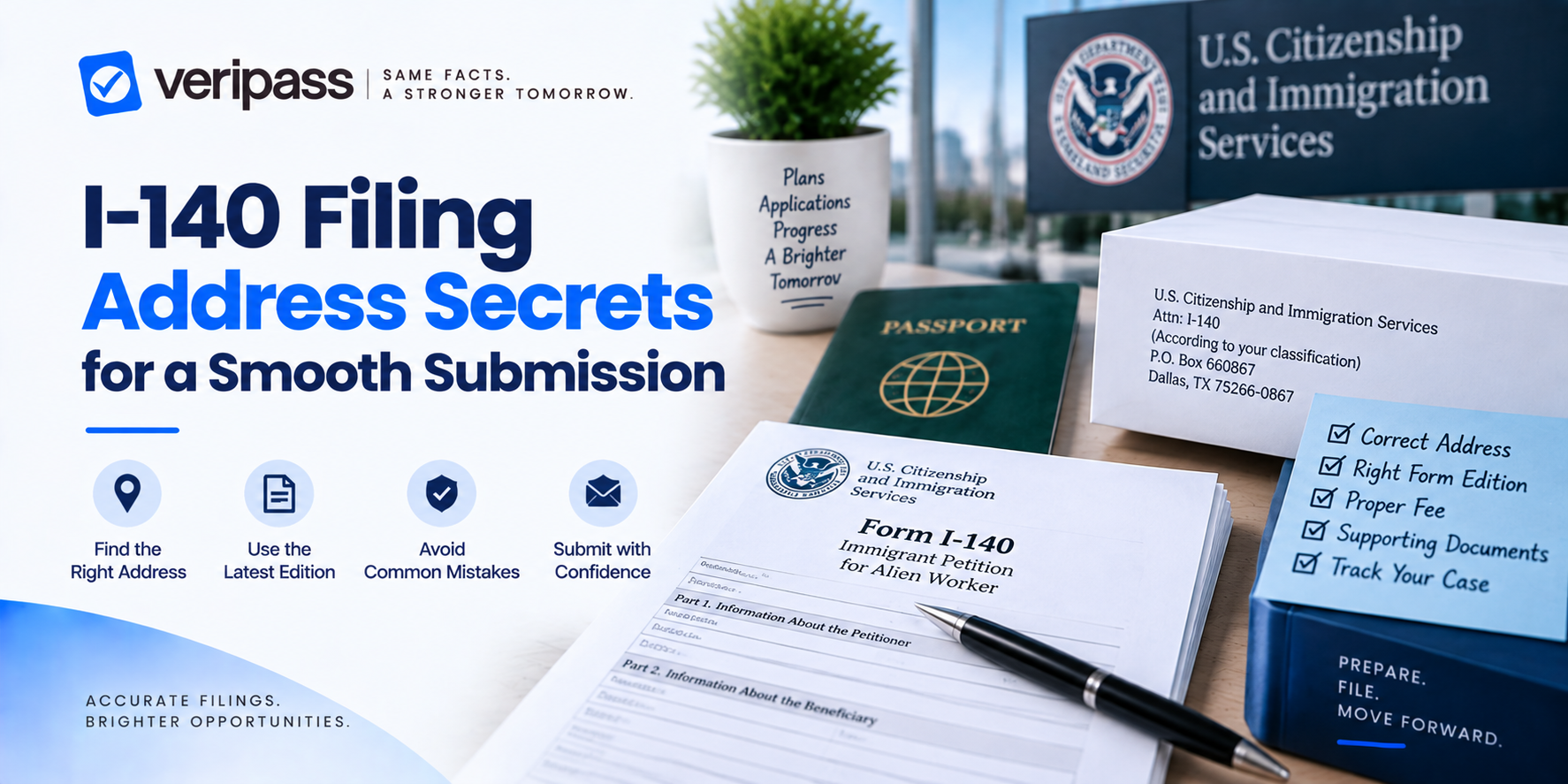
One wrong I-140 filing address can send a year of your work straight back to your doorstep. You collected the awards, chased the recommendation letters, paid the fees, and sealed the box with hope. Weeks later, the same package returns with a rejection notice, and your place in line goes with it.
USCIS runs several lockboxes, and each one accepts only certain forms from certain states. Your correct I-140 filing address depends on what you send and where you plan to work, and USCIS does not keep the filing date of a rejected package. This guide gives you the right address for your situation, shows you how to send your petition from outside the United States, and lists what to check before that box leaves your hands.
The addresses below match the official USCIS Direct Filing Addresses for Form I-140 page as of September 23, 2026.
See Also: Form I-140: Build a Strong Case for U.S. Residency
The quick answer
Your I-140 filing address depends on two things. The first is what you send with the I-140, and the second is the US state where you will work.
| What you are sending | Where it goes |
|---|---|
| Form I-140 alone | Dallas or Chicago lockbox, based on your work state |
| Form I-140 with Form I-485 | Dallas lockbox (Attn NFB), for every state |
| Form I-140 with Form I-907 (premium processing) | Elgin or Phoenix lockbox, based on your work state |
| Form I-140 with Form I-485 and Form I-907 | Elgin or Phoenix lockbox, based on your work state |
| Form I-140 alone, filed online | No address needed |
The full addresses are further down. Before you use them, settle one question first.
Online or by mail? Decide this first
USCIS lets you file some I-140 petitions online through a USCIS online account. If you file online, you skip the mailing address, the courier fees, and the risk of a lost package. You also get your receipt right away.
Online filing has limits. According to the USCIS I-140 filing procedures page, you can file online only when you submit a standalone I-140, with no other form except a Form G-28 if an attorney or accredited representative files for you. If you add Form I-907 or Form I-485, you must file by mail.
Attorneys report that EB-1A and EB-2 NIW self-petitioners can now file online. Check the USCIS Forms Available to File Online page to confirm your category before you start.
You can still get premium processing after an online filing. The USCIS I-140 page explains that if your pending I-140 has a receipt number starting with IOE, you can file a standalone Form I-907 through your online account or by mail.
If online filing fits your case, it removes most of the risks this guide covers. If you need to mail your petition, keep reading.
Find your I-140 filing address in three questions
Work through these questions in order. Stop at the first one where you answer yes.
Question 1. Are you including Form I-907 for premium processing?
If yes, your package goes to a premium lockbox, even if you also include Form I-485. The premium fee for Form I-140 is $2,965 for requests postmarked on or after March 1, 2026, according to the Federal Register.
Elgin Lockbox handles these states: Alabama, Connecticut, Delaware, District of Columbia, Florida, Illinois, Indiana, Iowa, Kansas, Kentucky, Maine, Maryland, Massachusetts, Michigan, Minnesota, Mississippi, Missouri, Nebraska, New Hampshire, New Jersey, New York, North Carolina, North Dakota, Ohio, Pennsylvania, Puerto Rico, Rhode Island, South Carolina, South Dakota, Tennessee, Vermont, Virginia, West Virginia and Wisconsin.
| Delivery method | Address |
|---|---|
| USPS | USCIS, Attn Premium I-140, P.O. Box 4008, Carol Stream, IL 60197-4008 |
| FedEx, UPS or DHL | USCIS, Attn: Premium I-140 (Box 4008), 2500 Westfield Drive, Elgin, IL 60124-7836 |
Phoenix lockbox handles these states: Alaska, Arizona, Arkansas, Armed Forces, California, Colorado, Georgia, Guam, Hawaii, Idaho, Louisiana, Marshall Islands, Montana, Nevada, New Mexico, Northern Mariana Islands, Oklahoma, Oregon, Texas, US Virgin Islands, Utah, Washington, and Wyoming.
| Delivery method | Address |
|---|---|
| USPS | USCIS, Attn Premium I-140, P.O. Box 21500, Phoenix, AZ 85036-1500 |
| FedEx, UPS or DHL | USCIS, Attn: Premium I-140 (Box 21500), 2108 E. Elliot Rd., Tempe, AZ 85284-1806 |
Question 2. Are you including Form I-485 without premium processing?
If yes, every work state uses the same Dallas address. You can file Form I-485 with your I-140 only when your priority date is current in the Visa Bulletin, and you are in the United States.
| Delivery method | Address |
|---|---|
| USPS | USCIS, Attn NFB, P.O. Box 660867, Dallas, TX 75266-0867 |
| FedEx, UPS, or DHL | USCIS, Attn NFB (Box 660867), 2501 S. State Highway 121 Business, Suite 400, Lewisville, TX 75067-8003 |
Question 3. Are you sending Form I-140 by itself?
Most self-petitioners outside the United States fall here. Your work state decides between Dallas and Chicago.
Dallas lockbox handles these work states: Alabama, Alaska, Arizona, Arkansas, Armed Forces, California, Colorado, Florida, Georgia, Guam, Hawaii, Idaho, Kentucky, Louisiana, Marshall Islands, Maryland, Mississippi, Montana, Nevada, New Mexico, North Carolina, Northern Mariana Islands, Oklahoma, Oregon, Puerto Rico, South Carolina, Tennessee, Texas, US Virgin Islands, Utah, Virginia, Washington, West Virginia and Wyoming.
| Delivery method | Address |
|---|---|
| USPS | USCIS, Attn I-140, P.O. Box 660128, Dallas, TX 75266-0128 |
| FedEx, UPS, or DHL | USCIS, Attn I-140 (Box 660128), 2501 S. State Hwy. 121 Business, Suite 400, Lewisville, TX 75067-8003 |
Chicago lockbox handles these states: Connecticut, Delaware, District of Columbia, Illinois, Indiana, Iowa, Kansas, Maine, Massachusetts, Michigan, Minnesota, Missouri, Nebraska, New Hampshire, New Jersey, New York, North Dakota, Ohio, Pennsylvania, Rhode Island, South Dakota, Vermont, and Wisconsin.
| Delivery method | Address |
|---|---|
| USPS | USCIS, Attn I-140, P.O. Box 88774, Chicago, IL 60680-1774 |
| FedEx, UPS or DHL | USCIS, Attn: I-140 (Box 88774), 131 S. Dearborn St., 3rd Floor, Chicago, IL 60603-5517 |
Notice that the premium lockboxes split the states differently from the standard lockboxes. Florida goes to Dallas for a standalone filing and to Elgin for a premium filing. Always read the table for your exact filing type.
Which state counts when you have no US employer
USCIS sorts most I-140 filings by the state where the beneficiary will work, not where they live today. That rule is simple for someone with a job offer. It gets less clear when you are an EB-1A or EB-2 NIW self-petitioner living in Lagos, Nairobi or Accra with no US employer.
For self-petitioners, use the state where you plan to carry out your work in the United States. USCIS asks you to describe this plan in Part 6 of Form I-140, including your job title, occupation code, and a plain description of the work. The filing procedures page says USCIS uses this information to check your proposed endeavor.
Keep your story consistent. The state you use for the address should match your business plan, your recommendation letters and your statement of purpose. If your plan covers several states, choose the state where most of the work will happen, and confirm your choice with your advisor before you mail anything.
[Internal links: your EB-1A Requirements article and your EB-2 NIW article, placed on “EB-1A” and “EB-2 NIW” in the first paragraph of this section]
Sending your I-140 from outside the United States
Most competitors assume you are mailing from inside the United States. If you are sending your petition from abroad, these points matter most.
- Use the courier address. DHL, FedEx, and UPS cannot deliver to a P.O. box. Use the street address in the “FedEx, UPS or DHL” row of your table. A courier package addressed to a P.O. box can stall or come back to you.
- Plan for transit time. International shipping takes several business days, and customs checks can add more. USCIS counts the day your package arrives, so send it early if you face a deadline.
- Keep proof of delivery. Save your tracking number, the delivery confirmation, and a photo of the sealed package with the label visible.
- Sort out payment before you ship. USCIS no longer accepts checks or money orders for paper filings. You pay with Form G-1450 for a credit, debit, or prepaid card, or Form G-1650 for a direct debit from a US bank account. If you have no US bank account, Form G-1450 is your likely route. Another person, such as a family member, friend or employer, can pay with their own card if they complete and sign the form themselves.
- Tell your bank in advance. USCIS may reject your package if the card transaction fails, so make sure your card allows large US dollar charges and has enough funds on it.
Where to send documents after you file
Your I-140 filing address covers the first package only. Later filings follow different rules.
- Upgrading to premium processing. If your I-140 is already pending, you file Form I-907 on its own. With an IOE receipt number, you can upload it through your USCIS online account. Check the Form I-907 page for the current mailing option.
- Adding Form I-485 later. Once your priority date becomes current, you can file Form I-485 on its own. Use the I-485 direct filing addresses page and include a copy of your I-140 receipt or approval notice (Form I-797).
- Responding to a Request for Evidence. Send your response to the address printed on the RFE notice, with the notice on top. Do not send it to the lockbox.
You may also see a different office named on your receipt notice. That is normal. The lockbox opens your package, processes the payment, and issues the receipt. A USCIS service center or office then reviews your case
Your checklist before you seal the package
Most rejections come from small errors, not weak cases. Check each item below.
- Open the USCIS I-140 addresses page on the day you mail and compare it with your label.
- Copy the “Attn” line and box number exactly as USCIS lists them.
- Match the address to your delivery method, with the P.O. box for USPS and the street address for couriers.
- Confirm you have the current edition of Form I-140 on the USCIS I-140 page.
- Check your fees on the USCIS fee schedule (Form G-1055). The base I-140 fee is $715, and most petitioners also owe an Asylum Program Fee.
- Place your signed Form G-1450 or G-1650 on top of the package.
- Add Form G-1145 if you want an email or text alert when USCIS accepts your filing.
- Sign every form. USCIS rejects unsigned forms.
- Fill in every required field. USCIS lists fields that trigger rejection when left blank, and self-petitioners must answer “No” to question 5 in Part 1.
- Keep a complete copy of everything you send.
Mistakes that send packages back
These errors keep coming up.
- Using old addresses. Pages from 2007 and 2010 still rank in search results and list the old Nebraska and Texas Service Center addresses. USCIS now uses lockboxes for new I-140 filings.
- Routing by home address. USCIS routes most I-140 filings by work state, not home state.
- Mixing up the tables. Sending a premium package to a standard lockbox, or the reverse, can delay or derail your filing.
- Paying by check. USCIS rejects paper checks and money orders unless you qualify for an exemption through Form G-1651.
- Trying to file I-140 and I-907 together online. USCIS requires this combination by mail.
How Veripass helps you get this right
The address is the last step. The bigger risk is inside the box: how you frame your case, which evidence you choose, and how well your documents tell one clear story.
Veripass works with founders, executives, and skilled professionals from start to finish. We help you position your case around the right pathway, build the evidence to support it, and prepare every document for filing. If your profile needs more proof of expertise, our team writes and publishes articles under your name to strengthen your record. You get a team that stays with you at every step, from the first strategy call to the day your package goes out.
That support covers EB-1A, EB-2 NIW, and O-1 in the United States, along with the UK Global Talent Visa, Canada’s C10 and Global Talent Stream routes, and Australia’s National Innovation Visa. If you are weighing more than one country, we help you compare them before you commit time and money to one.
You have already put months into your career and your evidence. Spend 30 minutes making sure your case is ready to send.
Book your free discovery call with Veripass today.
What is the filing address for the I-140 form with USCIS?
The I-140 filing address depends on what you send with the form and the state where you plan to work. A standalone I-140 goes to the Dallas or Chicago lockbox. An I-140 filed with Form I-485 goes to the Dallas lockbox for every state. Any package that includes Form I-907 for premium processing goes to the Elgin or Phoenix lockbox. Each lockbox has one address for USPS and a separate street address for FedEx, UPS, and DHL, so match the address to your delivery method. If you file a standalone I-140 online, you need no mailing address at all.
What address do I use to send USCIS forms?
USCIS has no single address for all forms. Each form has its own “Where to File” or “Direct Filing Addresses” page on uscis.gov, and the right address depends on the form, what you file with it and, often, where you live or work. Many forms now go to USCIS lockbox facilities in Dallas, Chicago, Elgin, or Phoenix. Some forms, including a standalone I-140, can be filed online through a USCIS account, which removes the need for a mailing address. Check the official page for your form on the day you mail.
How long is the I-140 processing time?
It depends on your category and the office handling your case. So far in fiscal year 2026, USCIS has decided half of all regular I-140 petitions in 3.7 months, down from a median of 9.3 months in fiscal year 2022. Self-petitions take longer per case, since EB-1A and EB-2 NIW petitions skip PERM certification and officers vet qualifications more closely at the I-140 stage. If you need speed, premium processing cuts the wait to 15 business days for EB-1A and EB-1B, and 45 business days for EB-1C and EB-2 NIW. Premium processing guarantees a decision within that window, not an approval, and a Request for Evidence pauses the case while you respond, with 87 days allowed for a reply. Check your current estimate on the USCIS processing times page.
How much does it cost to file an I-140 form?
The base I-140 filing fee is $715, plus the applicable Asylum Program Fee. Employers with more than 25 employees pay a $600 Asylum Program Fee, small employers with 25 or fewer pay $300, and nonprofits are exempt. Self-petitioners should confirm their amount on the USCIS fee schedule (Form G-1055). Premium processing costs extra, since the fee for all I-140 petitioners requesting premium processing rose from $2,805 to $2,965 for requests postmarked on or after March 1, 2026. You also need to budget for courier costs if you mail from abroad, plus any professional fees for preparing your petition. Pay by card with Form G-1450 or by US bank debit with Form G-1650, since USCIS no longer accepts checks for paper filings.
This article provides general information only and does not constitute legal advice. USCIS updates filing addresses, fees, forms, and processing times without notice, so confirm every detail on the official USCIS website before you file.