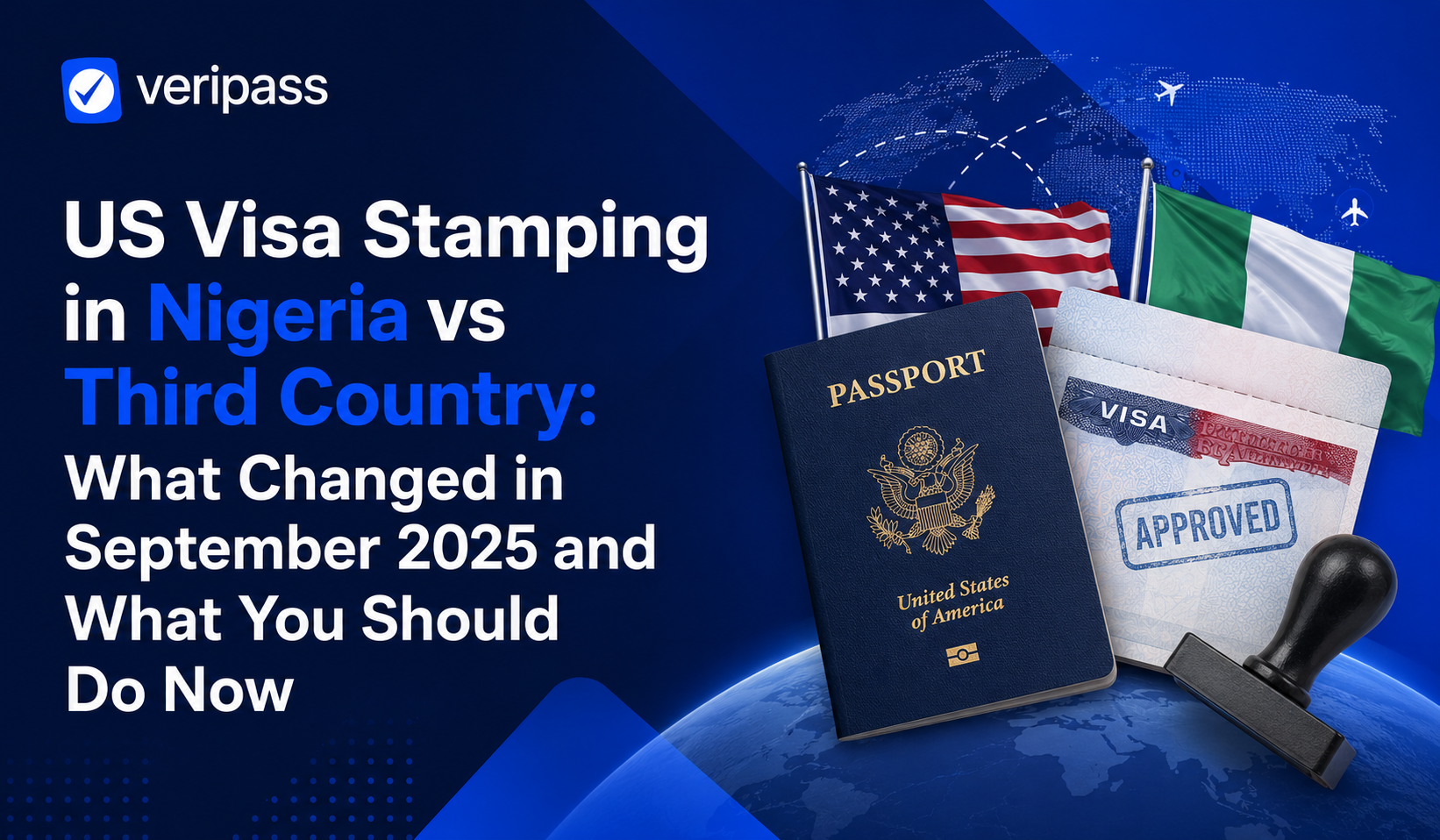
US visa stamping in Nigeria vs third country had a quiet answer that circulated among Nigerian founders, executives, and skilled workers: book Toronto, London, or Accra, skip the Lagos backlog, and get back to work. That answer stopped working on September 6, 2025.
The US Department of State ended third-country national visa processing on that date. Nonimmigrant visa applicants are now directed to apply in their country of nationality or in a country where they can prove legal residence. A Nigerian on H-1B in the US can no longer fly to Toronto and stamp there. A Nigerian executive transiting through London can’t book an appointment between meetings. The workaround is closed.
This article covers what the rules actually say, who still has legitimate options, what Lagos and Abuja look like right now, why the Dropbox option most people remember no longer applies to most categories, and what every EB-1A and EB-2 applicant currently dealing with the broader visa restrictions needs to know before planning anything.
Read Also: US Credit History for Nigerian Professionals: Building Financial Credibility After Arrival
What the Rule Actually Says
The guidance is direct. Nonimmigrant visa applicants must schedule their interviews at the US embassy or consulate in their country of nationality or in a country where they hold legal residence.
Residence means a document that proves the right to live somewhere long-term. A residence permit, long-term visa, or equivalent. Not a tourist stay, a work trip, or a property you own abroad. The consulate will ask for documentation, and applications without it are being refused, either at scheduling or at the window, with the visa fee non-refundable either way.
The rule applies to O-1, EB-2, H-1B, L-1, F-1, and their dependents. The only exceptions are applicants for A, G, C-2, C-3, and NATO visas, and diplomatic or official visa categories. Rare humanitarian or foreign policy exceptions exist but are genuinely rare.
Who This Affects and Who It Doesn’t
You are affected if you fall into any of these groups: a Nigerian based in Nigeria applying for your first US visa stamp. You apply in Lagos or Abuja; a Nigerian already in the US on H-1B, O-1, L-1, F-1, or another nonimmigrant status who needs a new stamp (Canada, the UK, and Mexico are no longer options; you return to Nigeria); or a Nigerian executive who used to schedule appointments around a travel calendar (you now schedule travel around your appointment).
You have options if you hold legal residence in another country (UK ILR, Canadian PR, UAE residence visa, or an EU long-term resident permit) and can document it. You are a dual national who can apply in either country of nationality, or you had a third-country appointment scheduled before September 6, 2025. Existing appointments are generally being honored, though some posts have cancelled them as local demand rose –confirm yours is still active before you fly.
What Happens If You Try to Stamp Somewhere You Don’t Live
Three outcomes, in rough order of frequency.
- The consulate refuses to schedule you because you cannot show proof of residence, and the fee is unrefundable.
- You get an appointment, but the officer refuses the application at the window with the same fee outcome. The refusal also enters your visa history and will be visible on every future application.
- The officer accepts the case but routes it into administrative processing under section 221(g), which remains in limbo with neither approval nor refusal.
The third outcome is the most disruptive for professionals with active US status and work obligations. A misjudged third-country attempt is not just a wasted trip but months of disruption to an ongoing US career.
US Visa Stamping in Nigeria: What Lagos and Abuja Look Like Right Now
For most Nigerian professionals on the O-1 or EB-2 path, returning to Nigeria is the realistic option. The practical question is what stamping in Nigeria actually looks like.

Current Wait Times
Wait times depend heavily on visa category. Employment-based interviews in the H, L, O, P, Q, and R categories run roughly 4 to 6 weeks in Abuja and 6 to 10 weeks in Lagos. B-1/B-2 tourist visa queues at both posts run far longer, often 7 to 13 months. Employment-based applicants get priority scheduling, which is why the gap is so wide.
After a successful interview, visa stamping itself takes 5 to 10 business days. Build that into your travel planning before booking flights back to the US. Live wait times are updated weekly by the State Department’s visa appointment wait time tool.
Abuja often runs slightly faster than Lagos for employment categories, but Lagos handles a higher volume of complex cases. If your employer or attorney has a preferred post, stick with it unless there is a specific reason to switch. Check both if you have flexibility.
Why Some Nigerian Applicants Get Pulled Into Administrative Processing
Section 221(g) administrative processing is where Nigerian employment-based applicants lose the most time, more than any other single issue. The officer neither refuses nor approves the visa. They hold the case for additional review, which can take weeks or months. The State Department’s own guidance suggests most cases resolve within roughly 60 days of the interview, though that’s an average, not a guarantee.
Three patterns trigger 221(g) holds for Nigerian O-1 and EB-2 applicants more than others: employer verification, where the consulate independently confirms the petitioning company’s operations or your role within it; document authentication, where Nigerian academic credentials, work history, or licensing are sent for verification; and security advisory opinions, which apply to certain technical fields and can add months on their own.
Bring originals of every supporting document, not just copies. Carry a recent employer letter on company letterhead with verifiable contact details. If your field touches sensitive technology, expect the hold and plan your travel so you’re not stuck outside the US when it happens.
When the Third Country Route Still Works
The third country option isn’t dead. It’s narrower, and it only works for Nigerians who actually hold legal residence in another country and can prove it.
What Legal Residence Means in Practice
The clearest qualifying documents are UK Indefinite Leave to Remain, Canadian Permanent Residence, UAE residence visa tied to employment, EU long-term resident permits, and similar national-level statuses.
What doesn’t count: a tourist visa, a business visa, a Schengen short-stay stamp, a transit visa, or property ownership without a residence permit. A two-year UK skilled work visa counts. A six-month UK visitor visa does not. A Nigerian who owns an apartment in Dubai but holds no UAE residence permit does not qualify to stamp there.
If you’re unsure whether your status qualifies, check the specific consulate’s published guidance before you book. Posts vary in how strictly they read the residence requirement, and a refused appointment costs the visa fee plus the trip.
Where Nigerian Residents Abroad Are Actually Stamping
UK residents apply at the US Embassy in London or the consulates in Belfast or Edinburgh. London handles the volume and tends to have longer waits. Canadian residents apply at the consulate covering their province, not whichever one has the shortest queue — Toronto, Ottawa, Montreal, Calgary, and Vancouver each have their own jurisdictions.UAE residents apply in Abu Dhabi or Dubai. EU residents apply in their country of residence: a Nigerian living in Germany applies in Frankfurt or Berlin, not Madrid.
You can sometimes shop for a faster post within the country where you live. You cannot shop across countries.
When It Works and When It Doesn’t
It works if you already live abroad on a qualifying status and your local post runs shorter than Lagos or Abuja for your category. A Nigerian on a UK skilled worker visa, renewing an O-1 in London, skips the round trip to Nigeria.
It doesn’t work if you’re flying somewhere short-term, hoping the consulate won’t check closely. They do check, and a prior refusal or a 221(g) hold on your record makes the case harder at a post that sees fewer Nigerian applications.
If you genuinely live in the country, run the numbers. If you’re flying in just for the appointment, Nigeria is faster, cheaper, and lower risk.
The Interview Waiver Option, and Why It No Longer Applies to Most of You
For years, Dropbox was the fastest route to renew a US visa stamp without sitting through another interview. That changed in two stages, and the second stage closed it for most Nigerian professionals.
What Changed and Who Still Qualifies
The interview waiver program had already been narrowed once, in February 2025, cutting eligibility from an expanded 48-month window down to 12 months. Then, effective October 1, 2025, the State Department narrowed it again, far more severely.
Under the current rule, nearly all nonimmigrant visa applicants — including those under 14 and over 79, who were previously exempt by default — now require an in-person interview. The interview waiver is now limited to: B-1, B-2, or B1/B2 visa renewals within 12 months of the prior visa’s expiration, where the prior visa was issued for full validity, and the applicant was at least 18; H-2A renewals on the same terms; and diplomatic categories (A, G, NATO, certain C-3, TECRO E-1).
H-1B, L-1, O-1, F-1, J-1, and M-1 applicants are no longer eligible for an interview waiver under any circumstances. If you’re renewing any of those, you’ll need an in-person appointment in Lagos or Abuja.
To qualify under the remaining categories, applicants must also have never been refused a visa (unless the refusal was overcome) and have no apparent ineligibility. The residence requirement from the September 6 rule also applies on top of this. Consular officers can still pull any waiver-eligible case for an in-person interview at their discretion.
What This Means for You
If you’re on the O-1, EB-2, H-1B, L-1, or F-1 path, you will sit for an interview in Lagos or Abuja for every stamp, including renewals. The windows that used to apply to H and L renewals are gone. The only people in your circle who can still use Dropbox are family members renewing B1/B2 tourist visas within 12 months of expiry.
Build the interview wait time from the section above into your stamping timeline. Renewals that used to take days through Dropbox now sit in the same queue as first-time stamps.
Automatic Revalidation: The Rule That Lets You Re-enter the US Without a New Stamp
If you’re already in the US on a valid status and your visa stamp has expired, you may not need to fly to Nigeria for a new stamp before every short trip abroad. Automatic revalidation, set out in 22 CFR 41.112, lets certain nonimmigrant visa holders re-enter the US on an expired stamp after a short trip under specific conditions: the trip must be 30 days or less, the destination must be Canada, Mexico, or (for F and J holders) adjacent islands only, your I-94 must still be valid, and you must not have applied for a new visa during the trip.
In practice, this means a weekend in Toronto or a week in Cancun doesn’t require a new stamp before you leave, provided your I-94 is current, and you didn’t apply for a visa while there. It does not work for a trip to Lagos, London, or Dubai. The Canada and Mexico restriction is absolute.
One trap to watch. If you apply for a new visa during the trip and it gets pulled into 221(g), revalidation no longer applies, and you’re stuck outside the US until the case clears.
The January 2026 Visa Restrictions and What They Actually Mean for EB-1A and EB-2 Applicants
This is the part most guides get wrong, and it matters more than almost anything else in this article if you’re pursuing a green card.
On January 1, 2026, Presidential Proclamation 10998 took effect, partially suspending visa issuance to nationals of 19 countries, including Nigeria among them. The partial suspension covers nonimmigrant B-1/B-2 visitor visas, F, M, and J student and exchange visitor visas, and all immigrant visas, including EB-1A and EB-2 NIW. This is broader than a lot of summaries suggest. It is not limited to tourist and student visas.
The proclamation applies specifically to people who are outside the United States on the effective date and do not hold a valid visa as of that date. If you’re already in the US, or you held a valid visa before January 1, 2026, the entry suspension itself doesn’t apply to you, and no visa issued before that date has been or will be revoked (per the US Embassy and Consulate in Nigeria’s own guidance). But if you’re a Nigerian national outside the US without a valid visa, pursuing an immigrant visa category, you are currently affected.
Separately, and just as consequential, the State Department announced on January 21, 2026, a pause on immigrant visa issuance, specifically covering 75 countries, including Nigeria, citing a public charge review. This is distinct from the proclamation itself. Under this pause, immigrant visa applicants can still submit applications and attend interviews, but issuance of the actual visa is on hold.
The USCIS Adjudication Hold: A Separate, Third Layer (Now Struck Down in Court, Status Unsettled)
On top of both of the above, USCIS issued a policy memorandum effective January 1, 2026 (PM-602-0194) that had placed a hold on the final adjudication of pending immigration benefit applications for nationals of the affected countries, including Nigeria, covering I-140 petitions, I-485 adjustment of status applications, and other benefit categories.
This is the part of the picture that just changed. On June 5, 2026, a federal court in the Dorcas International Institute of Rhode Island, et al. v. USCIS vacated that policy memorandum, with final judgment entered June 11, 2026. USCIS has stated it disagrees with the ruling but will follow it pending further review. As of this writing, the adjudication hold should be treated as not currently in effect, but given USCIS’s stated disagreement, an appeal or a replacement policy is a real possibility. If you have a pending I-140 or I-485, this is exactly the kind of detail to verify directly with your attorney before assuming either that the hold still applies or that it’s gone for good.
A Fourth Layer Worth Knowing About: Adjustment of Status Is Also Harder Right Now, for Everyone
Separately from anything specific to Nigeria, USCIS issued new guidance on May 21, 2026 (Policy Memorandum PM-602-0199), reframing adjustment of status itself as an “extraordinary discretionary benefit” rather than a routine pathway, with officers now generally expected to favor sending applicants through consular processing abroad except in unusual circumstances. This applies broadly, not just to travel ban countries — though dual-intent visa holders, including H-1B and L-1, appear to face less scrutiny under it because their immigration record already anticipates the possibility of a green card.
Put together: a Nigerian EB-1A or EB-2 applicant inside the US right now is dealing with the country-specific USCIS hold and this broader discretionary shift at the same time. Consular processing abroad isn’t a clean escape either, given the immigrant visa issuance pause described above. There is no simple “do this instead” answer right now. This is exactly the kind of layered, fast-moving situation where getting current legal advice before making a move, rather than relying on a general guide, matters most.
None of this is necessarily permanent. The proclamation requires a review every 180 days, and policy in this space has shifted before. The honest takeaway is: know exactly where your specific case sits today, and check again before you make any irreversible decision.
One More B1/B2 Note: The New Bond Rule
If a family member, parent, or business partner needs a B1/B2 to visit you in the US, there’s a separate change worth knowing. Effective January 21, 2026, Nigerian nationals found otherwise eligible for a B1/B2 may be required to post a refundable bond of $5,000, $10,000, or $15,000, determined by the consular officer at the interview and paid through the Treasury’s Pay.gov platform.
Worth flagging directly: Nigeria is also among the countries under the broader partial suspension described above, which means for many B1/B2 applicants, the suspension itself is the more immediate obstacle. The bond becomes relevant mainly for applicants who qualify for an exception to that broader restriction. The two rules operate separately, and both currently apply.
Where Veripass Comes In
US visa stamping in Nigeria is a sequential problem right now, not a single rule. The third country route is closed for most Nigerians, Dropbox is gone for employment-based applicants, and the January 2026 pause has added layers that didn’t exist twelve months ago, stacking a proclamation, an issuance pause, and a USCIS adjudication hold on top of each other. Automatic revalidation only works inside narrow limits.
Veripass helps you make the right call before you sit for the interview: whether to pursue consular processing or adjustment of status, given the current restrictions. Whether your residence abroad actually qualifies you to apply outside Nigeria, how your timeline should map against realistic Lagos and Abuja interview waits, and what to do differently if you’re carrying a prior 221(g) hold, a refusal in your history, or work in a sensitive technical field.
A wasted appointment costs the visa fee, the trip, and weeks of momentum. A misjudged third-country attempt can cost a refusal that follows every future application. Book a discovery call and let a Veripass strategist walk through your case before you book the appointment, not after.
Can I still get my US visa stamped in Canada or the UK as a Nigerian?
Only if you legally reside there. Since September 6, 2025, third-country national visa processing has ended. You can apply in Canada or the UK with a permanent residence in that country, documented properly.
Do I need an in-person interview in Lagos for my O-1 or H-1B renewal?
Yes. As of October 1, 2025, the interview waiver no longer applies to employment-based visa categories, including O-1, H-1B, and L-1. In-person interviews in Lagos or Abuja are required for first stamps and renewals alike. Dropbox currently remains available only for B-1/B-2 renewals under specific conditions.
What is automatic revalidation, and does it apply to Nigerians?
Automatic revalidation under 22 CFR 41.112 lets non-immigrant visa holders re-enter the US on an expired stamp after a trip of 30 days or less to Canada or Mexico, provided their I-94 is valid, and no new visa application was filed during the trip. Nationality isn’t a barrier to this rule.
Does the January 2026 immigrant visa pause affect my O-1 stamping?
Not directly, the O-1, H-1B, and L-1 are non-immigrant categories, and the Lagos and Abuja interviews for those continue. But if you are pursuing an EB-2 NIW or EB-1A, the picture is more complicated than a simple yes or no. The January 2026 proclamation’s partial suspension covers immigrant visas, a separate State Department pause affects immigrant visa issuance specifically, and a USCIS adjudication hold affects I-140 and I-485 processing for Nigerian nationals, regardless of whether you’re going through a consulate or adjusting status inside the US. None of these fully blocks your case, but all of them currently slow it down. Get current legal advice before assuming either path is the clean option.
Is it faster to get a US visa stamp in Accra than in Lagos?
Not anymore, and not for most Nigerians. Accra generally only accepts applications from Ghanaian nationals or legal residents of Ghana. Flying in for a faster appointment risks refusal at scheduling or at the window.
Can I travel to a third country for US visa stamping without a visa for that country?
No. You need a valid visa or residence permit for the country where you’re applying, and you need to prove legal residence (not just entry) to apply for a US visa there.
⚠️ This article is for informational purposes only and does not constitute legal advice. Immigration law and policy change regularly. Consult a licensed immigration professional for guidance specific to your circumstances.