
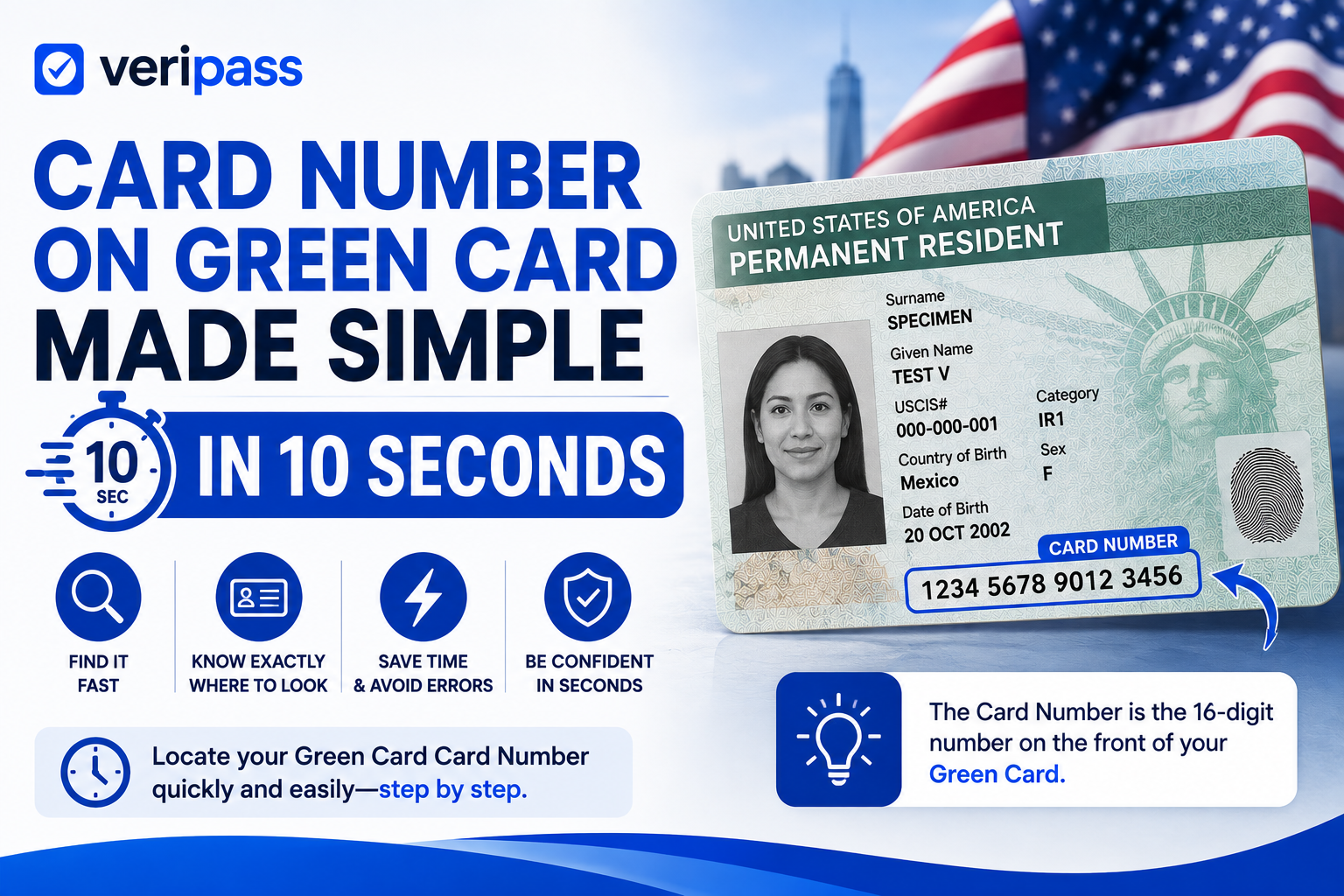
Card number on green card errors now carry a price, and you will probably never learn yours happened. Someone in HR photographs your green card, types thirteen characters into a form, and drops it in a drawer. Nine months later, a federal auditor opens that drawer. One character went in wrong, and your employer faces a fine of up to $2,861 for that single sheet of paper. You did nothing. Nobody told you. Your file is the one they are holding.
Here is the part that stings. Until March 2026, that mistake was free to fix. Your employer had ten days to correct it and paid nothing. ICE then rewrote its inspection guidance and reclassified the error as substantive, fineable the moment an auditor spots it, with no chance to correct it first (Morgan Lewis analysis). The penalty range sits in 8 CFR 274a.10, adjusted by DHS in January 2025 and still in force.
Now the good news. Card number on green card confusion clears up in about ten seconds once you know where to look, because the thing sits in plain sight on the back. Most people grab the wrong number because nobody ever showed them which one to take. This page shows you where it sits, how to read it without counting a single character, and the one rule that makes a typo almost impossible.
Read Also: Permanent Resident Card Document Number: Find It Instantly
What the card number actually is
Your green card carries two numbers, and people swap them constantly.
The card number identifies the card. Three letters, then ten digits. It changes every single time USCIS issues you a new card.
The A-Number identifies you. Seven to nine digits, printed on the front under the label “USCIS#”. It never changes. Not when you renew, not when you get a new work permit, not when you naturalize.
One person, five cards over thirty years, five different card numbers. One person, forever, one A-Number.
You will also see the card number called the document number, the receipt number, or the permanent resident number. On Form I-9 and inside most HR systems, “document number” is the label you will meet.
Your Social Security Number is a third thing entirely. Nine digits, issued by a different agency, and it appears nowhere on the card.
Where it sits, by card version
USCIS has redesigned this card several times, and the number moved.
Current design, issued from January 30, 2023. Back of the card, inside the block of machine-readable text. The front carries your photo, name, category, “Resident Since” date, expiration date, and A-Number. No card number on the front.
May 2010 through January 2023. Back of the card, same position. The mid-2017 refresh dropped the signature and added a second photo, though the number stayed put.
Before May 2010. Often printed on the front instead, near the top right of the printed block.
USCIS has confirmed the 2023 redesign did not invalidate anything issued earlier. New cards, older cards with a live expiration date, and certain older cards with no expiration date at all remain acceptable (E-Verify notice).
Find the card number on green card backs in ten seconds
Every other guide tells you the number occupies positions 16 through 28 of the first line. Now go count to sixteen in six-point type on a card that has spent four years in a wallet.
Do this instead.
- Flip the card over and find the three dense lines of text at the bottom.
- Read along line one. You will pass a long run of digits.
- The moment three letters appear together, stop. You have found the start.
- Take those three letters plus the next ten characters. Thirteen in total.
- You will run into two “<” symbols. Those are just padding. Stop before them.
That is your card number. No counting required.
The rule that kills typos
The font used in that machine-readable strip makes 0 and O look identical. Same story for 1 and I, 5 and S, 2 and Z, 8 and B. This is where most errors are born.
The format itself solves it. The first three characters are always letters. The last ten are always digits.
So if you think you spot the letter O in position seven, you are looking at a zero. If you think you spot the number 5 in position two, you are looking at an S. There is no judgment call to make and no exception to remember.
If you run a team, write that rule down and hand it to whoever does your onboarding. It removes the single most expensive mistake in the process.
Filling in Form I-9 without paying for it
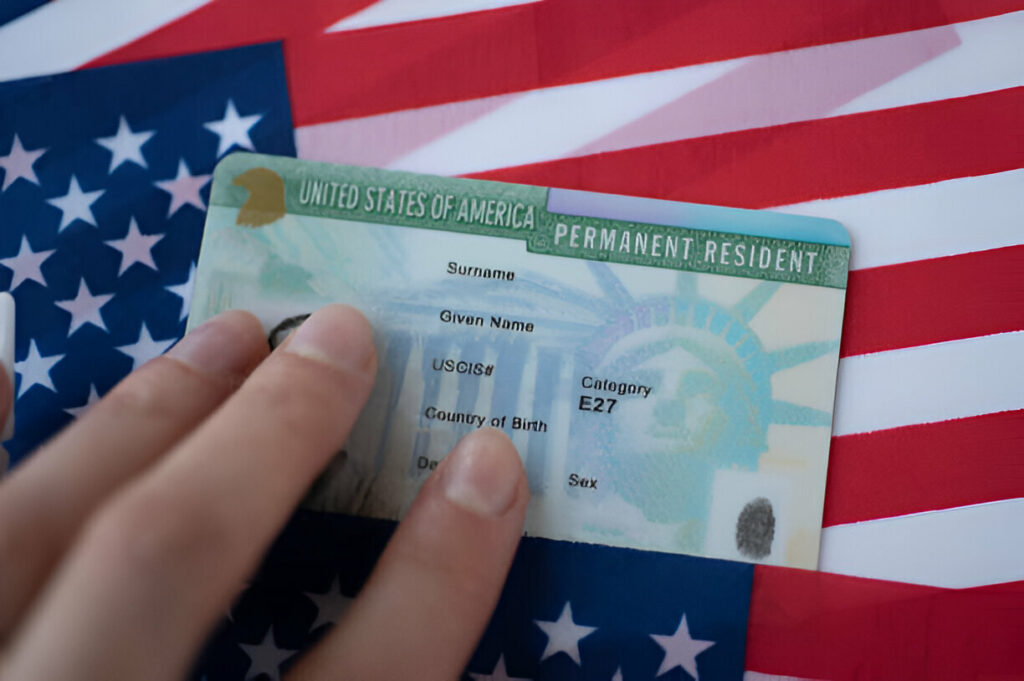
Your green card is a List A document, which means it proves identity and work authorization on its own. Your employer needs four fields in Section 2, and only four.
- Document Title. “Permanent Resident Card” or “Form I-551”
- Issuing Authority. “USCIS”
- Document Number. The 13-character card number from the back
- Expiration Date. The “Card Expires” date from the front
The mistake that generates fines is putting the A-Number from the front into the Document Number field. An auditor spots it instantly because the shape is wrong. Seven to nine digits where thirteen alphanumeric characters belong.
Two things your employer cannot do. They cannot ask for a different document once you hand over a valid green card, and they cannot refuse an expired one, since the M-274 Handbook for Employers still treats it as acceptable for List A. Both moves turn a paperwork problem into a discrimination claim.
If your employer runs E-Verify, the same number feeds that system separately. E-Verify also returns your photo, which your employer must compare against the card and against you. That step is required.
Why your receipt number may not match your card
This one confuses a lot of people, so read it twice.
Every USCIS filing generates a receipt number in the same 13-character shape. You probably tracked your I-485 or I-140 under one. The number printed on your finished card belongs to the case that actually produced the card, which is not always the case you watched online.
If the two differ, nothing is wrong. Use the number printed on the card every time. The card is the document being verified, so the card is the source.
What the three letters really tell you
The prefix marks where your case was handled. MSC and NBC point to the National Benefits Center, EAC to Vermont, WAC to California, LIN to Nebraska, SRC to Texas, YSC to Potomac.
IOE is the one nobody explains properly. IOE is not a building. It means your case was filed and processed electronically. Guides that list it alongside the physical service centers send readers hunting for a location that does not exist.
After the letters come two digits for the federal fiscal year, which runs October 1 to September 30. A case received on October 15, 2025 carries “26”, not “25”. Then three digits for the processing workday and five for your case within that batch.
When you cannot read it or cannot find it
The print has worn off. The back of the card takes the most wallet damage, so this happens often. File Form I-90 for a damaged card. Meanwhile your I-797 approval notice or USCIS online account may carry the number.
The card is lost or stolen. File I-90 as well. You do not need the card number, since your A-Number and basic details are enough. Once USCIS accepts the filing, request an ADIT stamp in your passport at a field office as temporary proof of status. That matters if you have travel booked.
The card expired. File I-90 to renew. Since September 10, 2024, your receipt notice extends card validity for 36 months from the printed expiration date when you present it alongside the expired card (USCIS alert). That replaced the old 24-month rule. Fees run $415 online and $465 by mail, biometrics included. Check the Replace Your Green Card page before paying, since fees move.
Your card expires in two years, not ten. Stop. I-90 is the wrong form, and USCIS will reject it. A two-year card means conditional residence. Marriage-based residents file I-751 and EB-5 investors file I-829. Both carry a 90-day window before expiration, and missing it puts your status at risk. Founders who came through EB-5 get caught by this more than anyone.
Your card has no expiration date printed. Check the small print for the form number. If it reads I-551, the card remains valid, though replacing it saves you trouble at borders and with employers. If it reads I-151, AR-3, or AR-103, the card was retired decades ago and no longer works as proof of status. Your residence is intact. The card is not.
What those 13 characters actually give away
Most articles tell you to guard the number and stop there, which helps nobody.
The honest version. The card number encodes a service center, a fiscal year, a processing workday, and a sequence position. No biometric data, no Social Security Number, no financial information. Someone holding it cannot open an account in your name.
What it does do is make a forged identity look more convincing, and it confirms to a stranger that you hold permanent residence. Treat it the way you treat a passport number. Keep a scan of both sides somewhere secure and separate from the card, avoid sending it over plain email or WhatsApp, and carry the card only when you need it.
Read your own category code while you are there
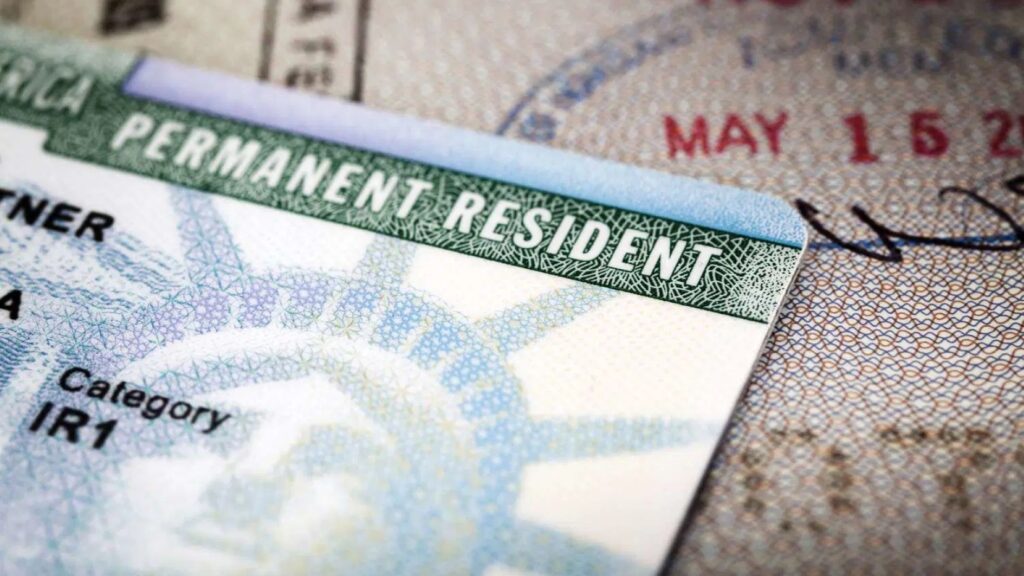
The “Category” field on the front records how you got in, and the second digit is the part people miss.
E11 and E16 are both EB-1A extraordinary ability. E11 means you entered on an immigrant visa from abroad. E16 means you adjusted status inside the United States. The same split runs through the system. E12 and E17 for EB-1B, E13 and E18 for EB-1C, E21 and E26 for EB-2.
So if you are weighing consular processing against adjustment of status, your future card will record the choice. You will need this code again for I-90 and Form I-131.
What to do this week
- Take out the card and locate the 13 characters using the three-letter trick.
- Photograph both sides and store the images somewhere encrypted, away from the card.
- Check the expiration date. Two years means I-751 or I-829. Ten years means I-90 within six months of expiry.
- Pull up your last I-9 and confirm the Document Number field holds thirteen characters, not nine. If you run a company, check every file for this error before ICE does it for you.
Where Veripass fits
Everything above assumes you already hold the card. If you do not yet, that is the harder problem, and it is the one Veripass was built for.
Veripass works with founders, executives, researchers, and skilled professionals across four routes. US O-1 and EB-1A for people with a record of recognized achievement. EB-2 NIW for people whose work carries national value and who would rather self-petition than wait on an employer. The UK Global Talent Visa for those building in tech, science, or the arts. Australia’s National Innovation Visa, subclass 858, for people with an international reputation in their field.
Three things separate this from going it alone or handing the file to a large firm.
You get told which route actually fits. Plenty of people arrive certain they need EB-1A when EB-2 NIW is the faster petition for their profile, or the reverse. Choosing wrong costs a year and a filing fee. That assessment happens before you commit to anything.
Your evidence gets built, not just collected. These routes turn on how well your record maps to published criteria. A founder with real traction still gets refused when the petition fails to connect that traction to the standard the officer applies. Veripass structures the evidence around the criteria rather than sending USCIS a resume.
Somebody stays with the file after filing. Client experience specialists carry your case from onboarding through decision, so RFEs and consular steps get handled rather than landing in your inbox on a Friday afternoon.
Card number on green card questions take ten seconds to settle. Getting to the card is the part worth real attention.
Veripass runs a free masterclass every Saturday covering how founders, executives, and skilled professionals qualify for these four routes, what evidence carries weight, and the mistakes that cost people a year. Register here.
Where is my card number on my green card?
On the back, inside the block of dense text along the bottom. Read across the first line and look for three letters sitting together. That is where it starts. Take those three letters plus the next ten characters, then stop at the “<” symbols. Cards issued before May 2010 often print it on the front instead, near the top right.
Is my 9-digit A-Number on my green card?
Yes. It sits on the front, labeled “USCIS#”. The range runs from seven to nine digits, so yours may be shorter than nine. Older cards label it “Alien #” or “A#”. It also appears in the text block on the back, padded with zeros to reach nine digits. This number identifies you rather than the card, and it stays with you for life.
Does a green card show a number?
It shows several. The card number runs thirteen characters and sits on the back. The A-Number runs seven to nine digits and sits on the front. You will also find a category code and a “Resident Since” date. Your Social Security Number appears nowhere on the card.
How many numbers is a green card number?
Thirteen characters in total: three letters followed by ten digits. So ten numbers, not thirteen. If the number in your hand is nine digits with no letters, you are holding your A-Number instead.
Fees, penalty amounts, and policy dates in this article reflect published guidance as of August 2026. Confirm current figures on uscis.gov before filing. This is general information, not legal advice.