
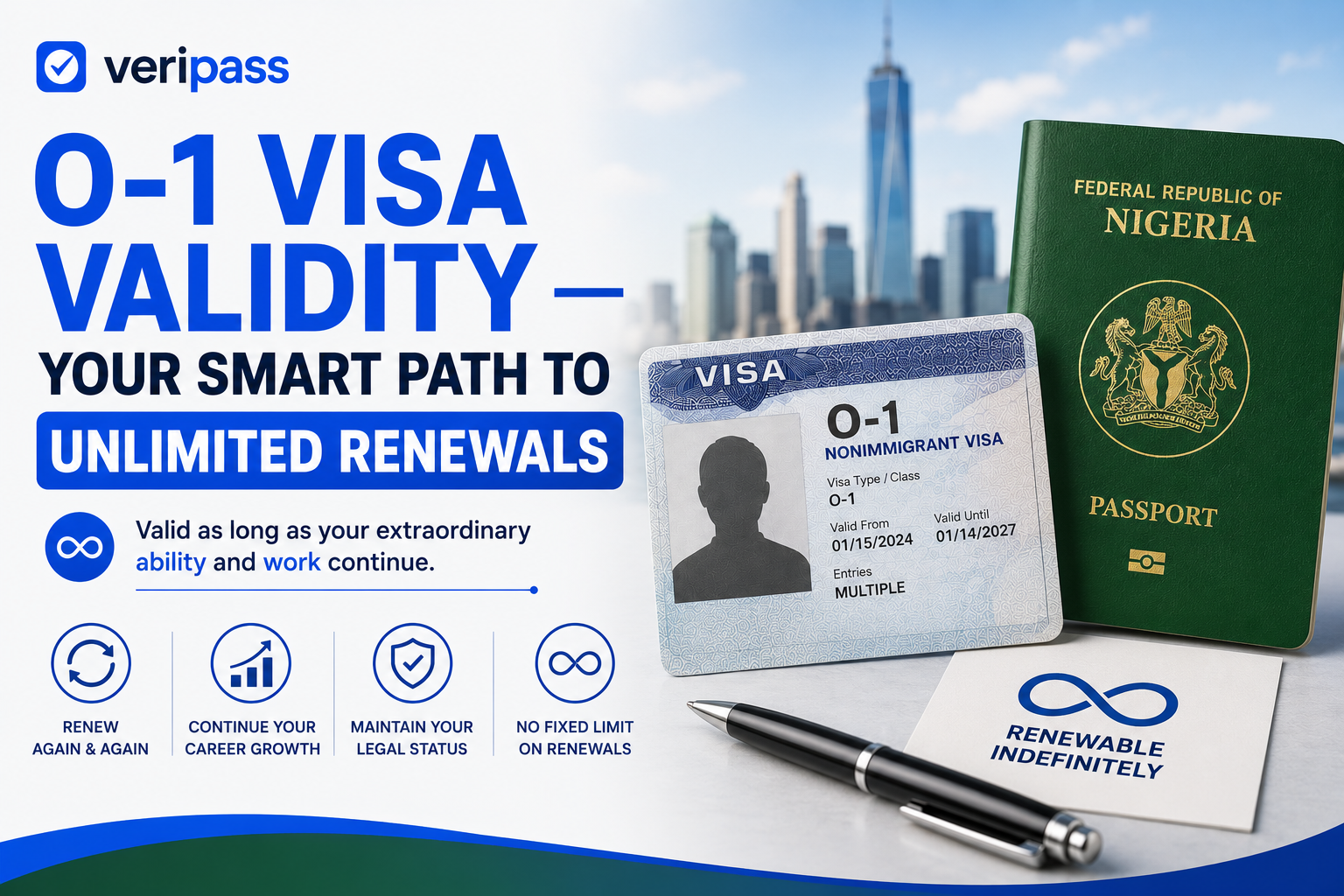
You booked the flight home. You landed. You went to the wedding. Now you’re at the consulate, and the officer tells you your visa expired ninety days after it was issued, single entry, and your company is running without you for the next six weeks. Nobody warned you, because nobody explained O-1 visa validity properly. And here is the part that stings the most. Your status was never the problem. Your O-1 visa validity ran for three full years. What ended was something else entirely, and you were never told the difference.
Nothing went wrong with your case. Three separate clocks govern your time in the United States, and they run at different speeds. Miss that, and you lose weeks. Understand it, and you can hold this status for a decade.
Read Also: O1 Visa for Entrepreneurs: Your Proven Path to America
The three clocks that control your stay
Your petition clock. USCIS sets this one. It appears on your Form I-797 approval notice and covers the work you described in your filing.
Your admission clock. A CBP officer sets this one every time you enter the country. It appears on your I-94 record, which you can pull for free at i94.cbp.dhs.gov. This clock decides how long you may lawfully remain.
Your visa clock. A U.S. consulate sets this one under the State Department reciprocity schedule. It governs one thing only, which is your ability to travel to a U.S. port of entry and ask to come in. It says nothing about how long you can stay once you are admitted.
An expired stamp does not put you out of status. An expired I-94 does. Hold on to that sentence, because it saves people a great deal of panic.

How long O-1 status actually lasts
USCIS approves your first O-1 petition for the time needed to finish the event or activity you described, capped at three years. That comes straight from 8 CFR 214.2(o)(6)(iii).
Not everyone gets three years. If your contract runs eighteen months and your evidence supports eighteen months, that is what you receive. The number USCIS writes down follows the story your documents tell.
When your work continues, your petitioner files again and USCIS grants extensions in increments of up to one year. And here is the part that changes how you should think about your long-term plan. The USCIS Policy Manual states plainly that there is no limit to the number of extensions a petitioner can file for the same person.
H-1B stops at six years. L-1A stops at seven. O-1 has no ceiling at all. People hold it for a decade or longer.
You also get a small cushion at each end. You may enter up to ten days before your validity period starts and remain up to ten days after it ends. You cannot work during either window.
The mistake that costs Nigerian and African founders the most
Here is what almost no article about O-1 visa validity tells you.
Your visa stamp has its own validity, set by your nationality, not by your petition. The State Department publishes this in the visa reciprocity schedule, and it changed sharply in July 2025 for a long list of countries.
As things stand today, a Nigerian citizen approved for a three-year O-1 petition receives an O-1 visa valid for three months, single entry. The same applies to O-2 support staff and to O-3 spouses and children. Ghana, Cameroon, Ethiopia, Uganda, Tanzania, Zambia, and roughly two dozen other countries sit in the same position. China moved to three months and single entry for O-1 as well.
What that means in practice is straightforward. You land, you work, and your I-94 gives you three years. Your stamp expires ninety days later. The moment you leave the country for any reason, you need a fresh appointment and a fresh stamp before you can return.
There is a piece of good news buried in the Foreign Affairs Manual. A consular officer may reissue a visa repeatedly off the same still-valid petition. You are not refiling with USCIS each time. You are booking another consular appointment.
So the planning question stops being “how long is my O-1 good for” and becomes “how often will I travel, and can my calendar absorb a consular appointment each time?” That is a scheduling problem with a real answer. It only becomes a crisis when nobody raised it before you left.
Reciprocity gets reviewed and revised without much warning, so check your country’s current entry allowance before you book anything.

What counts as an “event” when your work has no end date
Founders hit this wall constantly. The regulation ties your validity to an event, and building a company is not an event with a closing date.
USCIS has already addressed this, and the guidance sits in your favor. Its Policy Manual confirms that a job with no specific project or engagement can still qualify, so long as the job itself is the activity within your area of extraordinary ability. It goes further and states there is no requirement for a single event, and no rule that a gap of some number of days automatically creates a new one.
That gives you a workable path to a full three years.
- Build one connected story rather than a pile of unrelated tasks. Product milestones, funding rounds, board commitments, conference appearances, and partnership work can form a single continuous activity when you present them that way.
- Support each phase with real documents. Signed contracts, agent agreements, letters from clients, board resolutions, and dated project plans carry the request.
- Explain trips abroad instead of hiding them. USCIS accepts that travel between engagements does not break the event.
- Skip anything speculative. Freelancing with no named engagements and open-ended employment with no evidence both get cut back, and a thin itinerary is the most common reason a founder gets eighteen months in place of three years.
Your first filing shapes every extension that follows. Build it properly once.
Four filings, four different situations
People reach for “extension” for everything. It is the wrong tool most of the time.
| Your situation | What you file |
|---|---|
| Same work, same sponsor, more time needed | Extension of stay on Form I-129, up to one year |
| Same sponsor, role or terms changed materially | Amended petition on Form I-129, and your dates do not move |
| New employer, or a substantially different role | New petition on Form I-129, up to three years |
| Moving to a different visa category | Change of status request |
The amendment point deserves emphasis. An amended petition fixes what you are approved to do. It does not extend how long you may stay. People file one expecting both and get caught short.
There is also a helpful rule that rarely gets mentioned. USCIS guidance says an extension request should not be refused only because the event that supported your first petition has changed, and a request from a new petitioner should not be refused only because the employer or event has changed. Your record of achievement travels with you.
When something goes wrong
Your extension is pending after your I-94 expires. If your sponsor filed a non-frivolous request before your I-94 expiry, 8 CFR 274a.12(b)(20) lets you keep working for that same employer for up to 240 days while USCIS decides. Same employer, same terms.
Now the part nobody writes about. If USCIS denies the petition, your work authorization stops that day, not 240 days later. And if day 240 arrives with your case still pending, your authorization to work ends even though your request keeps you in a period of authorized stay. Those are two different things, and confusing them creates unlawful employment.
You lost your job before your petition ended. You may get up to 60 days, or the remainder of your validity period, whichever is shorter. Read 8 CFR 214.1(l)(2) closely. DHS may eliminate or shorten this period at its discretion. It is not automatic, it is not guaranteed, and you may not work during it. Treat it as a short runway to file something, not as free time.
Your sponsor withdrew the petition. The date on your approval notice stops protecting you. Withdrawal ends the basis for your status regardless of what the paper says.
You filed late. This is not automatically fatal. Under 8 CFR 214.1(c)(4), USCIS may excuse a late filing when the delay came from extraordinary circumstances outside your control, the length of the delay fits those circumstances, you have not otherwise violated status, and you remain a genuine nonimmigrant. The bar is high, and the decision is discretionary. It is still a door, and you should know it exists before you assume you are finished.
Your I-94 shows the wrong date. CBP errors happen. Check your record after every single entry. When the admitted-until date does not match your approval notice, visit a CBP deferred inspection site to correct it. Do not wait, and do not assume the approval notice overrides what CBP recorded.
Your spouse and children
O-3 dependents mirror your validity. Their status runs with yours, and their stamps follow the same reciprocity limits your stamp does.
Two details catch families out. O-3 status carries no work authorization at all. And O-3 extensions go on Form I-539, filed separately from your I-129, so somebody has to actually file them. Families lose status through paperwork nobody remembered to submit.
What to do in the next thirty days
- Pull your I-94 and compare the admitted-until date against your approval notice. Fix any mismatch now.
- Write down all three dates in one place: your petition end, your I-94 end, and your stamp expiry.
- Check your country’s current O-1 reciprocity terms and count how many trips you plan this year.
- Start extension documents six months before your I-94 expires, not six weeks.
- Decide on premium processing deliberately. USCIS acts within 15 business days, and an RFE stops that clock and restarts it in full once your response arrives. It buys speed, never approval.
- Review any change in role, employer, or company structure before you act on it.

Where Veripass fits
Everything above is knowable. Almost nobody assembles it in time, because the pieces sit in four different agencies and none of them talk to you.
Veripass exists for that gap. We work with founders, executives, and skilled professionals moving through O-1 and EB-2 NIW, and we handle the same questions for UK Global Talent and Australian talent routes, so we can compare pathways honestly rather than selling you the one we happen to file.
For O-1 specifically, we build the itinerary that justifies the full three years instead of eighteen months. We map your three clocks against your actual travel calendar, which matters enormously if you hold a passport now limited to three months and one entry. We tell you which of the four filings your situation needs before you file the wrong one. And because O-1 evidence and EB-1A or EB-2 NIW evidence overlap heavily, we structure your record so the work you do for status also builds toward permanent residence, rather than starting over in two years.
We also tell you when the answer is no, or not yet. That is worth more than an optimistic filing that comes back with an RFE.
Take the next step
If any date in this article made you reach for your passport, come to our next live session. We walk through validity planning, extension timing, reciprocity, and the O-1 to green card path, and we answer questions directly.
Register for the Veripass webinar
Bring your dates. Leave with a plan.
How long is an O-1 visa valid for?
Two answers, and mixing them up causes most of the trouble.
Your O-1 status can be approved for up to three years initially, set by how long your qualifying work is expected to last. If your contract or project runs eighteen months, you get eighteen months. Extensions come in increments of up to one year, with no limit on how many times you file.
Your O-1 visa stamp is different. Your nationality sets it through the State Department reciprocity schedule. Nigerian, Ghanaian, Cameroonian, Ethiopian, and Chinese citizens currently receive three months, single entry, regardless of a three-year approval. Your stamp controls travel only. Your I-94 controls how long you may stay.
Is an O-1 visa better than an H-1B?
For founders and senior professionals, usually yes. Four reasons.
There is no lottery. H-1B runs an annual cap with odds, so a strong candidate can simply lose. O-1 has no cap, and you file when you are ready.
There is no six-year ceiling. H-1B maxes out at six years. O-1 renews indefinitely as long as the work continues.
You can self-sponsor through a U.S. agent. H-1B requires a traditional employer, which blocks most founders. O-1 does not.
There is no prevailing wage requirement, which matters at an early-stage company.
The trade-off is real, though. O-1 demands a much higher evidentiary bar, needs a peer consultation letter, and ties your validity to a documented itinerary. H-1B is easier to qualify for once you win the lottery. If you already hold H-1B and it works, switching is not automatic value.
How long can you stay in the USA on an O-1 visa?
There is no cumulative limit. This is O-1’s defining advantage.
You enter for your approved period, up to three years, plus ten days before and after your validity window, though you cannot work during those ten days. When your work continues, your sponsor files an extension for up to another year. USCIS confirms there is no cap on how many extensions a petitioner may file for the same person.
People hold O-1 for a decade or more. Each renewal needs continuing qualifying work and current evidence, so it is not automatic, and there is no statutory cutoff forcing you out.
Is an O-1 visa difficult to get?
Honestly, yes. It is one of the harder nonimmigrant categories.
You must meet at least three of the eight regulatory criteria, or show a major one-time award. Those criteria cover things like published material about you, judging others’ work, original contributions of major significance, high salary, and critical roles at distinguished organizations. Then USCIS applies a final merits review asking a broader question, which is whether you have actually risen to the top of your field.
Two things make it harder than people expect. You need a peer consultation letter from a relevant expert body. And your itinerary has to justify the validity period you request, which is where founders lose time — a thin itinerary gets you eighteen months instead of three years.
What makes it easier than people expect is that the evidence is buildable. Press, speaking, judging, funding rounds, and patents can be developed deliberately over twelve to eighteen months. Most rejections come from weak presentation of a genuinely qualifying record, not from a genuinely unqualified applicant.
⚠️ This article is for informational purposes only and does not constitute legal advice. Consult a licensed immigration attorney before filing any visa petition.